

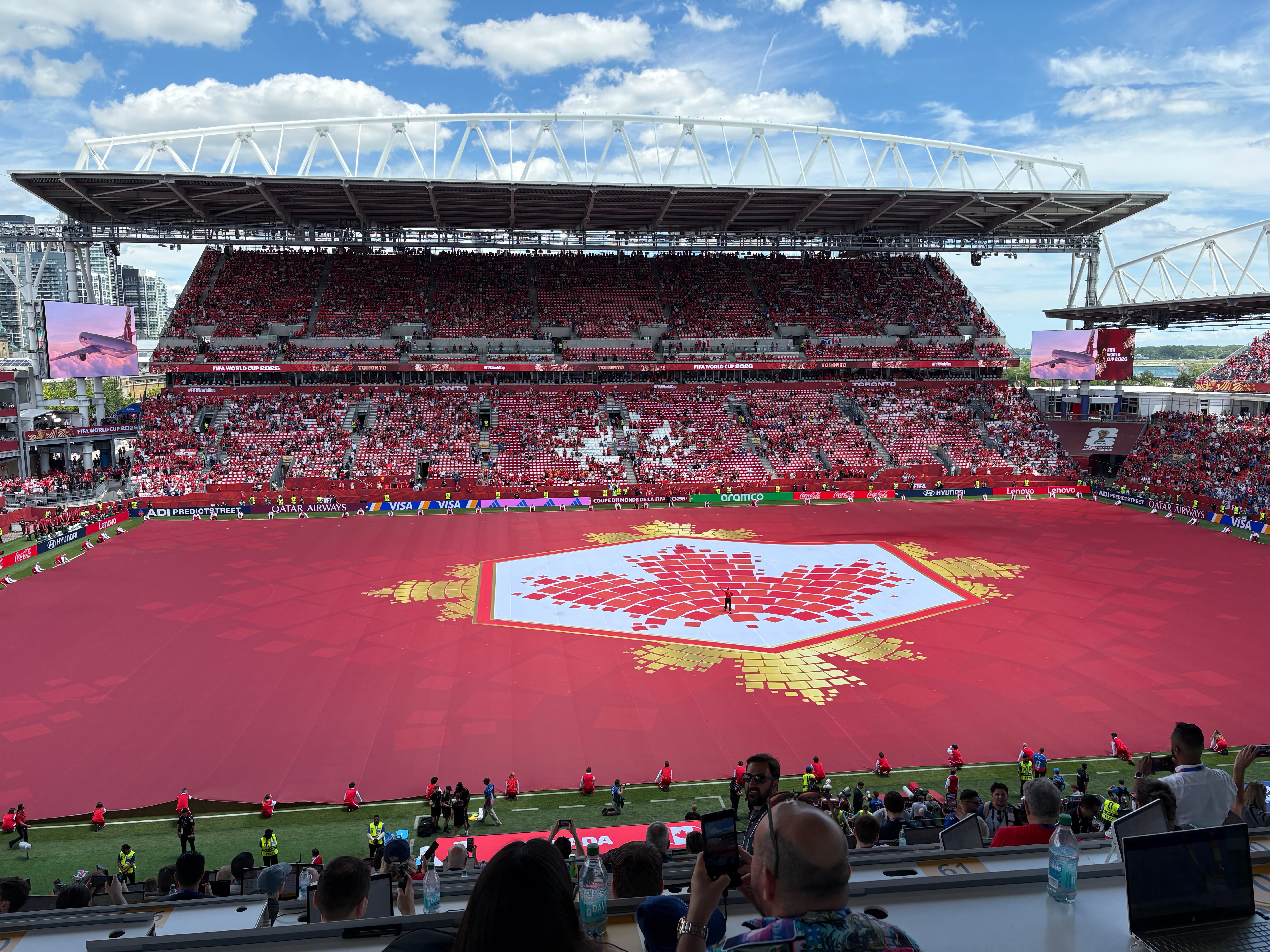
By: Aftab Ahmed
For Canada as a co-host, the most compelling frame for understanding the FIFA World Cup is the country’s own migration experience.
Alphonso Davies is its face.
Our captain, who should be more recognizable in Canada than he is, was born in Buduburam, a refugee camp in Ghana, after his parents fled Liberia’s civil war. He and his family moved to Edmonton when he was a child. His parents worked long hours to build a new life, while he helped care for his younger siblings.
Davies’ path to stardom ran through the local municipal infrastructure and community-led initiatives that help newcomer children get onto the pitch: universal access to schooling, sports fields, recreation spaces, local coaches, the Free Footie program, and government partnerships with grassroots organizations that made services accessible to a kid with extraordinary talent.

He joined the Vancouver Whitecaps residency program at 13, became the youngest player in the United Soccer League, became the first player born in the 2000s to play in Major League Soccer, gained Canadian citizenship, debuted for Canada in 2017, joined one of the world’s biggest football clubs, Bayern Munich, in 2019, and scored Canada’s first men’s World Cup goal in 2022.
Davies has not played yet at the World Cup because of a nagging hamstring injury, but if he takes the field at some point in the knockout stage wearing his customary armband, he would also be the tournament’s youngest captain.
Davies should be celebrated as a player, but his professional success should also remind us of the enabling public policy conditions that helped make it possible.
A well-managed immigration, refugee, and asylum system, reformed to meet Canada’s needs today, can be part of this country’s talent pipeline. Critically, newcomer policy cannot be separated from the public systems people depend on once they are here.
Affordable housing, health care, education, settlement services, and community programs have to keep pace with population growth and demand, so they can serve Canadians and long-settled residents while also giving newcomers a fair shot to succeed.
Historically, Canada has been good at doing both and is a global leader in this respect. We should not shy away from that ambition now because our public systems are under pressure, or because frustration with our policy landscape has weakened confidence in our capacity to fix it.

Davies’ journey sits within the big-picture story of the Canadian players in this World Cup. The squad echoes a migration journey with many diasporic strands and, more precisely, offers a portrait of Black Canada.
Fifteen players, or 58 per cent, have African or African-diaspora roots. Two more have Latin American or West Asian family roots. Seven players were born outside Canada.
Overall, 17 of 26 players, or 65 per cent, have African, Caribbean, Latin American, or West Asian roots. Five foreign-born players moved to Canada as children. Davies is the one player with a documented refugee background.
On the pitch, a public debate too often compressed into talking points becomes human, visible, and harder to caricature. These players are people before they are symbols, and heritage should never be reduced to a box-ticking exercise to make a policy argument.
Still, it is reasonable to notice what is in front of us. This group puts flesh and bone on the promise Canada has long projected to the world: families arriving, settling, working, struggling, raising children, and building excellence in communities across the country. But more to the point: On the soccer pitch itself, Canada is finally living up to expectations.
It began its campaign with a gutsy 1-1 draw against Bosnia and Herzegovina in Toronto, earning its first-ever point at a World Cup in its third tournament appearance. Then came the breakthrough in Vancouver: a dominant 6-0 win over Qatar, our first-ever World Cup victory.
On Wednesday against Switzerland, Canada needed a tie to top their group and remain in Vancouver for the Round of 32. They fell short after a spirited performance, losing 2-1 to the Swiss. That result means they will travel to Los Angeles this weekend for a knockout match, against South Africa, in what will be the most important game in Canadian men’s soccer history.
Hockey will always be the headline sport here, but Canada’s win over Qatar was, arguably, one of this country’s finest international sporting achievements, on par with the men’s hockey gold medal at the 2010 Vancouver Winter Olympics. The win over Qatar was Canada announcing itself in the world’s only true universal sport and the biggest by global viewership, in a World Cup on home soil, through a team that looks like the country Canada has become.
The beautiful game is holding up a mirror to Canada: a country whose immigration, refugee protection, and asylum architecture rests on a principle of openness that has delivered a net benefit to Canada.
At a time when so much beyond sports feels grim, that is something worth holding onto.
Aftab Ahmed completed his Master of Public Policy degree at McGill University’s Max Bell School and is a policy development officer with the City of Toronto. He serves as a regular columnist for Canadian and Bangladeshi media outlets and policy publications. He can be reached at mir.ahmed@mail.mcgill.ca. The views expressed in this article are his personal opinions and do not reflect those of any organization, institution, or entity with which the author is associated.
The Line is entirely reader and advertiser funded. No federal subsidies, no bailouts. If you value our work, please consider supporting us by subscribing or making a donation. Donations are not subscriptions and do not unlock paywalled content, but they help keep The Line independent

To contact The Line with a general inquiry or comment, please email info@readtheline.ca. For other ways to connect with us or to follow us on social media, please see our LinkTree.
Glad the Line is publishing this. There aren’t many things that I can put my hand over my heart and say that I truly believe that Canada is better than every other country in the world — but “multiculturalism that works” is one of them. I sometimes call it the Canadian Multicultural Miracle. We do immigration and integration at the scale/rate we do, better than anyone else. We should celebrate this more.
(Aside, this is the one thing I will never forgive Justin Trudeau for: Spiking the immigration rates so high that it broke our ability to integrate and house everyone. And maybe permanently breaking the immigration consensus and the Canadian Multicultural Miracle. We already took immigrants at 3x the rate the U.S. does, with better outcomes, but we had to go and jack the rates to 10x the U.S. Just a damn tragedy.)
The win over Qatar was great! Writing it is on par with the 2010 hockey gold medal win is pretty divorced from reality, in my estimation.