


By: Alex Muir
Going into the elections tomorrow, Donald Trump is as unpopular as any president in 80 years going into a midterm vote. Price inflation has outrun paycheques in most states, and the Democrats’ closing argument, corruption, now ranks at or near the top of voters’ concerns. Nobody serious expects Republicans to have a good night — the question is which kind of Democratic win it will be.
There are two plausible answers, and they differ more than the topline national polling suggests. The first is a narrow Democratic victory: taking 20 to 25 House seats, and a Senate that ends up closely balanced within a seat either way. The second is a big win: 35 to 40 House seats and a real Senate majority. The same environment could produce either one.
What both cases share
1) A president whose job approval is in Truman territory. The New York Times/Siena history chart puts Trump at 34 per cent approval going into the midterm. That is one point above Harry Truman’s 33 per cent in 1946 and below George W. Bush’s 37 per cent in 2006 (New York Times). The averages are a bit kinder: 37.4 per cent in the Silver Bulletin and 38.4 per cent in the RCP average, five points below his standing on Election Day 2018 (RealClearPolitics). His net approval, about −27, is eight points worse than Bush’s −19.3 in 2006 (MS NOW). Truman’s party lost 55 House seats. Bush’s lost 30. Trump’s own party lost 40 in 2018, when Gallup had him at 40 per cent and the Times average had him at 42 (Gallup).
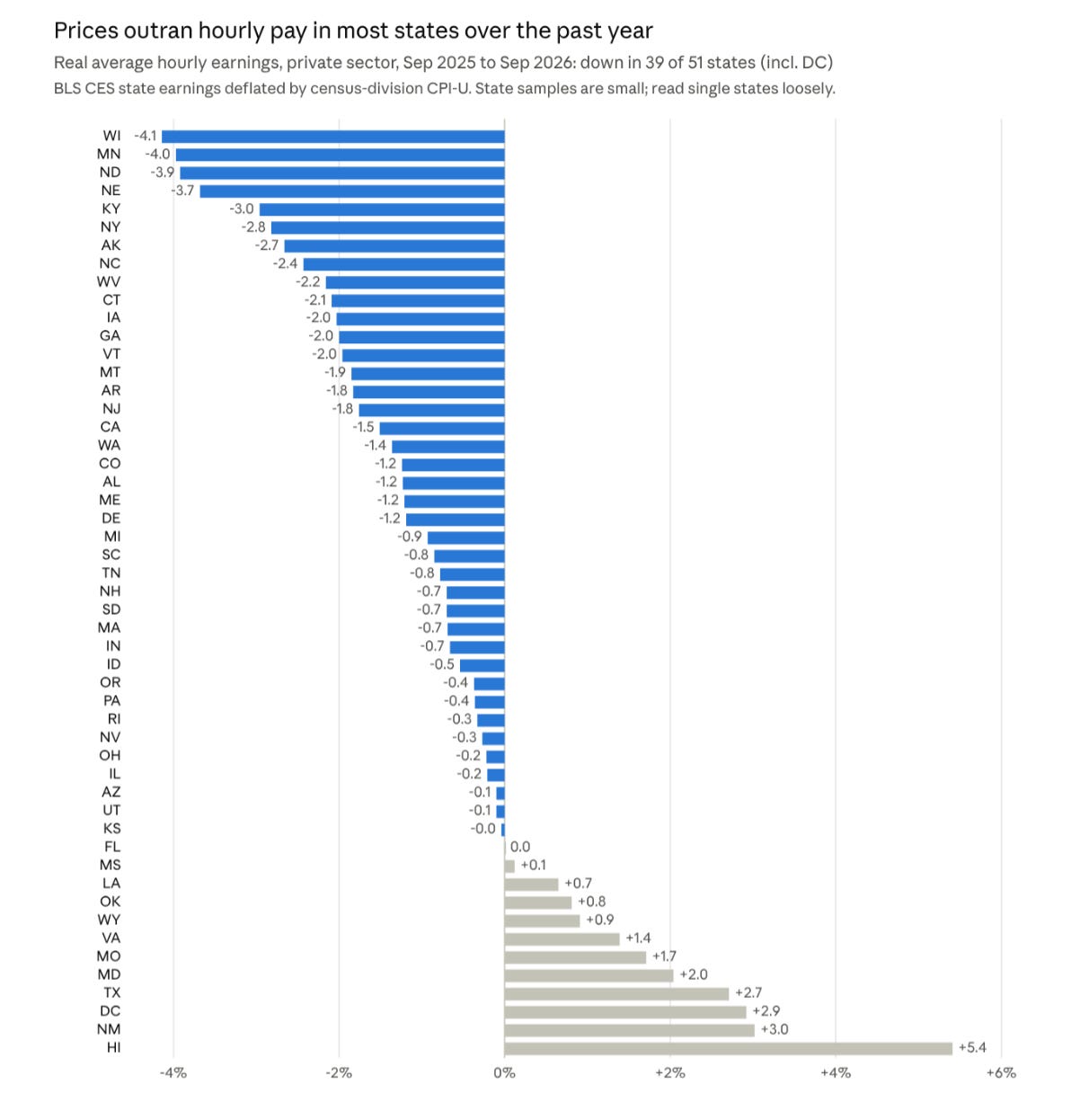
2) A late, regional squeeze on pocketbooks. Over the year to September, consumer prices rose 3.7 per cent and private-sector hourly earnings rose 2.9 per cent (both not seasonally adjusted; September wages are preliminary). After adjusting for regional inflation, real hourly pay fell in 39 of 51 states, counting Kansas’s dip of less than a tenth of a point. Florida was flat (BLS).
This matters because the losses are concentrated in the electoral battlegrounds. The Washington Post, measuring a basic family budget against household income, found costs outpaced incomes in 42 of 46 battleground districts from 2019 to 2024. The worst was New York’s 17th District, a Harris-won Republican seat, where costs rose 34 per cent and incomes 19 per cent (Washington Post via Yahoo).
3) A closing issue set increasingly focused on corruption. In the final CNBC All-America survey, 36 per cent named government corruption as one of the country’s most important issues, ahead of cost of living concerns like groceries at 34 per cent and gas at 23 per cent (CNBC). Fox News found 88 per cent extremely or very concerned about corruption, compared with 85 per cent for inflation (Politico). A record 89 per cent tell Gallup that government corruption is widespread (Gallup).
Democrats are spending a lot of money tying corruption to prices. “Corruption is why your costs are high” is how strategist Jesse Ferguson summarizes the playbook, and Blue Rose Research found that making the connection raised Democratic support by about three points (Politico). In some places this has meant a return to messaging about Jeffrey Epstein: $36 million in ads, including more than $20 million from Senate Majority PAC in Alaska, Maine, Iowa, Ohio, Kansas and Georgia (Politico).
The map decides the size
All three forces are present in both scenarios. What differs is how far into Republican territory they reach. Sean Trende of RealClearPolitics argues that waves “hit a wall” around “solid Trump +10 seats or their equivalent.” (RealClearPolitics) Historically flipping seats that are +10 or above, while not impossible, is unusual.
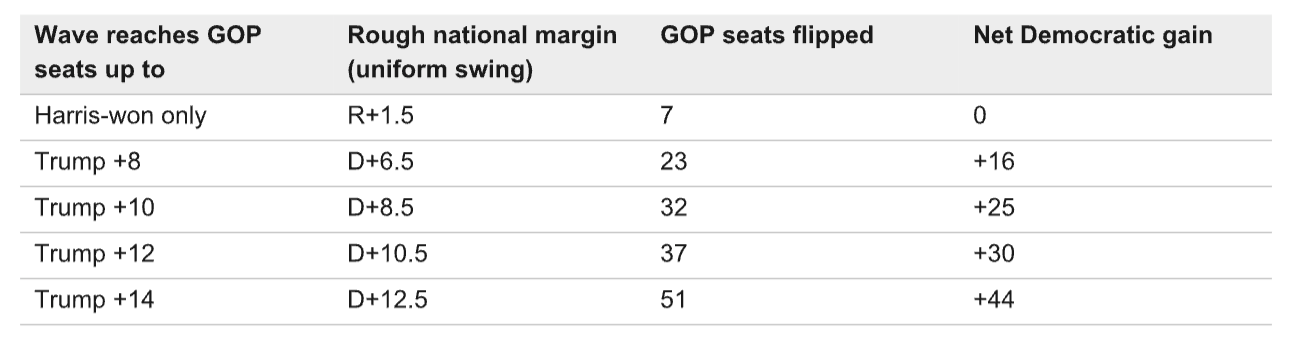
Only 25 Republican-held seats sit between Trump +0 and Trump +10; those would be the first to flip. Another 19 sit between +10 and +14, including 14 in the Trump +12 to +14 range alone. With the House at 216 Democrats and 218 Republicans, a net gain of about two flips control. The RCP generic-ballot average is Democrats +8.3 (RealClearPolling). On a uniform swing (which isn’t likely to happen), that lands almost exactly at the wall. Everything that follows comes down to whether the wave stops there or goes past it.

The case for a normal win
The normal-win case rests on the levee holding. Trende puts it bluntly: “If the Democrats win the popular vote by eight points on this map, and get 15 seats — that’s extraordinary.” His own model, which applies historical flip rates by partisan band, produced about 23 seats in a 2018-style year (Poll Vault).
The economic squeeze supports this view more than it first appears. To begin with, it is relatively recent. District wage data runs through March 2026, and through then paycheques still beat prices in most competitive seats: real wages had fallen in only 27 of the 81 (BLS QCEW). The turn came with the spring fuel spike following the intervention in Iran. It is also regional, particularly hitting the Midwest and Northeast, where inflation ran 4.1 to 4.3 per cent, while Texas pay kept growing. A grievance that is new and regional moves votes at the margin. It rarely produces the broad, uniform swing needed to flip seats deep in the other party’s territory.
The corruption message has limits, too. Gallup’s “most important problem” question, which is open-ended and doesn’t hand respondents a list, still has economic concerns ahead of government and leadership by 38 per cent to 26 per cent (Gallup). Corruption ranks first when pollsters split the economy into groceries, gas and inflation. Some 41 per cent of independents in the CNBC poll say neither party would handle corruption well. Republican strategists describe the Epstein ads as “Republican base suppression,” aimed at keeping soft Trump voters home (Politico). That approach can tip a close race, but it is a weak lever to flip a district Trump won by 10 or more two years ago.
Then there is the possibility of systemic polling error, which cannot be ruled out. A two-point miss takes the national margin from D+8.3 to about D+6.5. That puts the limits of the wave around Trump +8 seats, which means the Democrats pick up 16 to 20 seats. Somewhere between that and the uniform-swing +25 seats is where a normal win lands: 20 to 25 seats, and a viable majority that will feel like less than the environment promised and Democrats expected.

The case for a big win
The big-win case starts from the same chart and points to the 19 seats beyond the wall. Four more points to the Democrats across the board would nearly double their gains, from +25 to +44, and 35 to 40 seats sits right in that Trump +12 to +14 band.
The national numbers to reach it are within view. NYT/Siena has Democrats up 11 on the generic ballot (New York Times). RCP’s John McIntyre notes that 13 of 18 pollsters’ final surveys are at or near their best Democratic numbers of the cycle. He argues that a swing modestly smaller than the 2025 Virginia and New Jersey governor’s races would still produce about D+11, and that “no one should be surprised if Democrats land on the ‘over’” (RealClearPolitics). Democrats led by 8.3 points at this point in 2018 (their last big midterm gain against Trump) and gained 41 seats.
The swing won’t be uniform, of course — but it also doesn’t need to be. In Republican-held battlegrounds, rents rose about nine per cent in three years, compared with four percent in Democratic-held ones (Washington Post via Yahoo). A swing heavy in the Midwest and Northeast could reach Trump +12 seats there even if the national number stays near D+8/9.
The corruption message is also built to reach exactly those voters. Democrats are buying time on Fox News and right-leaning YouTube channels (Washington Sun). In the POLITICO Poll, 47 percent of Republican midterm voters call Epstein attacks fair game (Politico). A senior Republican official called the ads “openly scratching at a sore that we already sort of have” (Politico). This is important because the logic of redistricting is that Republican voters in Trump +12 districts continue to behave like Republicans. A message that persuades five per cent of them to stay home or switch is how a wall gets breached.
The Senate: one seat or six
The Senate magnifies the gap between the two scenarios. Republicans hold 53 seats. Democrats need a net gain of four, because a 50–50 tie goes to Vice President JD Vance. The 270toWin consensus of seven forecasters puts 49 seats at least leaning Democratic, 46 Republican and five toss-ups (270toWin).
With every race called by the RCP average, Democrats finish at 53, flipping North Carolina, Ohio, Texas, Maine, Alaska and Kansas (RealClearPolling). Iowa would be the 54th. Nate Silver warns that the races are “not a bunch of independent coin flips” (Politico), and the correlation runs both ways. A miss toward Democrats would also put South Carolina (Graham Nordone +2.7) and Nebraska, both recently added to RCP’s toss-up list (RealClearPolitics), potentially on the board. It will be surprising if Nebraska, Florida (Moody +6.1), and Mississippi are actually close enough to be interesting, but if they are then the levee has well and truly burst and the Democrats are having a dream night.
What to watch Tuesday night
The early returns will show quickly which election this is. The first signals:
Trump +10 to +14 districts. If Democrats are winning Republican seats in that band, especially in Pennsylvania, Michigan, Wisconsin and New York, the wave has broken through. If they are winning Harris-won and single-digit Trump seats but falling short in that band, the levee is holding.
Iowa and Kansas. These are the Senate races most exposed to potential polling error. If Democrats win either one, the averages were not overstating them. If they lose both, 51 seats becomes a ceiling.
Texas, Florida and Mississippi. These are states where real wages held up and Democrats closed on corruption. Strong Democratic showings there would mean the corruption message did work the economy couldn’t.
The difference
The two cases are based in the same environment: a president at historically low approval, falling real wages in 39 states, and a corruption message reaching voters who backed Trump two years ago. They disagree about a band of 19 districts and a handful of Midwestern statewide polling results.
A normal Democratic win would still give them control of the House and potentially even the Senate: a six to eight-point popular-vote victory on a map designed to minimize change by both sides. A big win would be the largest seat swing in a generation, compressing 2006 and 2008 into a single election. Essentially which one we see depends on whether the wave stops at Trump +10 districts, or reaches Trump +14. We will have window on which kind of night its going to be fairly early, from Florida, Georgia (Don't expect Atlanta results early though), and North Carolina.
Alex Muir is a principal at Pulse Decision Science, a full-service research and data firm based out of Washington, D.C, and a Senior Advisor at Innovative Research Group in Canada. He has provided polling, data analytics, or qualitative research to presidential primaries, gubernatorial races, U.S. House and Senate races, and independent expenditures. He also does corporate and public affairs work in both Canada and the United States. He has worked with political, corporate, and non-profit clients in Canada, Australia, Great Britain, Mexico, Ukraine and Israel. He is married to Line editor Jen Gerson; Gerson abstained from any role in the preparation or publication of this article.
The Line is entirely reader and advertiser funded. No federal subsidies, no bailouts. If you value our work, please consider supporting us by subscribing or making a donation. Donations are not subscriptions and do not unlock paywalled content, but they help keep The Line independent

To contact The Line with a general inquiry or comment, please email info@readtheline.ca. For other ways to connect with us or to follow us on social media, please see our LinkTree.