

By: Andrew MacDougall
Could I have done it?
Standing in the tidal waters off Juno Beach, I am placed in my grandfather’s footsteps, 82 years after he visited this place in the late morning of June 6, 1944 — 82 years ago today. Could I have stomached the long overnight crossing of the English Channel knowing that combat and possible death awaited? Would I have given up my comfortable life in the service of the greater good?
I have never had to answer those questions, thanks largely to the efforts of my grandfather and his fellow soldiers all those years ago. And yet, the question rushes into my mind as I survey the shore. Would I have had the guts? Looking around, it’s easy to imagine this place full of death and destruction. I’ve read the history. I’ve seen the footage. I’m the last generation to have had living relatives who did the fighting here.
Unlike my grandfather’s time, there is no artillery, tank, or rifle fire raining down on me. I am not stepping over the bodies of the soldiers of the Queen’s Own Rifles and the other first-wave regiments. I am not pushing on to Beny-Sur-Mer and then on to Villons-des-Buissons a few kilometers down the road. I am not a North Nova Scotia Highlander. I am a civilian here with my two young daughters and my 83-year old mother, not my band of brothers.
But we are here to remember Roland Garfield MacDougall and his brothers in arms who didn’t come back to Canada like he did. We’re in Normandy to honour the lives of the thousands of children, grandchildren and great-grandchildren that never were. That my grandfather’s two great-granddaughters can splash about carefree on this beach on this scorching late spring day is a testament to the over 100,000 men who landed here on D-Day and pushed the Germans out of France. Their history is on every corner and every beachfront promenade. My daughters are surprised to see this place is (still) festooned with Canadian flags. We might be forgetting, but the people who live here never will. And how could they? Many of the streets are named after the heroes who liberated France.
These days, the “Nan” sector of Juno Beach is a decidedly tranquil place, chock-a-block with what appear to be 1980s and ‘90s-era holiday homes. The only beachfront shapes my grandfather would have recognized are the silhouette of the villa now known as the “Maisons des Canadians,” as well as the steeple of the Église Notre-Dame-de-la-Nativité in the heart of the village of Bernières-sur-Mer approximately 500 metres inland. Well, those, and the concrete remnants of the German defensive positions, from which so many Canadians were mown down. They’re still here, too, serving as silent markers of death and destruction.
But the Germans didn’t get my grandfather.
For reasons that surpassed his understanding, Roland MacDougall — Ron to his mates — made it home. But not before having his eye plucked out by sniper fire in a town close to Carpiquet Airfield in the month following D-Day, a period during which his regiment was decimated by a battle-hardened unit of Hitler Youth armed to the teeth with tanks and artillery. The battles he was part of eventually produced the surrender of Caen, a key win in the push to close the Falaise Gap and then move on to liberate Paris.
But the win came at an awful price.

A crescent-shaped memorial in modern-day Villons-les-Buissons commemorates the place Canadian soldiers branded as “Hell’s Corner,” i.e. the scene of the month-long battle between 9th Canadian Infantry Brigade and Hitler’s demons. The Canadians fought valiantly here in the days after D-Day, even though they had lost their seaborne artillery support as they were counterattacked on three fronts. But they held the line. And they pushed on from that line in early July as part of Operation Charnwood, the battle that finally saw Caen fall into Allied hands.
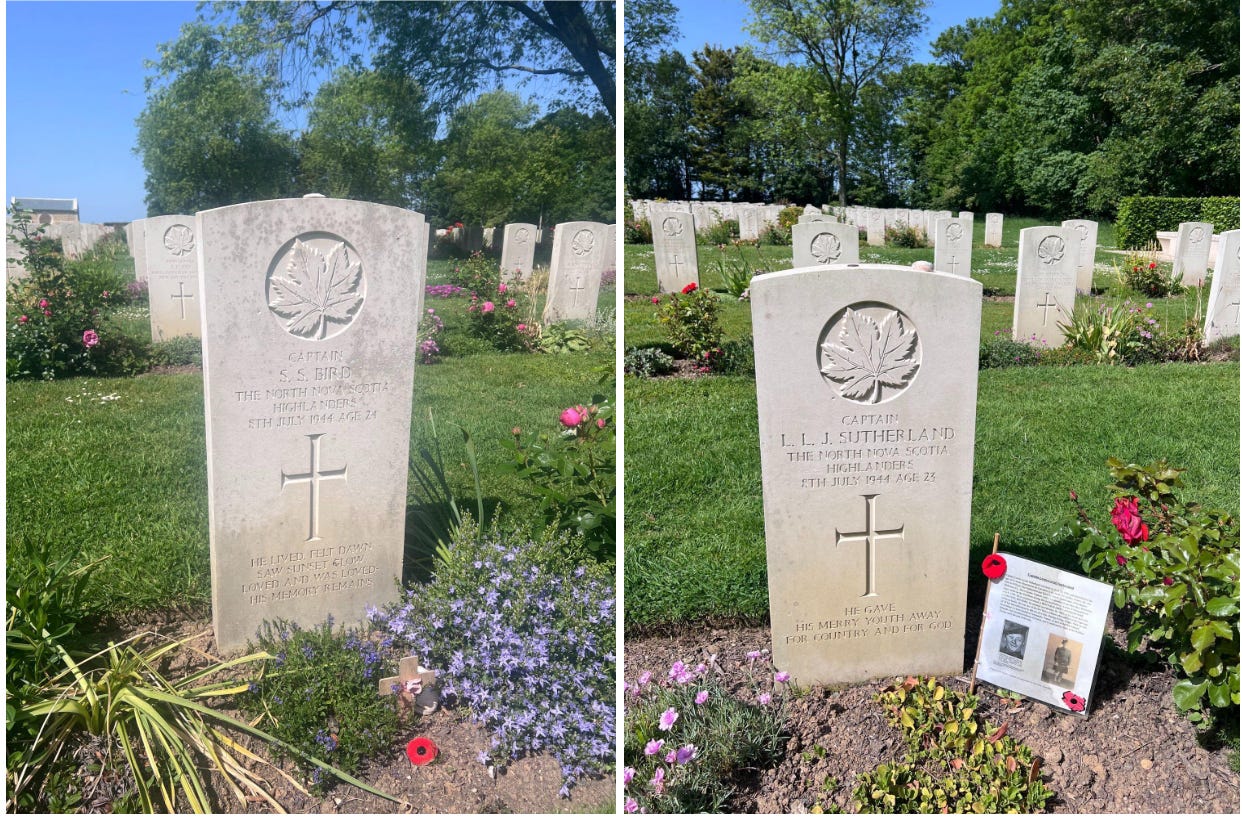
The villages of Villons, Buron and Authie are now all reconstructed, their ancient farm village cores now ringed by an array of new-build properties. The memories of Charnwood now lie in the Canadian War Cemetery in Bény-sur-Mer, a few kilometres back toward Juno Beach. It is here that my grandfather’s two best friends from the regiment — Captain Lewis Sutherland and Captain Stephen Bird — take their eternal rest.
Beny is a beautiful place, a fitting and peaceful monument to the 2,044 Canadians who gave their lives in Normandy. I’ve been here once before, with Prime Minister Stephen Harper during the 65th anniversary D-Day celebrations. But those visits are always run on a tight schedule. This is the first I’ve had the proper time to sit and think about the sacrifice made by these men. And doing it in their presence overwhelms me. Why am I here and not the grandchildren of Captains Bird and Sutherland? After all, had my grandfather’s radio operator not called over to him at the exact moment he did, the sniper’s bullet heading squarely for my grandfather’s temple would have killed him, not plucked out his eye and shattered his orbital like it did. And I wouldn’t be here. Nor would the two girls now wandering the rows of the cemetery. My grandfather was a luckier soldier than Bird and Sutherland, not a better one.
The latter is a thought that can wreck you. I now have a deeper understanding of why my grandfather never talked about this place or what happened here. Until, that is, he was diagnosed with brain cancer and lay dying in an Ottawa hospital in 1999. Then it all started spilling out. Stepping over the bodies on Juno Beach. The firefights with the Germans. Laying on the ground with his eye and bits of his skull somewhere around him, his last memory that of a fellow soldier being torn apart by an artillery shell, and that soldier’s leg pinwheeling through the air and landing in front of him just before he passed out.
My grandfather’s openness about the war had actually started a bit earlier, around the time the film Saving Private Ryan came out. I used to take my grandparents to the cinema a fair bit, but he didn’t want to join my grandmother and I in the theatre for Steven Spielberg’s film. But he did ask to watch it when it came out on DVD. And after we watched that magnificent and chaotic opening sequence on Omaha Beach he asked for the film to be paused while he went to the bathroom. He was still there 15 minutes later when I went to call on him; I could hear the tears coming from the other side of the door. “I never thought I would see that again,” he said upon his exit, his one remaining eye raw from the tears. And if I ever meet Spielberg, I will pay him that compliment.
Why did my grandfather volunteer for that life? Why did his friends? Why did so many Canadians from right across the country sign up for their chance at death? In a world now largely free of personal sacrifice, it feels like a question we’re losing the ability to answer. Can the national will still be summoned? Just how did a much younger country manage to mass the men and materiel to fight in the manner that Canada did in the Second World War? How did a Canadian army go from fewer than 10,000 men to a mobilization that eventually incorporated a tenth of the country’s entire population? What would it take to draw four million of us together under arms in 2026? Would we muster ourselves in those numbers to repel forced attempts at a 51st state? Would the fight even last long enough for us to put together a plan?
Truth be told, it’s hard to see it happening. We are now a country of individuals pursuing more solitary and selfish aims. The country is, in so many ways, different to what it was then. Most importantly, our military is a shadow of its former self. But it’s also easy to forget some of the similarities between the Canada of yesteryear and the Canada of today.
Some now worry about national cohesion in the wake of mass immigration. Would we fight together, arm-in-arm? Is there even a Canada, or are we Justin Trudeau’s post-national hotel? But in the late 1930s Canada, like now, was a country of immigrants. Indeed, one of the most striking sections of the Juno Beach Centre’s displays is the pre-war section on early 20th century immigration in Canada. There were hundreds of thousands of Ukrainians, there were tens of thousands of Germans and Brits, etc. Between 1896 and 1914, three million immigrants settled in Canada. Between the two World Wars another 1.5 million came. And out of this newness was forged Canada’s most ever effective fighting force, ready to bleed for King and country.
Then, like now, Canada was a country with a sluggish economy. And while we are not currently in the midst of anything like the Great Depression, many young people are undoubtedly like my grandfather was in the mid-1930s, wondering just what opportunities they will be able to pursue. One of six sons of a First World War veteran (with a nasty temper), my grandfather opted to lie about his age and enlist at 16 to get away from the vicissitudes of his life in rural Prince Edward Island. Six years later he was married and on a boat to England. Two years after that he stormed the beaches of Normandy. Precious few these days will think about a career in the military. To be fair, it’s not clear the current military has the means or ability to give them a career, despite recent promises to boost its funding.
What’s not in doubt is that the citizens of Canada in its present guise have a life of material comfort that far surpasses that of their ancestors. My grandfather had to work his farm hard; there wasn’t much in the way of distraction. There was no infinite scroll or bottomless supply of content. He wasn’t coddled or encouraged to get educated in subjects that had little practical application to life as he knew it. He wasn’t encouraged to get educated at all. In that sense, fighting overseas screamed purpose, it screamed opportunity. It screamed a way out.

What’s more, Hitler was a bad man. A horrible man. Arguably the most horrible man who ever lived. The world could see what he was, and acted accordingly. Of course, the men and women who powered Canada’s response to the (second) German occupation of Europe also had a firmer sense of good and evil. It was a more religious society, one that was comfortable dealing in moral absolutes. Canada was good, Hitler was evil. Canada was something worth fighting for, and national socialism something to fight against. Nowadays, there would be a not-insignificant portion of our younger online army who would, if not make the case for Hitler, excuse or explain away his crimes. They would find a reason to run Canada down instead of looking clearly at the sins of its opponents. If the world today can find people capable of endorsing outfits like Hamas and the Iranian Revolutionary Guard, carrying a new Hitler’s water wouldn’t be that much of a stretch.
Of course, the kind of war fought by Canada and the Allies couldn’t be fought in the modern world or modern information economy. For one, there could be no “stealth” invasion of Normandy. The bloody internet sees all. Nor would the public bear the carpet bombing of cities like Dresden and Berlin. More to the point, modern societies would not bear the casualty sums tallied across Normandy and beyond. The invasion was a success, even if thousands of Canadians had to die to achieve it. Contrast this to the coverage and reaction to the 165 dead across the 12 years of operations in Afghanistan. We’ve come to expect war to be bloodless, even as the Ukrainians and Russians show us that tech-enabled warfare is (even more of) a charnel house.
But Canada isn’t leading that next generation of warfighting, either.
A few days after visiting Bény-sur-Mer we toured some of the remnants of Hitler’s “Atlantic Wall” defences at Longues-sur-Mer, as well as the impressive American cemetery at Omaha Beach, where nearly 10,000 American soldiers lie. The Allied bombing missed too much of the former, which caused the deaths of too many of the latter. Today, it would be a scandal that paralyzed public opinion. Then, they simply cracked on with the job. Hitler’s forces weren’t going to pause to allow any sort of back-seat driving or reckoning.
But it was a visit to the seaside town of Arromanches that drove home the current paralysis in much of the West.
Thanks to the horrible failure of Dieppe in the summer of 1942, a price paid mostly in Canadian blood, the Allied command decided that a frontal assault on a German-held port would be impossible as part of any broader invasion. Instead of conquering a harbour, they would bring some harbours to Normandy. Enter the “Mulberries,” temporary port structures whose ruins still dot the beaches and waters of Arromanches.
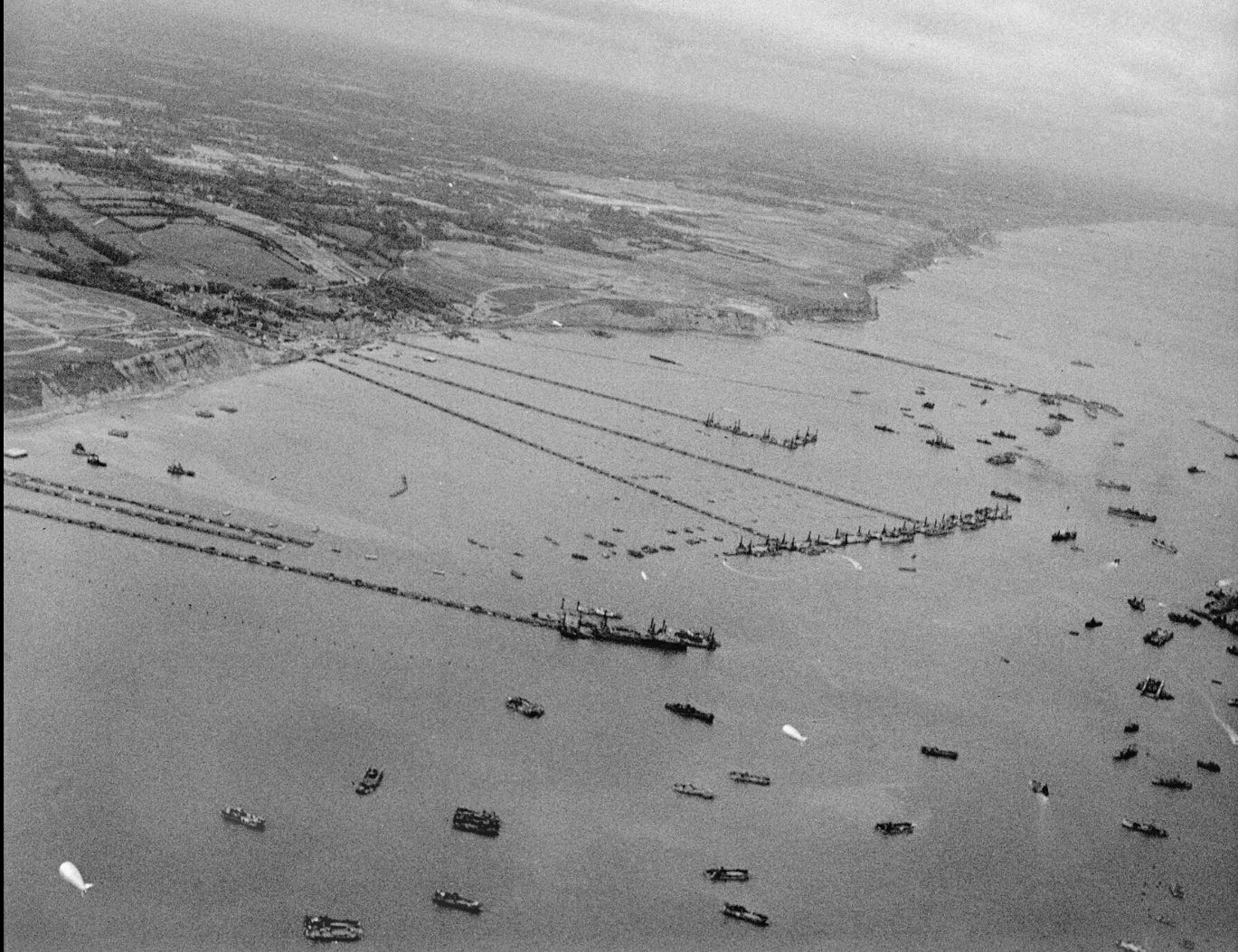
The Mulberry harbours were enormous. They were marvels of engineering and construction, ones that anticipated and compensated for the massive tides off the coast of Normandy. They were built across England, sunk off its south coast (to hide their existence from German spies) and then raised when the time came to drag them across the English Channel as part of D-Day. And their journey from conception to deployment was approximately … two years.
These days, we can’t build anything in two years, let alone a critical piece of infrastructure needed to secure a war. The F-35 was an active topic of conversation when I left government in 2013 and it is still an active topic of conversation today, 13 years on.
What are we even doing?
Maybe it’s because I lost my father last year. Maybe it’s because I’m now 50 and watching my 83-year old mother age. Maybe it’s because the world I knew, one that was anchored in American military might, is now disintegrating. Or maybe it’s because our information economy now tears at our national canvas instead of painting on it. I’m losing the things that gave my life its historic sense of understanding. Standing in my grandfather’s footsteps brings back that meaning. Being in awe of his sacrifice — and that of the others who served here — brings back perspective. I might have troubles, but I don’t have anything like theirs.
Looking at the past with rose-coloured glasses is usually a waste of time. We’re never going to be the country we were when it served up the “Greatest Generation.” But we do need a renewed sense of nationhood. We need to become a place that can once again pull together to do big things when called upon by the world. Different things, surely, but big just the same. What we shouldn’t be in a rush to do, especially in the face of Trumpian disorder, is to further weaken ourselves, whether by continuing our economic and military stagnation, or carving up the country via referendum.
Standing in Normandy, I can see that the problems of this world don’t get solved by going it alone.
Andrew MacDougall is a director at Trafalgar Strategy and former head of communications to Prime Minister Stephen Harper.
The Line is entirely reader and advertiser funded. No federal subsidies, no bailouts. If you value our work, please consider supporting us by subscribing or making a donation. Donations are not subscriptions and do not unlock paywalled content, but they help keep The Line independent

To contact The Line with a general inquiry or comment, please email info@readtheline.ca. For other ways to connect with us or to follow us on social media, please see our LinkTree.
An absolutely beautiful and heart rending essay..I read it aloud to my husband, having to stop occasionally to choke back the tightness in my throat. I have visited those places with my son when he was only 14, and I prayed he would never have to experience what those men did..
“Lest we forget”