

By: Andrew Potter
The Ottawa I grew up in during the 1980s felt small, ugly, narrow minded, and dull. But there was one day of the year that was 100 per cent bona fide, unapologetic, cask-strength fun, and that was Canada Day.
As teenagers, it was one of the few can’t-miss social events of the summer. Everyone went downtown, in little squads of four or five, carrying backpacks full of cans of beer purchased across the river in Hull, or mickeys of rum or rye smuggled out of our parents’ liquor cabinets. We would loop down along the Rideau Canal, gathering friends along the way. We’d cross over by the National War Memorial and walk up to Wellington, then slide along Sussex to Major’s Hill Park.
From there, who knew. There were events and activities on offer, music and face painting and buskers, but those were mostly beside the point. Maybe we’d head down to the Market, or join the throng along Rideau Street. There was always the comical promise to meet friends “over at the flame” on Parliament Hill, but more often than not it was impossible to get anywhere near it. And so the day was mostly just killing time until the fireworks, and in the meantime there were three main objectives to the day: Drink, hang out with friends, and celebrate Canada, wandering the downtown precinct as part of what felt like an endless sea of red and white.
That isn’t so much a rough order of importance as just different ways of describing the same situation: We were young, it was summer, and we were Canadian, and that was more than reason enough to be happy.

What was so remarkable about the feeling at the time was how transparent and uncomplicated it all seemed. Growing up in the nation’s capital, the fundamental rightness of Canada and being Canadian was never really something we questioned. Sure, there were Quebec separatists around, but they were just wrong, as Pierre Trudeau kept pointing out. To the extent that we thought about the west at all, it was that Alberta had great football teams and even better hockey teams, B.C. was a great place to go on vacation, and at any rate they were surely great and proud Canadians like the rest of us.
But of course, it was not remotely uncomplicated. The first Quebec sovereignty referendum in May of 1980, followed six months later by the federal government’s introduction of the National Energy Program, kicked off a decade and a half of almost non-stop national drama, culminating in the failures of Meech Lake and Charlottetown and the near-death experience of the second Quebec referendum in October 1995.
The journalists and political scientists called it the era of “mega-constitutional politics,” but that puts a political and institutional gloss on what was in effect an exercise in extreme regional antagonism and national self-doubt. Were Canadians even a people? It is a question we never really answered at the time, until after 1995, we simply stopped asking.
Not that the problems went away. Fast forward 40 years, and it isn’t just the constitution that is at stake anymore, it’s the symbols as well.
Start in 2017, when the 150th anniversary of Confederation, intended to be a cross-country party on a scale approaching that of the great Centennial year of 1967, got swallowed whole by demands for reconciliation. The pandemic kiboshed any celebration at all in 2020, then at the end of May 2021, after the discovery of what were believed to be unmarked graves at the former Kamloops residential school, Justin Trudeau ordered every flag on federal property lowered to half-mast, with no end date attached.
The flags stayed down through that Canada Day, over the whole summer and into the fall, past the first National Day for Truth and Reconciliation on September 30th (a day Trudeau himself spent at the beach in Tofino) and on and on, more than five months in total, before they finally went back up just before Remembrance Day, thanks to extreme pressure from military veterans.
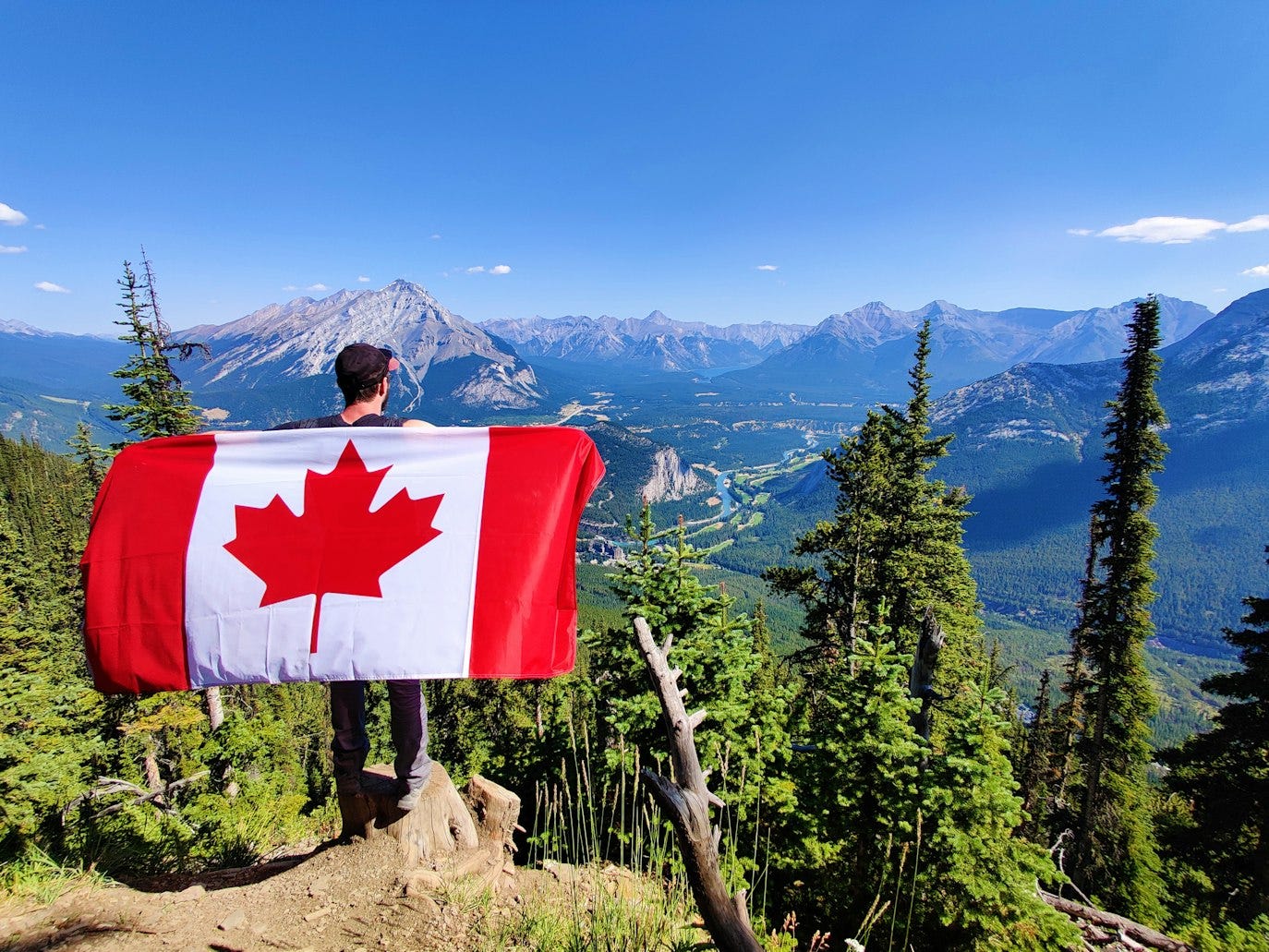
The following winter, the flag was back in the news, draped over pickup trucks and hung off overpasses by the Convoy that occupied downtown Ottawa for most of February. It was the same flag, put in service of the exact opposite political agenda, inside of about six months, and this time it was the left’s turn to complain. A recurring theme amongst progressives during the post-Convoy years was profound dislike for the very sight of the Maple Leaf.
It never ends. This July 1st, the flag’s most complicated theatre is Alberta, which is holding a referendum in October on whether to remain part of Canada at all. Fly the flag on your porch in Calgary this week, or conspicuously don’t, and it reads less like decoration than like an early ballot. And running underneath all of it is the great argument of the Trump years, about how loudly Canada should be asserting its sovereignty against a president who continues to muse about making us the 51st state, which has turned flying the flag, or singing the anthem with any real gusto, into a small test of political type.

This is all pretty much the inevitable outcome of our post-95 decision to refuse to talk about the constitution. Canadian nationhood was never built on a shared history, or language, or ethnicity. It was assembled, after 1867, out of political institutions and their symbolic furniture — the Crown, the BNA Act, the Charter, the Mounties, along with the maple leaf and the beaver and the rest of it. The problem with a place like Canada is that once you refuse to talk about the institutions, there’s only one place for dissent to manifest itself, and that is over the meaning, political valence, and even legitimacy of the symbols themselves.
Which is what makes a new poll worth mentioning. Angus Reid has tracked how proud Canadians are for forty years. In 1985, one of the first of those summers of the backpacks of beer and the mickeys of rye, 78 per cent of us said we were very proud to be Canadian. That drifted down to 52 per cent by 2016, and by the time Justin Trudeau left office last year, it had cratered to 34 per cent. Then it reversed, hard: Abacus Data reported this week that pride is back up to 77 per cent, a 12-point jump in just two years, with the biggest gains among the young.
But ask Canadians why, and the answers aren’t because we have come to any big agreement over the notwithstanding clause or the Senate, any downing tools amongst the separatists in Alberta or Quebec, any great sense that we have achieved reconciliation. Ask Canadians what makes them proud to be Canadian, and it’s the usual stuff like the country’s natural beauty, our reputation for tolerance, peace order and good government. Meanwhile, we are increasingly anxious about things like affordability, national division, and the general direction of the country and our place in the world.
Where does this leave us? The good news is the country has clawed its way back to roughly 1985 levels of pride without resolving a single one of the arguments that were live in 1985, in 1995, in 2021, or now. That’s actually more important than you might think: it suggests that Canadians are a people despite themselves — there’s a there there, even through periods of intense disagreement and self-doubt.
The bad news is that there is probably no getting back to a Canada Day that isn’t, in some way, contested.
But it probably always was, we just didn’t let it spoil anything. One of my favourite memories of those teenaged Canada Days is a night a bunch of us were standing near the Alexandra Bridge on the Ottawa side, waiting for the fireworks. Looking to spoil the fun, a small group of Quebecers trooped over the bridge, carrying an enormous fleur-de-lis flag and chanting anti-Canada slogans. In any other country this might have led to a fight. Most of the crowd just looked away and ignored them.
Then a bunch of guys showed up carrying an even bigger Canadian flag. They walked up to the separatists (what else could they have been?) and started walking circles around them, rolling them up in the Maple Leaf like a pound cake wrapped in cellophane. The Quebecers actually laughed. There were high fives all around, and everyone went back to waiting for the big show.
Nobody in that crowd was confused about what the country was fighting over. They just weren’t going to let the argument cost them the fireworks. I don’t see why it has to cost us ours. We just need somebody to bring a bigger flag.
Andrew Potter lives in Montreal.
The Line is entirely reader and advertiser funded. No federal subsidies, no bailouts. If you value our work, please consider supporting us by subscribing or making a donation. Donations are not subscriptions and do not unlock paywalled content, but they help keep The Line independent

To contact The Line with a general inquiry or comment, please email info@readtheline.ca. For other ways to connect with us or to follow us on social media, please see our LinkTree.
I enjoyed much of this essay, but respectfully disagree that Canada was based on institutions. Institutions organized us, but we were founded on a shared vision of accommodation, bringing together historic enemies -- English and French, Protestants and Catholics -- in a way the Old World had never managed. That has been our template ever since and is why, despite our various failures to live up to our ideals, we have become the most diverse, inclusive, and welcoming country in the world, something obvious to anyone who has travelled abroad.
The implosion in national pride since 2017 is thanks entirely to a federal government and prime minister that chose to present us to ourselves and the world as a racist, genocidal hellhole from which only the reigning party and our former PM could save us. This destructive spell ended with the re-election of Trump, when we had a chance to see what a real racist hellhole looked like, and when our national scold was replaced by a prime minister who cheered our accomplishments.
Today, as before, we recognize when we have failed and make good faith attempts at correction, while rejecting the endlessly negative mantra of "decolonization", proud to have inherited parliamentary democracy; responsible government; universities with liberal traditions of open enquiry and advanced programs in arts, science, architecture, etc; a justice system rooted in English and French common law; a precise system of weights and measures; and a tradition of welcoming others to join us.
Canada is home both to Indigenous peoples, to peoples from elsewhere who have been well and truly Settled for nearly half a millennia, and to peoples who have settled here, past tense, ever since.
Ask most people who say they are proud to be Canadian what "Canadian" means, and they will come up with either "not American" or various pieces of left bureaucracy.
That's because the actual fact, that Canadians are a binational people, and that many many people with paperwork that says they are "Canadian" are in fact not, is something we can't honestly discuss.
Yet.
Happy Dominion Day! ( Psalm 72 )