

By: Andrew Potter
For anyone old enough to remember the Cold War, the idea of an American president supporting Russia in a war of naked aggression and conquest in Europe is unthinkable. Yet it has been two weeks now since Donald Trump announced that he had agreed to a diesel deal with Vladimir Putin, effectively joining the war in Ukraine on Russia’s side.
Trump hasn’t sent troops into battle, but he does not really need to. Between the Elon Musk-fronted strangling of Ukraine’s battlefield Starlink terminals, the oops-we-did-it-again failure to share crucial intel with Ukraine of Russian missile launches, the slow-rolling by Pete Hegseth’s Pentagon of already-paid-for air defence missiles, the backroom strong-arming of Ukraine’s allies in Europe, and Trump’s waiving of new sanctions against Russia, it is abundantly clear which side Washington is on.

We are a long way from what was arguably the high water mark of American global leadership against authoritarianism. Standing at the Brandenburg Gate in June, 1987, ostensibly there to celebrate Berlin’s 750th birthday, Ronald Reagan used the occasion to call out the Soviet Union. Directly addressing Soviet leader Mikhail Gorbachev, Reagan said: “General Secretary Gorbachev, if you seek peace, if you seek prosperity for the Soviet Union and Eastern Europe, if you seek liberalization: Come here to this gate! Mr. Gorbachev, open this gate! Mr. Gorbachev, tear down this wall!”
The low water mark is even easier to date. In late April, 2025, a day after one of Russia’s most savage bombardments of Kyiv to that point, Trump posted on Truth Social: “Vladimir STOP! 5000 soldiers a week are dying. Let’s get the Peace Deal DONE!”
The relative status of the two men, with these two addresses, couldn’t be more glaring. Reagan was issuing a command, secure in his moral position, fully confident that he was on the right side of history. Trump was pleading, grovelling, abasing himself and his office before the whims of a murderous dictator.
How are we to understand the strange, formidable hold that Vladimir Putin has over Donald Trump?
The usual explanations don’t quite work. The oldest is the kompromat theory, descended from the Steele dossier and from Trump’s decades of murky dealings in Russian real estate and beauty pageants. The dossier has never been properly verified, notwithstanding the established facts about Russian interference in the 2016 election and the endless contacts between Trump’s circle and Russian businessmen and officials.

The second is simple greed. Trump wants Russia back into the global fold, goes the argument, because he wants to do business there. Trump’s people certainly keep interesting company: pro-Russian lobbyists, a Russian-American investor and Trump ballroom donor with Kremlin ties who got a Treasury licence in ten days, an oligarch paying for Don Jr.’s wedding. But Trump reportedly cleared US$2.2 billion in 2025 by monetizing the presidency, through crypto, merchandise and real estate, with none of it involving Russia. He doesn’t need Putin to get rich, and the domestic grifting train still has two years left to run.
The third explanation, that this is all about the midterms and gas prices, collapses on the basic math: the four million tons of Russian diesel that Trump convinced Putin to dispense is about a week of American demand, and it is headed for a global market, where the price is set. It won’t do anything for what Americans pay at the pump, but it will put an extra few billion dollars into Russia’s war chest.
The most plausible interpretation is that Trump is in love.
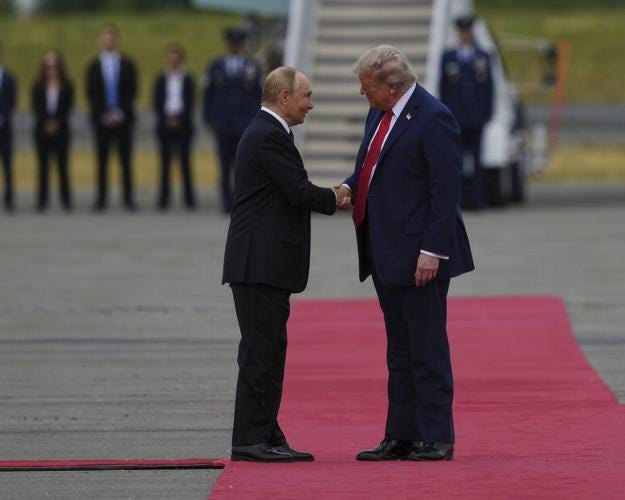
This doesn’t mean the root of Trump’s attraction to Putin is sexual. What appears to draw Trump to Putin is what the ancient Greeks called eros: the passionate longing for what one does not possess. Trump looks at Putin and sees everything he wishes he were: steely, cold-blooded, ruthless, and completely without mercy.
Trump is none of these. He is impetuous, weak, vainglorious, fickle and spineless. There is a reason “TACO” became the organizing concept of his administration. But the Greeks understood something about eros that isn’t captured by most geopolitical analysis: the lover is always the weaker party. He pleads, flatters and cloys. He forgives everything and demands nothing, because demanding would risk the beloved’s displeasure. “Vladimir, STOP!” is the sound of that dynamic, a man begging someone he can’t bring himself to confront.
It also explains Trump’s profound loathing of Ukrainian president Volodymyr Zelensky. Eros has a dark side, and that is jealousy. Zelensky is everything Trump isn’t: a man who actually faces down the strongman, at enormous risk and cost, and doesn’t flinch. Every time he does so, every time he defies Putin or resists Trump’s demands that he capitulate, Zelensky reminds the American president of his own weakness. Hence the fury, the ritualized humiliations, the demand that he be replaced.
The Greeks saw that love was a form of madness that could overrun rational thought. When romantic or sexual passion loses its balance with reason, eros turns to mania, an obsessive, out of control desire marked by jealousy, emotional volatility, and a destructive fixation on the beloved.
Trump’s infatuation with Putin is what is driving American foreign policy right now, with the rest of the world getting dragged along. The ones paying for this mania are the Ukrainians, the Europeans, and everyone else who ever counted on America standing for something.
The Line is entirely reader and advertiser funded. No federal subsidies, no bailouts. If you value our work, please consider supporting us by subscribing or making a donation. Donations are not subscriptions and do not unlock paywalled content, but they help keep The Line independent

Very good.
Fascinating piece.