

By: Andrew Potter
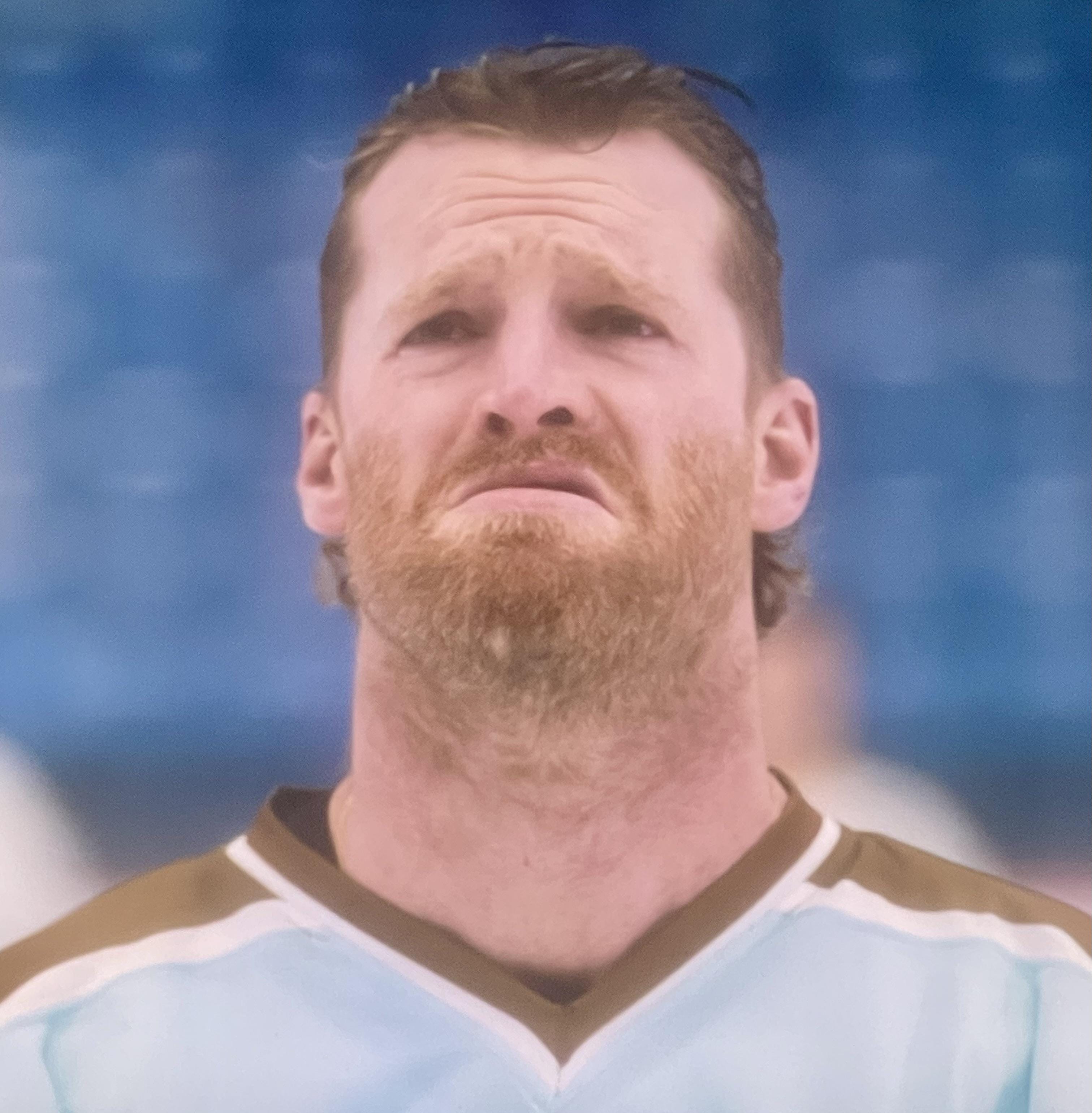
The third episode of Shoresy opens with a children’s choir standing on the ice in Sudbury, singing a sweet but slightly shaky bilingual take on “O Canada.” As the kids work their way through the anthem, the camera pans slowly down the starting lineup for the Bulldogs, a senior whale-shit hockey team playing for its very survival. Most of the players are doing the usual of staring at the rafters, game-faced and tough. Then the camera lands on Shoresy, the foul mouthed, gap-toothed captain, who is doing a terrible job of holding back tears as he marble-mouths the lyrics.
The simple read of the scene is that it’s a sight gag. Shoresy is a hopeless hoser — his phone’s ringtone is “O Canada” — and the sheer Canadianness of the moment is just too much for him.
Except what if it isn’t a joke? What if the message of the scene is that Shoresy is actually the only person left in the country who actually understands what a national anthem is for, and why we play it before sporting events from beer league hockey to the World Cup of soccer?
It’s a question worth asking after we come through yet another bout of national outrage over a supposed humiliation at the hands of the Americans.

Last week in New York, before a game between the Maple Leaf and the Islanders, American actress Sarrah Strimel Bentley completely botched “O Canada,” mangling the words and losing the thread in front of a packed arena. The reaction by Canadians on social media was predictably self-righteous, and a few days later Bentley was duly trotted out to issue a contrite apology.
Was it disrespectful? Sure it was. But it would be a lot easier to get worked up over an American dissing our anthem if Canadians weren’t doing a much more thorough job of it ourselves. Just days before the New York debacle, at the Grey Cup in Calgary, Sarah McLachlan (who is otherwise a national treasure) delivered a rendition of “O Canada” that began with a poor attempt at the French lyrics and quickly segued into a meandering, half-assed effort that had people in the stands looking hopefully skyward for the Snowbirds to come and drown her out.
A few months before that, at Saputo Stadium in Montreal before a men’s friendly soccer match between Canada and Peru, the singer lost her way so completely that the stadium crew had to mercy-kill the performance by frantically piping in a pre-recorded track.
So, bitch all you want about an American actress flubbing a foreign anthem; at least she has the excuse of not being Canadian. What is ours?
The truth is, there is no particular reason for anyone to show the anthem much respect, because Canada itself stopped treating it with any respect a long time ago.
A few years back, the Justin Trudeau government decided to rewrite the official English lyrics, largely to accommodate the dying wish of a francophone MP who had made gender-neutralizing the song his final cause. The French lyrics, which are famously militaristic, religious, and archaic, were of course left untouched.
Yet as with so much of Trudeau’s casual vandalism of our national symbols, this was merely the symptom of the underlying rot. Once upon a time, it was standard operating procedure to stand beside your desk and sing “O Canada” before classes began in public schools across the country, maybe paired with God Save the Queen or the Lord’s Prayer. Today, only four provinces — Manitoba, New Brunswick, Nova Scotia, and Ontario, with a combined population of just under half the country — mandate the daily playing of the anthem. Prince Edward Island has only just introduced a bill to make it mandatory again, and incoming British Columbia Premier Lorne Doerkson has floated the idea of doing the same. In the rest of the country, an entire generation has grown up without the daily habit of hearing the song at all.
The same abandonment has happened at the rink. There was a time when Canadian hockey teams employed dedicated anthem singers, men and women whose entire job was to own the anthem and deliver it the same way, night after night. The gold standard was Roger Doucet, who sang for the Montreal Canadiens throughout the 1970s and effectively standardized the modern bilingual rendition. For more than two decades, the Ottawa Senators had Lyndon Slewidge, an OPP officer who stepped onto the ice, sang it straight, and stepped off. In Edmonton, Paul Lorieau did the job for 30 years.
What all of these singers had in common was they weren’t trying to be stars. They weren’t performing; they were officiating. They were civil servants of the arena, and they understood that the whole point of the job was to disappear into the ritual.
Today, some teams — Calgary and Edmonton in particular — still use a regular singer, but every team also relies on a revolving door of local hotshots, touring pop stars, and minor celebrities. And too often, they make a hash of it. They screw it up not because “O Canada” is a difficult piece of music, but because they refuse to sing it straight. They bend the notes, drag the tempo, swallow the phrasing, mess with the lyrics, and turn a 90-second civic rite into a self-centred performance.
The primary culprit here is Whitney Houston. Ever since her take on “The Star-Spangled Banner” at the 1991 Super Bowl, every singer handed a microphone before a sporting event has been chasing their own Whitney moment. The problem is that almost nobody is Whitney Houston, and even if they were, a national anthem isn’t supposed to be a vehicle for the singer’s career or ego.
Which brings us back to Shoresy, standing on the blue line in Sudbury, trying to keep it together.
Our current obsession with authenticity teaches that rote repetition is empty and hollow, and that personal expression is the only mark of real feeling. If you sing the anthem the same way every night, you’re just going through the motions. If a pop star stretches the high notes and “makes it their own,” they’re breathing life into it.
The lesson from Shoresy is that the truth is the exact opposite. He isn’t choking up because he’s thinking about Parliament, or Confederation, or some abstract theory of Canadian nationalism. He’s fighting back tears in the exact same way people get choked up at weddings.
Think about a wedding ceremony. Nobody cries because the minister has decided to improvise a fresh, edgy take on the vows. In fact, if the officiant tried to make the ceremony about their own personal flair, it would ruin the event. Their job is to be a transparent vessel, to recite the old, familiar words straight, so that the ritual can activate whatever emotions the people in the room have brought with them.
This consecration of the ordinary and the routine is exactly how the national anthem is supposed to work. Every dreary Tuesday morning standing beside a desk in public school connects to every freezing Saturday morning in a minor hockey barn, every Hockey Night in Canada broadcast connects us to Canada performing minor miracles at the World Cup of soccer. It takes a bunch of battered guys in a small-town arena and connects them to something older, larger, and more durable than themselves.
Nobody understands this, of course. The playing of the anthem is instead seen as optional, even offensive, because it is colonialist or sexist or jingoistic or otherwise exclusionary or oppressive or irrelevant in any number of half-imagined and dimly understood ways. The inevitable effect is the dismantling of a piece of the shared social infrastructure that once served to bind Canadians together, across the country and through the generations.
So sure, it is annoying when supposedly professional singers abuse the national anthem. But they are just treating the song with the same level of seriousness that Canadians themselves have decided it deserves.
The Line is entirely reader and advertiser funded. No federal subsidies, no bailouts. If you value our work, please consider supporting us by subscribing or making a donation. Donations are not subscriptions and do not unlock paywalled content, but they help keep The Line independent

To contact The Line with a general inquiry or comment, please email info@readtheline.ca. For other ways to connect with us or to follow us on social media, please see our LinkTree.
From your lips to God's ears, Andrew. The gold standards for singing our anthem remain singers like Roger Doucet, Jeanette Reno, and Michael Burgess. Stop messing about with different cadences, pitches, or (worst of the worst) different lyrics.
If the performance is the problem, then just stop it being a performance to be watched, and turn it into a collective ritual in which everyone can participate. Do what European soccer matches do: don't have a singer at all, just play the music and let the crowd and players do the singing, at the level of participation that suits them.