


By: Andrew Potter
In late September, Prime Minister Mark Carney told the New York Times that, with the immigration system back under control, the question was when to “resume some controlled increase in the population.”
In light of last week’s federal budget it would appear that the answer he landed on was, “immediately,” though how under control it is, and what led to his decision to open it up, is an open question. But it matters enormously, because of this graph:
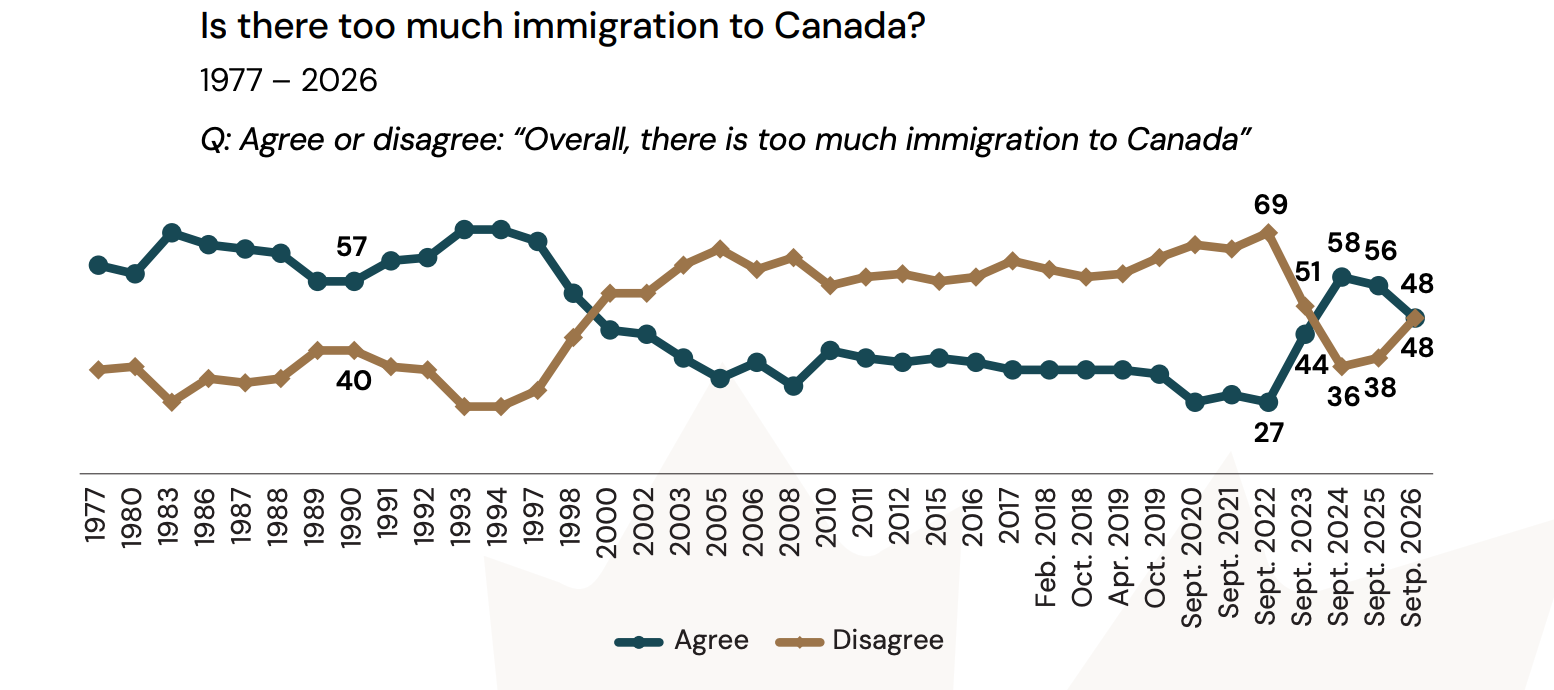
It is from the latest Environics report on public attitudes towards immigration and refugees, and it tells a complicated narrative about the collision of national identity, economic need, and social cohesion. It may be the most important graph in Canadian domestic public policy right now.
It helps to start by appreciating just how recent our national comfort with high levels of immigration actually is. When Brian Mulroney more than doubled the targets in the late 1980s, the public backlash led to the creation of the Reform Party and sparked a decade of anxiety about “hyphenated Canadians” and cultural balkanization. It was only at the end of the 1990s that opinion flipped from predominantly anti-immigration to generally in favour.
For most of the next quarter century, a solid multi-partisan majority rejected the idea that we were taking in too many people. That consensus did not just happen — it was a hard-won achievement driven by smart policy and even smarter public messaging. But the Liberals under Justin Trudeau didn’t seem to grasp that. Instead, they treated it as something close to a baked-in fact about Canada, a fundamental part of our supposed diversity-is-our-strength post-modern identity. And so when they opened the immigration floodgates after the COVID-19 pandemic, the government seemed completely shocked to see that the share of Canadians who said there was too much immigration more than doubled virtually overnight, from 27 per cent in 2022 to 58 per cent in 2024.

What matters here is precisely why people changed their minds. And while there was no doubt some unease about the changing face of our cities, the truth is Canadians didn’t turn on immigrants so much as they turned on the people in charge. In its surveys, Environics asks those in the “too much immigration” camp to explain their views. Over the past three years, the fastest-growing and now number one answer is that the government is doing a lousy job of managing the system.
When the public finally realized how badly Ottawa had lost control of immigration in late 2024, the Trudeau government responded to rising public anger by belatedly started cutting back on newcomers. When he took over, Mark Carney declared that immigration had been “far too high” and that the country had “lost control” of its temporary resident programs. He made finishing the job one of his signature promises.