

By Andrew Potter
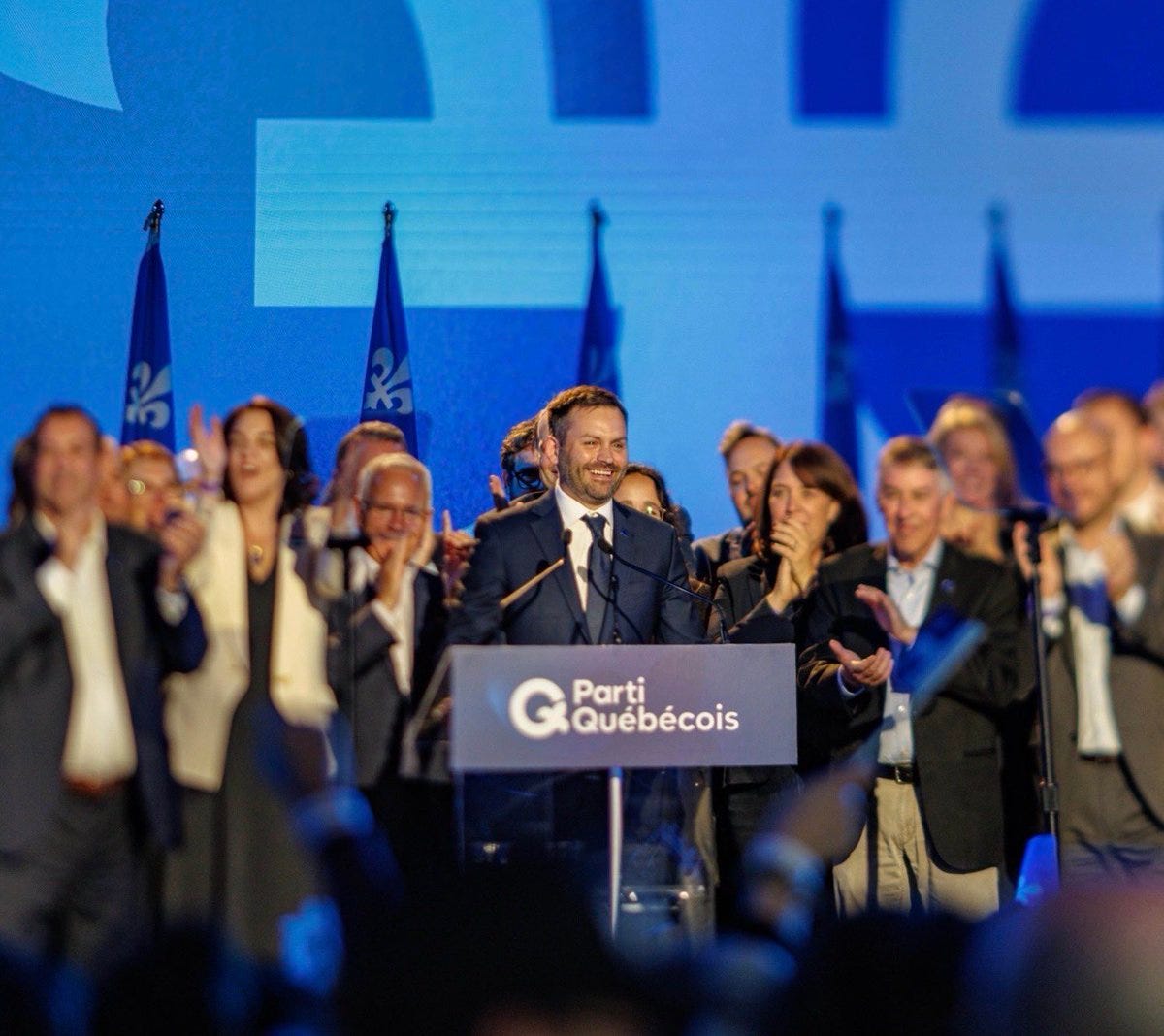
For the first time since 2014, Quebec will have an explicitly separatist government. The Parti Québécois, led by Paul St-Pierre Plamondon, won a minority government on Monday, taking 59 out of the 127 seats in the national assembly.
Yet the PQ victory was probably the least surprising result of the election. In the dying days of the campaign, Plamondon’s main opponents — CAQ leader and premier Christine Fréchette, and Liberal leader Charles Milliard — took advantage of their last media availabilities not to sell themselves and their party to undecided voters, but to apologize for running lousy campaigns.
At a stop on Sunday, Milliard said he did not have many regrets, except the fact that he didn’t make himself the face of his party’s campaign earlier — his campaign bus didn’t even have his picture on it for the first week. As for Fréchette, there was a window, early in the campaign, when it looked like she might be able to pull a Mark Carney and electro-shock her flatlining party back to life. But that slammed shut pretty quick, as she also conceded at a stop in Shawiningan on Sunday. Instead of rallying the faithful, she ran through a list of her campaign’s mistakes, including not warning strongly enough about separatism and not highlighting the CAQ government’s accomplishments during its eight years in power.
For her troubles, the CAQ were completely wiped out, with Fréchette even losing her own seat in Trois-Rivières. Meanwhile, the upstart Conservatives, led by former “radio poubelle” shock jock Éric Duhaime, won their first seats and gained official party status with 19 members. Adding to the fun is the distribution of the popular vote. The PQ took only 28 per cent, the Liberals got 24, Conservatives 21, and the CAQ just under 14. The left-wing Québec solidaire needed only 11 per cent of the vote to win their nine seats.

The upshot is that there is now a sharply sovereigntist government in Quebec City, and Mark Carney has yet another problem to deal with. Plamondon, or PSPP as he is usually referred to in the media, has pledged to aggressively seek independence, eventually through another referendum. In the meantime, he’ll spend as much time as possible trying to generate the “winning conditions,” which means picking fights with Ottawa in order to make it clear that Canada doesn’t work for Quebec.
One early example: he has said he will defund the position of the Lieutenant Governor, and spend the money on homelessness. The constitutional implications are unclear, but it is one of those things Carney will probably want to bend on, as long as there is some way of giving it a constitutional fig leaf. Quebec already pays the barest of lip service to the position, sidelining the office holder both practically and symbolically. It is hard to see how further reduction in either aspect of the position would matter much.
On the national unity question, there are a few things working in Carney’s favour. The first is the thin popular support for both the new government, and for sovereignty in general. The PQ’s share of the vote is the lowest ever for a new government, beating the 32 per cent that brought the PQ to power in 2012. At the same time, support for sovereignty currently sits around 30 per cent, suggesting Plamondon has a lot of work to do making Ottawa the enemy.
But more than anything, there is Carney’s own popularity. According to a new Angus Reid poll, the prime minister’s approval rating in Quebec is now 67 per cent, notably higher than that of Bloc Québécois leader Yves-François Blanchet, at 47 per cent. And a different poll has PSPP’s favourability sitting at just 40 per cent.
Ultimately, the reality of the situation in Quebec is that after eight years in power, the CAQ was a spent force, while the Liberals had a new leader who spent a big chunk of the campaign hiding from voters. A PQ victory was the only plausible outcome, and from a national unity standpoint, Plamondon’s position is about as weak as could be hoped for.

The big wild card in all of this, as usual, is Donald Trump. Rumours have been swirling throughout the campaign about possible White House involvement in supporting a PQ victory. It all culminated with a week to go when Fréchette went public with a think-tank report warning of an American psy-op aimed at stoking separatism in Quebec. That story didn’t go anywhere, but it was revived in the last days of the campaign when the Montreal Gazette reported that Plamondon had sought, and scheduled, a meeting with the U.S. State Department in Washington in early March. The meeting was cancelled and not rescheduled, and the State Department has otherwise kept its distance from the Quebec vote.
Plamondon will no doubt find ways to make trouble for Ottawa, but his efforts might meet with limited public support, at least in the near term. He might also discover that he has enough to deal with fixing the province’s roads, hospitals, and other services, with limited public finances. On that last item, it is worth noting that Plamondon has promised to hold a referendum on independence once Trump leaves office in 2029, assuming his government lasts that long.
Coincidentally, 2029 is also when the federal equalization formula, which this year will send $13.9 billion to the province, is up for mandatory renewal.
The Line is entirely reader and advertiser funded. No federal subsidies, no bailouts. If you value our work, please consider supporting us by subscribing or making a donation. Donations are not subscriptions and do not unlock paywalled content, but they help keep The Line independent

To contact The Line with a general inquiry or comment, please email info@readtheline.ca. For other ways to connect with us or to follow us on social media, please see our LinkTree.
I'll just note in passing that the PQ is dreaming in technicolour if they think the US is the friend that will welcome an independent Quebec. I suspect many Quebeckers don't fully appreciate that living in a country that is officially bilingual means they have 35 million friends for that project, even if not whole hearted friends. Better than zero. America is toying with the idea that they should pass a bill making English the official language of the US so as to see off the creeping bilingualism with the Spanish-speaking Latino population. Concessions to a French speaking crew to the north will be infrequent. In effect, any communication with any territory outside Quebec will be in English.
French is the fourth language in this hemisphere - representing a sliver of the overall population. English, Spanish and Portuguese each have speakers in the hundreds of millions vs 7/8 million francophones. Quebec has the best deal that they can ever achieve thanks to the Quebec Act of 1774. A cause, as an aside, for the American revolt as they wished to assimilate Quebec as they did with Louisiana and saw the concessions to the French fact as an 'intolerable act' to go along with all the other evils of King George III.
I am pleased it is a minority government. I sense that will handcuff the PQ government in these febrile times.
Interesting times we live in. QC separatism is profoundly different than the minority push for separation in AB. First, it is through legitimate democratic channels. Second, but more importantly QC separating would be a MASSIVE gift to the rest of Canada. You could still have a fun visit to Montreal in the summers, and the rest of Canada would be significantly wealthier with far less headache immediately. This time hopefully Carney and the rest of Canada tell QC to shove it if they try and leverage this threat for more. Just imagine, no more pandering, no more colossal gifts of money, no more humoring a national separatist party, no more waste with dual labelling and mandatory bilingualism. This is a good day for Canada. Lets go QC Separatists!!!