

By: Clarke Ries
The Americans appear to be taking refusal well.
In lieu of bending the knee on the trade file, Canada scheduled the implementation of retaliatory tariffs on U.S. goods for the Tuesday before a long weekend and then buggered off. U.S. President Donald J. Trump’s obsessive anti-Canada invective in the days since does not suggest any similar intent to touch grass.
He warned that Montreal-based Bombardier will not be allowed to sell its aircraft in the U.S. unless it also manufactures them on his side of the border. He posted about our “currency-dollar” imbalance, implying that the loonie’s lesser buying power compared to the greenback is an insidious Canadian plot. He mused that the U.S. would be better off ending trade with Canada altogether, claiming it would save America $90 billion annually. This is believed to be a deliberate attempt to sap the will to live of the last few fact checkers still operating in the no-man’s-land of what used to be institutional American journalism.
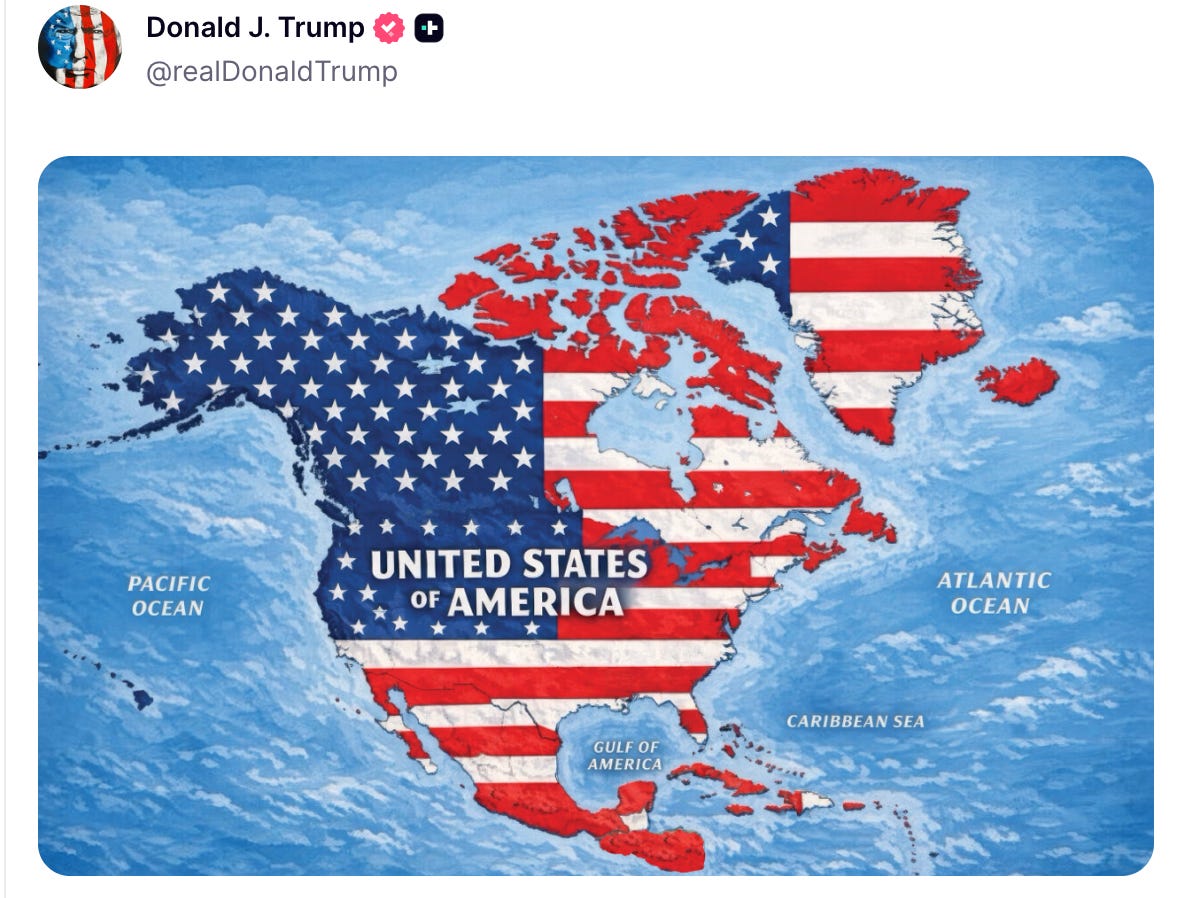
Oh, and if Trump’s reference to Carney as “governor” was too subtle in the AI-generated political cartoon he posted recently, there’s now also the giant map on his Truth Social account in which Canada is labelled “United States of America” and painted with the Stars and Stripes. You can ask Venezuela, now a satrapy of the U.S. governed by Secretary of State Marco Rubio in his spare time, whether to parse that message seriously or literally.
We are not living in an age of nuance. We are now in a trade war, aimed to break us to heel.

For generations, would-be intellectual hard-asses spouting off about war, hard power and realpolitik have relished quoting the Melian Dialogue, a dramatization by the Greek historian Thucydides of a conversation between Athens (the local superpower) and the Melians (their mostly-harmless neighbours).
As the Athenian army entrenched outside Melios’s walls, preparing to crush it in retaliation for its refusal to accept vassalization, Athenian diplomats informed the Melians that the strong do what they can, and the weak suffer what they must.
That’s true as far as it goes, but power-tripping bullies who quote the Melian Dialogue are usually disgruntled when the weak respond to the strong by saying: “Fine, show us what you can actually do.”
A year and a half ago, we witnessed exactly that type of tantrum when Trump hollered in Ukrainian President Volodymyr Zelensky’s face that, “You’re either going to make a deal or we’re out. And if we’re out, you’ll fight it out. I don’t think it’s going to be pretty. You don’t have the cards.”
Back then, I suggested that Trump’s fury was an expression of panic at the prospect that Zelensky might publicly snub Trump’s crappy ceasefire plan and then succeed without him.
Why? Because a bully’s pleasure is in dominating cringing subordinates. If their lessers decline to cringe, the bully is confronted with their deepest fear: that if push comes to shove, they’re not actually strong enough to force the submissive displays they’ve been demanding.
Now, a year and a half later, Trump’s worst fears are coming true in Ukraine: the front line has barely budged despite his best effort to throw the Ukrainians to the wolves, and it turns out Russia is the combatant sweating over its remaining cards as cutting-edge Ukrainian drones systematically obliterate Russia’s oil refineries, tanker fleet, and logistics hubs.
The Russian military has now blown 15 consecutive deadlines set by Putin since 2022 to seize Donetsk, the province just across the border that Trump attempted to force Zelensky to concede at the negotiating table. The Institute for the Study of War now doubts Russia will ever fully occupy Donetsk. It’s the equivalent of an invasion of Canada grinding to an ignominious halt in Hamilton’s southern outskirts.
You’ll notice that it’s been awhile since you’ve heard Trump brag about how he’s going to “art of the deal” the Russo-Ukrainian War.
Ukraine isn’t the only country finding more success away from Trump’s negotiating table than at it. Emboldened by the shockingly uncomplicated vassalization of Venezuela, Trump tried the same strategy with Iran: surgically remove the country’s leader in some spectacular fashion, then negotiate terms of surrender with whoever picks up the phone the next day. In and out, 20-minute adventure.
Iran responded by shrugging off metric tons of well-aimed American and Israeli ordnance that liquified most of the country’s executive-level org chart, and then cut off 34 per cent of the world’s oil trade by mining the Strait of Hormuz and winging missiles at any vessel that dares to attempt passage.
Half a year into a fistfight the White House only expected to last a few weeks, the Iran War is shaping up to be the most catastrophic strategic defeat in American history — all because the Iranians, like the Ukrainians before them, refused to play their assigned role in the humiliation ritual.
If the United States really wanted to, it could defeat Iran: it’s been centuries since anyone has successfully bet against the American ability to dominate conventional battlefields over the course of a full-scale ground war.
But the United States — as distinct from Trump and his entourage of increasingly cartoonish viziers — doesn’t want a ground war. The United States doesn’t want to occupy Tehran, which is what it would take to make explosive-tipped projectiles stop flying in the Strait of Hormuz. Americans don’t want the casualties. They don’t want the belt-tightening. They don’t want the hassle.
The American public’s disinterest in actually sacrificing anything to win the Iran War constrained Trump’s aggression to a low-risk air campaign, and pummelling Iran from the skies has accomplished very little at very great strategic expense. America’s global arsenal of precision long-range munitions is nearly empty, while the Strait of Hormuz remains closed to all traffic unwilling to pay Iranian tolls for safe passage, which started at $2 million per ship and may soon increase to five to seven per cent of a ship’s cargo value.
Despite Trump’s attempt to maintain domestic normalcy by draining the Strategic Petroleum Reserve — vast caverns carved out of salt deposits that once stored half a billion barrels of crude — American refineries are paying about 35 per cent more for oil since the start of the war. Just weeks ago, the Strategic Petroleum Reserve reached its practical operational floor: if extraction continues, petroleum engineers anticipate the Reserve’s pipes and pumps will begin to sustain damage, its storage chambers will begin to collapse, and recovery of the remaining oil will drastically slow.
For the American consumer, the consequences — of the Iran War, of scattershot tariffs levied on a whim, of tax cuts that predictably overwhelmed the paltry savings from DOGE and spooked the bond markets — have already begun to arrive. Inflation is running 50 per cent above the Federal Reserve’s target. American gas prices are up 43 per cent since the start of the year. The cost of beef is up 20 per cent in two years. Stubbornly-high mortgage rates that had just started to fall rebounded this year and are heading to seven per cent. The price of diesel just hit an all-time high.
Neither these effects nor their causes are lost on the American people: Trump’s approval rating among independent voters has declined to 25 per cent, a range usually reserved for the flea that spreads bubonic plague.
Nor is the blast radius confined to the White House. The Republican Party, composed mainly of politicians who would like to be re-elected, keeps getting blown out in special elections that should have been safe Republican wins: for example, the election of a Dem to a state senate seat in Texas by a margin of 14 points, in a district Trump won by 17 in 2024. The polling for the November midterms — less than two months from now — looks like it was produced by a doomsday cult.
In short, Trump’s influence is waning, not just over American politics as a whole but over the Republican Party. Ten Trump-endorsed candidates have lost Republican primaries in the leadup to the November midterms, equalling the total number of Trump-endorsed candidates who lost primaries in 2018, 2020, and 2024 combined.
One morning Donald Trump woke from dreams of a third term to find himself transformed in his bed into a horrible vermin. When the same thing happened to Gregor Samsa, he just became a giant bug. Trump’s metamorphosis is far more horrifying: he’s become a lame duck.

If Canada was in a trade war with a truly “United” States, filled with terrible purpose like it was after Pearl Harbour or 9/11, the strategic move would be to hide in the outhouse until the big bad wolf had finished flattening our cottage.
But we are not in a trade war with an internally-unified giant. We are in a trade war with a failing president whose inconstancy in the face of even mild political pain is so legendary that it’s been immortalized by the acronym “TACO” — Trump Always Chickens Out.
That acronym’s phrasing is imperfect: Trump is not afraid of risk. He’ll happily slap his hand down on stovetops of every conceivable temperature. What Trump can always be counted on to do, once he’s connected the sensation of pain with the fact that his hand is resting firmly on a heating coil that’s just hit 400 degrees, is attempt to snatch his hand away.
This point bears emphasis: Trump does not care whether continuing to touch the stove is in America’s best interest. He doesn’t even care if keeping his hand on the stove will achieve whatever half-baked plan motivated him to lurch toward it like Augustus Gloop toward a river of chocolate. Trump’s self-interest is all-consuming, and if he finds himself in intolerable pain — an easily-blown breaker in a man who lacks all conviction — nothing else matters to him but making the pain stop as quickly as possible.
I once explained that Trump only played a master negotiator on TV — that in reality, he’s a comprehensive pigeon. He has yet again proved it by taking a noticeably light touch with every Canadian product for which he believes shortages or higher prices for American buyers would cause him — or have already caused him — intolerable political pain. He has handed us a list of the weapons that Trump himself believes will make him bleed.
Heavy crude from Alberta, which American refineries in red states are so reliant on these days that even a recent, innocent fluctuation in oil sands output is causing conniptions.
Potash fertilizer from Saskatchewan, which comprises 86 per cent of the supply relied upon by American farms, most of which are in red states.
Auto parts from Ontario, which are a critical feedstock for the manufacturing industry in red states like Indiana and in the battleground states of Michigan and Ohio.
Electricity from Quebec and New Brunswick, whose most reliant customers are in north and east Maine, the base of support for a Republican senator who’s up for re-election in November and behind in the polls.
The strong do what they can, the Athenians informed the Melians, and the weak suffer what they must.
But the weak suffer only what they must.
Quislings and cowards look at Trump and see strength beyond Canada’s capability to confront. Sharper eyes see a politically-crippled lightweight with a glass jaw, leading a political party on the ropes after two years of hammer blows to the American standard of living inflicted by his colossal blunders at home and abroad.
We don’t need to burn down the White House for a second time to win this trade war: like a honey badger harassing an elephant away from a water hole, we just need to persuade the idiot pachyderm currently occupying the White House that his life will be more pleasant if he screws with somebody else and leaves us alone.
But what if we lose, the “realists” moan. What about pragmatism?
A nation derives its longevity from its character, and nothing could be more corrosive to Canada’s national character than meekly raising our haunches in Trump’s direction and assuming the mating position. Kamil Galeev once wrote that civilizations that go down fighting often rise again, fuelled by a national mythos preserved during whatever dark age befell them. Civilizations that quietly accept subjugation rarely do.
That principle matches Canada’s public mood, which seems to be not just defiance but a strange kind of elation in the face of the barbarians at our gates. Canadians are a people who have grown used to mediocrity of late, and what we mostly seem to be feeling is pleasant surprise that our leadership (and by the looks of the polls, our nation) is willing to pay the price to demonstrate some self-respect.
Whatever happens next might really hurt, the consensus seems to be, but at least we’re not going to go out like a bunch of punks. Win or lose, the Americans are going to remember they were in a fight. And in the end, win or lose, Canada will be a better place — and perhaps even more importantly, Canadians a better people — for having fought.
Canada’s decision to drop the gloves has also starkly illuminated where our national weakness truly lies.
Our national weakness is found in the vicarious thrill our homegrown bullies feel watching Trump and his coterie of titanic assholes demolish the foundations of a shining city upon a hill while a chorus of libtards wail in despair and eggheads with too many degrees beg him to stop.
Specifically, our increasingly unacceptable national weakness is that when the demented demolition circus running the American state looks north, our domestic supply of assholes keeps cheering it on from the nosebleed seats.
For years, Canada has hosted a growing subculture of these numbskulls. They idolize the martial, quasi-fascist Spartan culture that Frank Miller glorified in his art, and they’ve been quick to condemn anything and anybody in this country that smacks of weakness, effeminacy, sensitivity, or unseriousness.
But the final irony is this: it’s the numbskulls who have fled the battlefield. They thought Carney was about to knuckle under to a bad deal, and that with “peace in our time” secured on their behalf, they could Statler and Waldorf the terms of surrender Carney had been forced to accept at their leisure.
Now suddenly it’s war, and the numbskulls are in our comment sections, journalism outlets, and press conferences trying to avoid sounding like invertebrates as they urge our negotiators to fly back to Washington and beg for peace.
It has been left to a government composed of, and supported by, the sort of Canadians the numbskulls consider weak, effeminate, oversensitive, and unserious to deliver to a foreign tyrant the line the numbskulls have fantasized their whole lives about delivering.
Come and take it.
The Line is entirely reader and advertiser funded. No federal subsidies, no bailouts. If you value our work, please consider supporting us by subscribing or making a donation. Donations are not subscriptions and do not unlock paywalled content, but they help keep The Line independent

To contact The Line with a general inquiry or comment, please email info@readtheline.ca. For other ways to connect with us or to follow us on social media, please see our LinkTree.
Your brand promise of 'lively writing' delivers in this one. I've been starting to numb out to the whole trade war conversation but this woke me up :)
Someone needs to explain the following to Poilievre, Juvani and Majumber:
- "nothing could be more corrosive to Canada’s national character than meekly raising our haunches in Trump’s direction and assuming the mating position."
I don't think any of them has ever told a bully to fuck off! Lack of character here is concerning.