


Happy weekend, everyone. Make it even better by checking out the latest episode of The Line Podcast.
Also, check out last week’s episode of On The Line, where Matt Gurney is joined by Kent Fellows, Associate Professor of Economics at the University of Calgary’s School of Public Policy, for a conversation about game theory, the trade war, and the challenge of getting Canada’s economy moving again. Plus, very special guest Alan Findlay, the newest member of The Line’s team.
And now, on with the dispatch.
The Snowbirds made their last-ever full appearance in Canada on Sunday, closing out the Aero Gatineau airshow with a typically crowd-pleasing performance. They have two shows left in their season, both in California, then they’ll do a flyover for the Grey Cup in November. And that will be it for the flight demonstration squadron of the RCAF that was formed in the summer of 1971.
Yes, they are supposedly only going on “hiatus” until the replacements arrive for the CT-114 Tutor jets, which have been in RCAF inventory since 1963 and have served as the Snowbirds’ platform since the beginning. The replacement, the government says, will be the Swiss-made, propeller-driven CT-157 Siskin II, with new aircraft expected to become operational “sometime in the early 2030s.”
When it comes to the federal government, especially when it comes to DND procurement, “the early 2030s” is little more than a shrug emoji, a phrase that functions not as a firm commitment, but as an admission that there isn’t one. We are talking, at minimum, about a gap of six to eight years, but more than likely a full decade or more, during which the skies above the Peace Tower will be quiet on Canada Day, during which airshows from Abbotsford to Halifax will have to make do with foreign performers, during which one of the most effective propaganda tools the Canadian Armed Forces (and by extension Canada) possesses will simply cease to exist. But more than anything, it is another thread snipped out from the already threadbare fabric that links Canadians to one another and to the land they share.
There is a passage in Walter Bagehot’s essential 1867 book The English Constitution where he distinguishes between the “dignified” and the “efficient” parts of a constitutional order. The efficient parts do the actual work: Parliament, cabinet, the machinery of public administration. The dignified parts, the Crown above all, exist to inspire loyalty, to focus public reverence, to hold the emotional architecture of the nation together while the efficient parts get on with the frequently messy business of governing. Bagehot’s point is that a healthy polity needs both, where the dignified institutions act as a buffer, absorbing the friction that partisan politics generates while keeping the public broadly attached to the system as a whole.
Canada has always been a country thin on the ground when it comes to dignified institutions. The Crown, already one step removed from true royalty as represented by the Governor General, has for decades been treated by Liberal governments with a shifting mix of negligence, contempt, and condescension. The RCMP has been misused for years, deployed as a political instrument when convenient, starved of resources and leadership when not. The CBC has been allowed to drift into irrelevance and dependency in equal measure, its mandate wildly unfocused and its funding never quite sufficient to do the vague job it has theoretically been assigned.
And then there is 24 Sussex Drive, the prime minister’s official residence, which has sat empty and deteriorating since 2015, its electrical systems a declared fire hazard, its plumbing failing on a regular basis, mould and asbestos throughout, costing taxpayers millions in basic upkeep while the government ran out the clock on successive promises of renovation.
The heritage community has a term for what happens when a building is allowed to decay through inaction rather than intent. They call it demolition by neglect. As a description of Liberal stewardship of our national symbolic heritage, it is hard to improve on. Justin Trudeau’s decision to order the Canadian flag to fly at half staff over federal buildings for the better part of a year — an act of vandalism dressed up as virtue — remains only the most unconscionable and egregious single episode of this broad-based pattern.
There is scant evidence this pattern will change. Yes, Mark Carney has launched a campaign to find someone willing to fix up 24 Sussex, but it is an open question when, or if, that will ever happen. Besides, the problem isn’t with any one project, any given symbol, any particular institution. It is that the Liberal Party of Canada fundamentally doesn’t take the country seriously, and hasn’t for a very, very long time.
In their time, the Snowbirds have performed over 2,700 air displays for more than 140 million people. Sunday afternoon, the constitution of Canada got a bit less dignified.

On that happy note, we have more inspiring news to report from the trenches of the Conservatives’ suicide-by-friendly-fire.
After a scant four months at the head of the Conservative Party of British Columbia, Kerri Lynne-Findlay’s tenure has come to a total and unceremonious end. Those watching the chaos of B.C. politics will know that recent weeks have seen an exodus of Conservative MLAs, along with truly incredible levels of internal sniping, leaks, and dramatic firings from party staff. All of this has been made all the more ominous by the fact that the B.C. wing has, for months, served as a kind of proxy trench for the broader federal movement’s own internal and highly pointless fight about who was Conservative Enough.
We at The Line wrote the federal Conservative party off as fundamentally unserious losers some months ago. Sorry. We have lots of friends in the party and we love you dearly, and we know that there are brilliant and capable people who serve as staff, volunteers, and politicians. No disrespect to any of you personally.
But, also, come on.
You know we’re right. And we know that you know because you say to us privately what you won’t dare say publicly: that a significant plurality of this party’s base has devolved into a totally ungovernable morass of angry conspiracy theorists who are radically more interested in imposing purity tests on fellow Conservatives than actually winning anything. As B.C. has demonstrated, the base is increasingly too fractious to maintain any kind of internal coherence as a party, much less a government. We’ve been harsh in our criticism of the party for how it has handled Donald Trump and the current U.S.-Canada trade file — and we think that criticism is as valid today as it was when the party refused to put down the “Carbon Tax Election” t-shirts in the face of Mark Carney and Trump’s threat of turning us into the 51st state.
But what we’d also note is that, beyond a generalized critique about the absolute state of this country (see above) and a convenient stance about how we need to fix our own problems rather than blame Trump for economic woes, there’s really no coherent ideological vision of what Conservatives want this country to be anymore. From the outside, the whole movement really just looks like social-media directed vibes, and throwing bones to increasingly unappeasable bases.
Yes, we know that those bases show up reliably to rallies, donate to party coffers, and zealously volunteer. But there are just not enough “Real Conservatives” — so narrowly defined — to win an election in this country. To quote the kids today: The math ain’t mathing.
Like, when you’ve lost Stephen Harper, you’ve lost the nation, and we don’t see any obvious road back from that. As long as this movement continues to be content to operate itself like a petty university campus soap opera, not only will they not take power, but they’ll be increasingly ineffective at simply being opposition.
Which is a problem, because a country granting Prime Minister Mark Carney Saddam Hussein levels of popularity actually does need an effective opposition capable of reminding the Mandate of Heaven that he, too, is mortal. Too bad the Conservatives aren’t interested.

Your formidable Line editors don’t have much to add from Friday’s podcast, in which we discussed Carney’s speech to the European Union, and plans to take on some kind of “associate membership.”
We’re not going to get too caught up on whether or not the Prime Minister’s Office lied — again — when an anonymous source claimed that Canada was not seeking such a membership. Because, well, “associate membership” doesn’t actually mean anything.
Or, rather, nobody seems to know what it might entail, if anything.
From what we can see, we’re probably looking at a symbolic acknowledgement that gives Canada a seat at the table to discuss a range of issues from banking infrastructure and defence alliances, to improved work visas, or easier access to European universities. What does not appear to be on the table is some kind of true economic partnership that ties Canada to a currency union, or to the EU’s notoriously sclerotic and mishmash bureaucracy.
So, on the whole ... good? The Liberals have always been good at symbolic gestures, and, well, we’re actually pretty happy with all of the moral support we can muster at this difficult time, thank you.
Getting the EU to more tables means more voices and more weight — which limits the capacity of the United States to unilaterally set terms and demands on issues where Canada has a legitimate interest. If Canada wishes to continue to fight to oppose U.S. vassalization, we’re going to need to be strategic and canny. We’re going to need to play larger powers off one another, shimmying our interests between the gaps issue by issue. It’s going to be a long and hard game going forward.
We understand the strategy, but we maintain some reservations about the unresolved weaknesses. The first, as noted above, is that after almost two years of Trump II, Canada is still very far from having its internal business in order. We generally agree with the direction the Carney government is trying to take the country; we love attracting capital, and we want to build all the things. However, we retain a slow, risk averse institutional governmental culture, fundamental problems of scale and ambition, and a massively too centralized and over-regulated business environment.
If we want to beat Trump, we need to move harder and faster on these fronts.
Our other concern came about this weekend when we saw Donald Trump bragging about some kind of deal with Denmark over Greenland that, he claims, will give him effective control over the long-coveted land mass.
A note of skepticism: we don’t know what’s in this deal, and we wouldn’t be surprised if it was simply a re-statement of the terms of previous agreements that the U.S. had already agreed to going right back to the ‘50s.
But, the fact that Denmark is agreeing to sign anything with the U.S. at this point should suggest that European resolve is not quite where Canada needs it to be. We know that Canadian resolve is high — at the moment. But resolve has to be met with real action, and an equal willingness by other allies to make hard and difficult choices in the face of U.S. pressure. Canada’s unique vulnerability means that our willingness to incur costs in order to preserve as much of sovereignty as possible must be likewise high, but not all of the other middle powers suffer from the same exposure. Many European nations are deeply dependent on the U.S. defence industry and cannot simply swap that alliance out neatly or quickly. This is all the more challenging in the face of a Russian federation that is growing more aggressive by the day. In other words, they have different kinds of risks than we do, and we can’t expect all of them to accept the same level of sacrifice.
On the whole, we at The Line are big plus ones for Liberal Democracies Sticking Together on paper. We just remind everyone that liberal democracies are messy, and to set expectations accordingly.
A few months ago, Alexandria Ocasio-Cortez made a fascinating comment. The Democratic U.S. Congresswoman, very clearly identified with the left-wing edge of the party, was being interviewed about some truly bonkers comments made by Francesca Hong, who was seeking the Democratic nomination for the Wisconsin gubernatorial race. (Our favourite was Hong’s call to cancel Thanksgiving, since it celebrated colonialism; in the end, Hong did not get the nomination, for reasons we think ought to be obvious.) AOC clearly knew she couldn’t actually defend the comment, so conceded that Hong, like many progressive politicians, had made a lot of weird comments that voters would have to learn to forgive. “Woke 1 was crazy,” the Congresswoman said.
We aren’t going to focus any more on the U.S. politics of this; AOC’s statement is useful more as a Western cultural barometer than it is an insight into modern America. But by any standard, AOC’s comment was fascinating. The fact that she felt moved to make it at all was telling, but it also opened so many wonderful other questions. What the hell was Woke 1? When did it become crazy? What is Woke 2? Are we to assume it isn’t crazy? And, critically, your Line editors wondered, what is one position — just one — that AOC then held that she’d now agree was crazy?
The congresswoman’s disavowal of Woke 1 came to mind a few days ago when Jon Kay, friend of The Line and an editor at Quillette, tweeted an image that had been provided to him by a teacher at the York Region District School Board, in the Greater Toronto Area. The image contained a bunch of the usual eye-rolling progressive equity and anti-racism statements that became so ubiquitous in recent years — the years of Woke 1, apparently. See that image below.
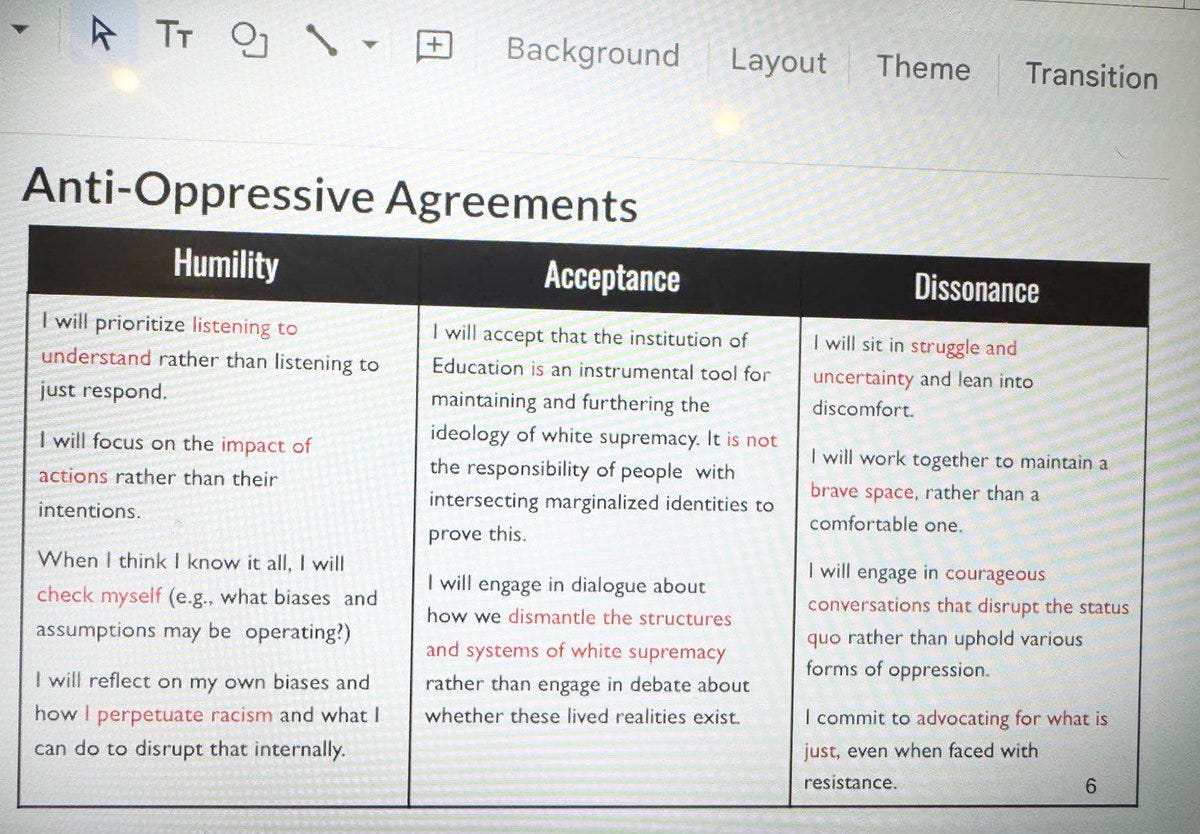
This stuff is clearly nuts. We are honestly torn whether to spend any time taking on the specific points, or simply presenting it here, unannotated, and trusting in our readers to laugh at it without any guidance from us. Let’s split the difference and say only this — while it’s obviously appropriate to use the education system to instil civic virtues, and it’s always appropriate to set workplace standards for decorum and conduct, this kind of groupthink thought policing went so far beyond that that it was always going to end badly for the proponents.
Normies thought this shit was crazy, prog friends. Most of them just didn’t want to risk the blowback of saying so because they’re nice people with real lives.
But, as The Line has oft noted, the woke pendulum was swung way, way back to something more like balance. The danger of the blowback is accordingly mostly gone now. Indeed, looking at the above, what struck us most wasn’t just the arrogance or the absurdity of it, but how dated it seems. Those “agreements” above already read like an artifact out of another era.
That there are still little residual deposits of this kind of nonsense clinging on in the depths of the public sector, whether via internal departments or budgets being directed to for-profit “equity” organizations, is undeniable, but we suspect these last holdouts will get fewer and fewer in the coming years.
And will look all the more ridiculous when they’re found. Because they are ridiculous. This kind of nonsense is the last-gasp of the glorious fading moments of the amazing party that was the post-Second World War era. It’s getting harder and harder to remember how luxurious our lives once were — as Line editor Gurney has quipped, a society that has time and energy to fret about micro-aggressions is a society that is blessedly entirely free of macro ones.
That was nice while it lasted, but the moment has passed. We may one day miss the days when all we had to worry about were equity modules.
The Line generally never waded too deep into the culture wars, partially because there was a ton of attention there already, partially because we felt they were distractions from more important issues, but also because we had some faith that sanity would eventually prevail because “Woke 1” was indeed crazy and wouldn’t last. It was simply too unnatural and doomed to eventually die once released into the open. We’re happy to see that happening. One of the only things we find odd is that politicians — like Ontario premier Doug Ford, for example — haven’t taken full advantage of the moment of reckoning and proactively shut this nonsense down. Why let it die a natural death when you can kill it and look like a hero?
Like, now? Ontario teachers should not be subjected to this ever again. Ford has the power, via his education minister, to ensure they never are. What’s he waiting for?
Well, that’s all for now, folks. Enjoy the last of your weekend and we’ll see you all on Monday.
The Line is entirely reader and advertiser funded. No federal subsidies, no bailouts. If you value our work, please consider supporting us by subscribing or making a donation. Donations are not subscriptions and do not unlock paywalled content, but they help keep The Line independent

To contact The Line with a general inquiry or comment, please email info@readtheline.ca. For other ways to connect with us or to follow us on social media, please see our LinkTree.
For decades, the Liberals and the Canadian media have held Canada in contempt. And the Conservatives have been, and remain, too cowardly to seriously challenge that axis. The current Elbows Up effusion is purely anti-Trump, and will dissipate with his inevitable departure. All that's left will be Carney's Eurocentric asset-stripping.
We'll know we have an actually nationalist Canadian government when the Snowbirds come back. With jets.
Good wrap as always.