
Hey all! We hope you enjoyed the Superbowl.
But if you’ve got some time, or just aren’t into football, check out the latest episode of The Line Podcast. And after that, check out our most-recent On The Line, where Matt Gurney interviews Vice-Admiral Angus Topshee, commander of the Royal Canadian Navy.
And now, on with the dispatch.
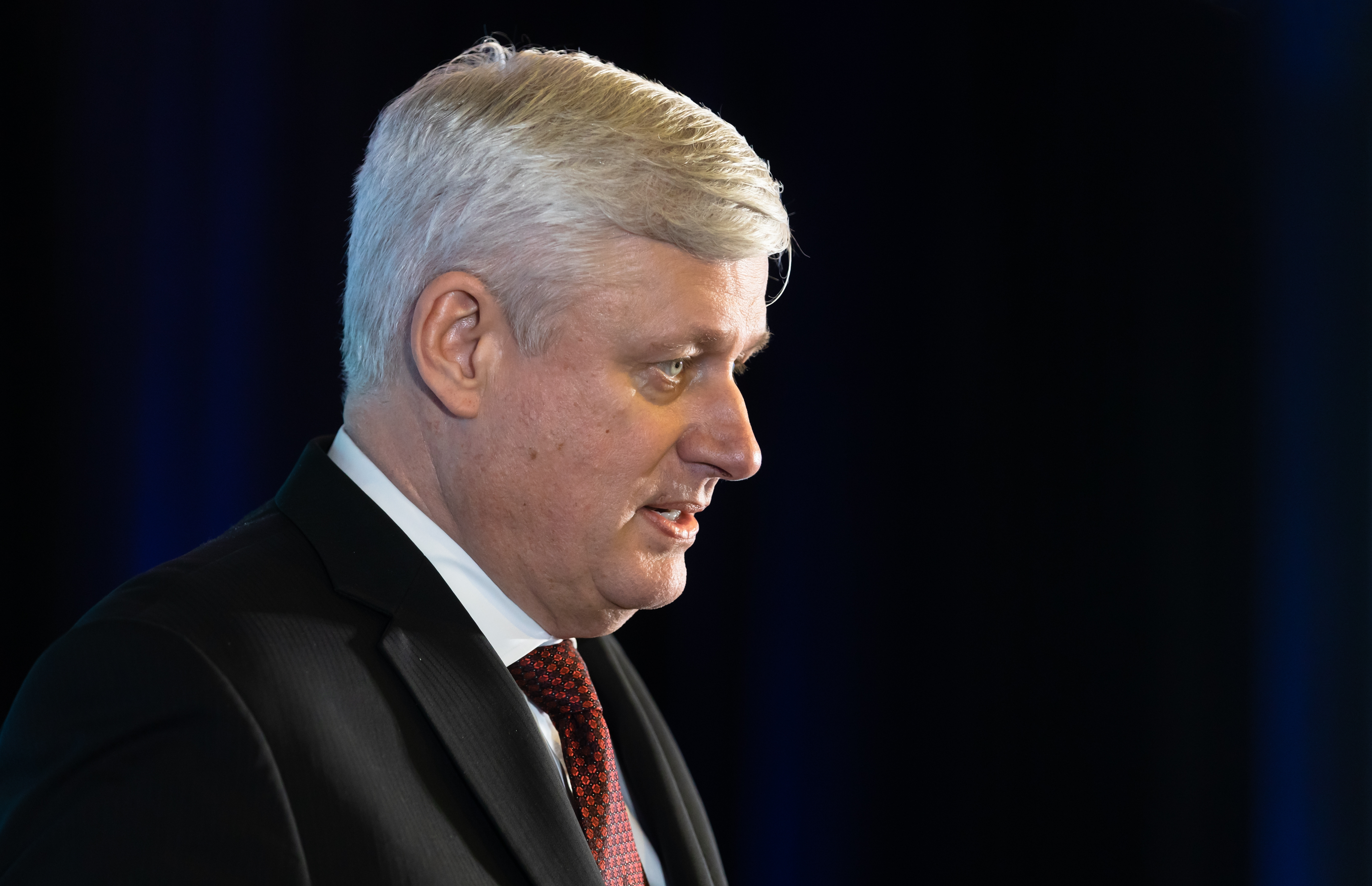
It was Stephen Harper week in Ottawa, anchored by the unveiling on Tuesday of his official portrait painted by Toronto artist Phil Richards. It’s a great painting, depicting Harper in the prime minister’s Centre Block office and includes symbolic references to his personal, political and professional life. But what was remarkable about the occasion was not the portrait itself, but what Harper made of the moment.
Standing in the Sir John A. Macdonald Building, encircled by former staffers, colleagues, officials, party leaders past and present, Harper didn’t speak like a retired partisan reminiscing about old battles. He talked, directly and urgently, about Canada’s unity and independence.
“I sincerely hope that mine is just one of many portraits of prime ministers from both parties that will continue to be hung here for decades and centuries to come,” he said. “But that will require that in these perilous times, both parties, whatever their other differences, come together against external forces that threaten our independence and against domestic policies that threaten our unity.”
This is not the typical self-patting on the back you expect when former leaders return to the capital to see themselves immortalized on canvas. Nor was it marked by disguised score settling or told-you-sos. Instead, Harper – the architect of a decade-long Conservative government who was often portrayed as bland and managerial – used the platform of his portrait unveiling to articulate something resembling a philosophy of the office.
Harper’s emphasis on unity and independence, on a collective project that binds disparate regions and identities into a shared polity, betrays an acute awareness of something that perhaps only those who have held the position truly grasp: that the prime minister’s primary job is not policy, not partisanship, not even governance in the everyday sense, it is to keep the country whole.
If you doubt that this is an enduring concern, consider the wider context of Harper’s comments. He shared the stage not just with Conservatives, not just with his own party’s faithful, but with figures from across the political spectrum. Former prime minister Jean Chrétien, whose political style is famously different from Harper’s, joined him earlier in the week at an event in Ottawa to speak about Canadian patriotism and unity amid rising global tensions. They weren’t merely performing a cross-partisan photo op; they were signaling something deeper, namely, that Canada’s unity transcends the usual partisan divides, that its survival is a project bigger than any one party or ideology.
And that’s the lesson here. The enduring work of holding Canada together doesn’t stop because a prime minister leaves office. It doesn’t end with an election loss or a change of party. Canada, as a political entity, is perpetually under strain from global economic pressures, from cultural and regional fissures, from its massive geography and the centrifugal forces it contains. In times like these, when talk of separatism flickers back into respectability in both Quebec and Alberta, when external geopolitics pose real questions about sovereignty and autonomy, the reminder that unity is not a given but a continuous project is a vital one.
That is what Harper seemed to understand in Ottawa this week. Not that he wants to be prime minister again — that ship has sailed – but that the office he once held represents something enduring: a locus of responsibility for the nation’s coherence. One wonders how many other former prime ministers, in their autumn years, ever arrived at this conclusion. Most leave the spotlight only to find themselves in the rear-view mirror of history. But Harper’s week in Ottawa suggests a more expansive postlude: that being a prime minister doesn’t end in any meaningful way. You might pay a visit to the Governor General and formally resign, but the work of sustaining Canada persists, in the memories, the discourse, and, yes, the portraits that hang in the halls of power.