

Hey all. Before we get to the dispatch, a programming note: The Line will operate as normal this week, but starting next week, we’ll take some time off. Podcasts will continue, but written content will wind down for a week or two while your Line editors rest and deal with family matters. As ever, we’ll respond quickly in the event of a sudden and major news development, but we’re hoping we don’t have have any need. A break would be nice!
Speaking of podcasts, don’t miss last week’s The Line Podcast.
Also, don’t miss the latest On The Line, where Matt Gurney spoke with Dr. Brian Goldman about his new book, The Casino Shift, and also the challenges facing Canadian health care.
And now, on with the dispatch.
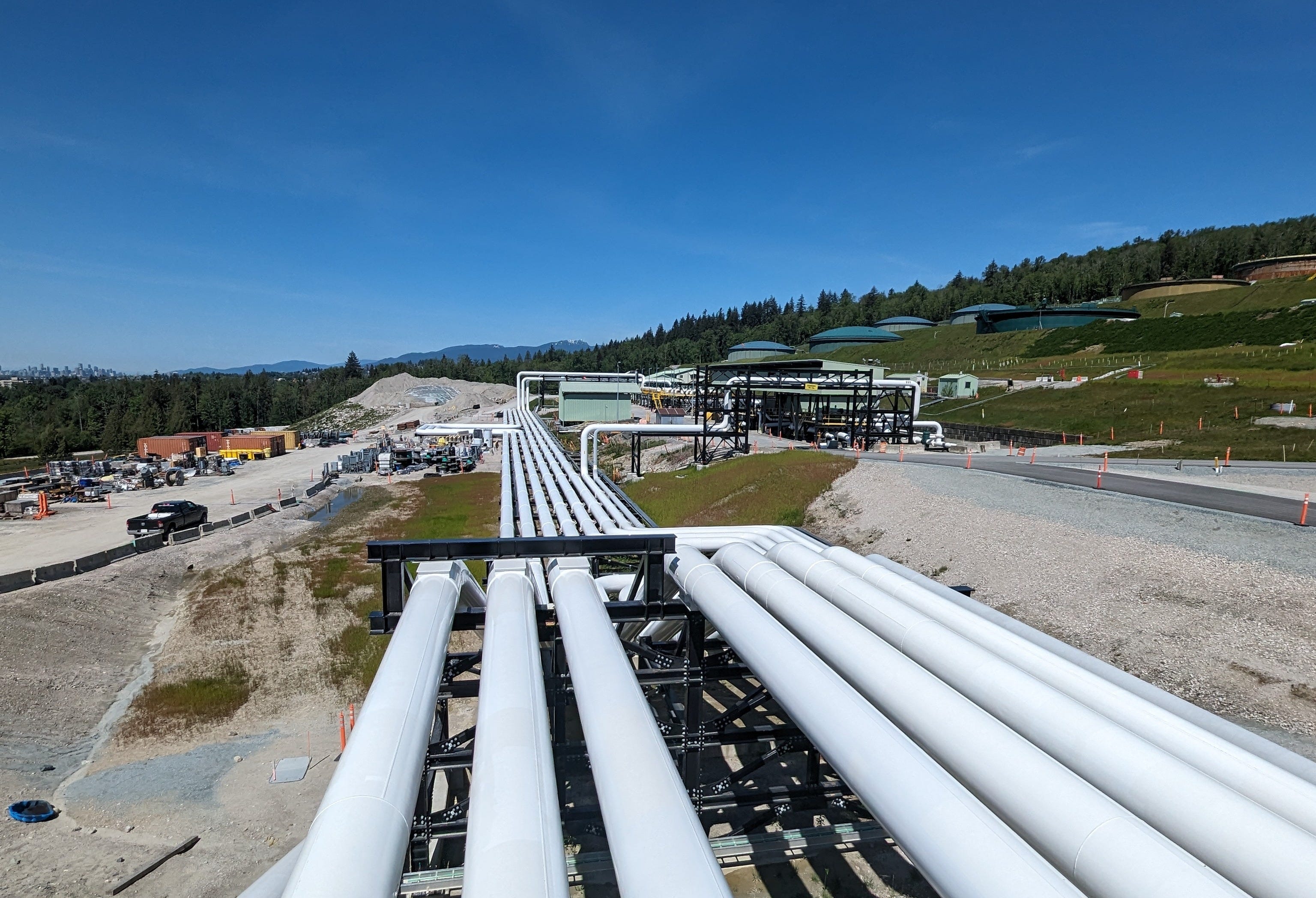
The big news last week at home was the announcement of twin federal deals with the Alberta and B.C. provincial governments. The deals are each bilateral agreements, with Ottawa reaching terms with Premiers Eby and Smith rather than a tripartite agreement. But the net effect is the same: the federal government is supporting a new pipeline from Alberta to the Pacific coast, and B.C. isn’t going to oppose it. In exchange, the federal government will keep in place the northern tanker ban, meaning that this new pipeline will follow a route to the south, believed at this time to generally mirror the existing Trans Mountain pipeline’s path from Alberta to the Pacific.
It’s easy to see the politics of this. Rather than getting B.C. to concede anything directly to Alberta, Eby just dealt directly with Carney. Eby gets to wash his hands of it, noting correctly that the pipeline is a matter of federal jurisdiction, but he also gets to claim the victory of getting Carney to recommit to the tanker ban.
For Smith and Alberta, the win is obvious. Ditto Carney — and he moved even before the announcement to declare that the most aggressive of the Trudeau-era climate goals no longer fit the new reality. That’s probably worth spending some time on later!
But for now, The Line is happy to see this deal. Our only complaint would be that it took this long. In fairness, this went quickly by the standards of Canadian governance. But some kind of deal along exactly these lines was an obvious option from the get-go. We at first wondered if there was perhaps some uniquely challenging engineering obstacle with the preferred route, but with the new pipeline apparently intended to follow the path of the existing one, we’re forced to conclude that this is simply how long it took the feds and both provinces to actually come up with a deal. They probably feel like they were moving at warp speed. They weren’t.
The challenge now shifts to actually getting the damn thing built. We do not dispute the political value of this agreement. And even though we think it took too long, we do not deny it would have required some real politicking to pull it off. But this may prove to be the easy part. As The Line has often noted, Canada no build good. And even if B.C. agrees not to impede the project and to issue all the necessary permits and permissions in a timely way, we would not be shocked to see activists and protesters looking to find ways to slow this project down.
But that is a problem for the government in the future. For right now, it got a win. We congratulate it for that, and we hope it helps settle things down in Alberta. Figuring out how to do these things faster, and, in a perfect world, figuring out how to have the government step back entirely and just let the private sector move with confidence, can be tomorrow’s job. But we hope they don’t put it off much longer than that.

While you’re reading this dispatch, one of your Line editors is likely at another Stampede event in her hometown of Calgary. And the other Line editor is wondering why his hometown of Toronto has no version of it.
If you haven’t already, we’d encourage you to listen to or watch the third segment of Friday’s podcast, where Matt Gurney offered up a theory of Canadian culture. In short, he said, the country’s two largest cities and historical cultural centres are no longer able or interested in advancing Canadian culture. Montreal is now torn between the forces of Quebec’s bizarre politics, and Toronto is far too self-conscious of its status as new kid on the block among global cities, and actively shuns anything that seems old, quaint or provincial. Given the current political leadership in the city, Toronto would be more likely to apologize for its past than honour it.
What’s unifying about that? Calgary and the Stampede are the proof of why this is a flawed approach. The Stampede works because it eagerly embraces the city’s heritage, in a way that everyone — multi-generational Albertan, new immigrant, or even tourist — to take part in and share in the fun on an equal basis. Much of Canada’s culture is now regional, not shared — and that’s a problem that we don’t know how to solve.
Toronto needs something like the Stampede. Canada needs something like it. Hell, these aren’t necessarily distinct things — given Toronto’s lopsided contribution, via the concentration of media, to the national conversation, a really pro-Canada, kick-ass event in Toronto would ripple out.
But … what the hell should it be?
We don’t know. Toronto is a good festival city, and (no jokes about the Leafs, please) can rally around sports, which is a pretty harmless and universal way to bring people together. But in terms of something that would honour the city’s or province’s heritage and also bring people together, no matter how long they’ve had in roots in Canada, we don’t have any good ideas.
So, we are throwing it open to you, the readers. Drop a comment below, or pop us an email at info@readtheline.ca. What is something that Toronto (and any other Canadian city, town or village) could embrace that would fill the same civic role as the Stampede? We are open to ideas — should Stampede go national? Should a new holiday be created? Is there a current holiday that needs more attention, or something local or regional that should be given more attention? Let us know!

Speaking of sports: Halfway through Canada’s match against Morocco at the World Cup on Saturday afternoon, things were going well. The match was scoreless, but Canada had been the better team, and against a team that was ranked sixth in the world — Canada was 30th — they were holding their own, and then some.
Unfortunately, the second half also happened. Morocco scored off a clever play not long after the break, and Canada never looked terribly likely to claw back into the match after that. Morocco ended up winning 3-0, a score that didn’t really justify the nature of the match.
So, in the end, what was the verdict for the Canadian team? A solid B+, we would argue. The men’s national team had never earned a point in its only two previous visits to the World Cup, and in this tournament they did that with a draw against Bosnia-Herzegovina in their first match, and then won their first game (against a woeful Qatar), advanced out of the group stage for the first time, and won their first-ever World Cup knockout match against South Africa. Any time you are doing many things your nation has never done before, it has to count as a significant checkmark on the good side of the ledger.
Could the match against Morocco have gone differently? Sure. But the Canadians were also without their best player — by a mile — Alphonso Davies, and lost midfielder Ismael Koné to a broken leg suffered in the Qatar match. Canada, in global soccer terms, simply doesn’t have the depth to absorb a couple of big injury losses and not find themselves at a disadvantage against a team like Morocco, which made the World Cup semi-finals in 2022. They played well, and should be saluted for it.
But was being a co-host of the tournament worth it? That part is much less clear. FIFA, no stranger to flat-out corruption, raked in vast stacks of cash that was made possible by taxpayer money poured into host cities by various levels of government. By some accounts, Canadian taxpayers will have spent close to $1-billion for the right to host 13 games, seven in Vancouver and six in Toronto.
There is simply no way where that is value for money. The promises of tourism revenue were always hollow, and indeed there was no evidence that foreigners had arrived in either city in numbers above what they normally do in the summer months. There was plenty of hotel availability in Toronto last week while the city hosted a game between Portugal and Croatia, suggesting that legions of visitors had not swarmed the town.
And yet: the vibes in downtown Toronto were pretty great. People have been in soccer jerseys in great numbers in recent days, filling pubs, going to the stadium, basically just being caught up in the fun of the whole thing. Anyone who went to one of those games will have had an absolute blast.
FIFA sucks, to be sure. But they can put on a great party, even if we quibble at the price tag.
Thanks, all. Talk to you soon.
The Line is entirely reader and advertiser funded. No federal subsidies, no bailouts. If you value our work, please consider supporting us by subscribing or making a donation. Donations are not subscriptions and do not unlock paywalled content, but they help keep The Line independent

To contact The Line with a general inquiry or comment, please email info@readtheline.ca. For other ways to connect with us or to follow us on social media, please see our LinkTree.
A pot pourri of The Line articles and readers comments from several sources on this mater.
The funding for this pipeline seems to be all "smoke and mirrors." There are no private enterprise companies mentioned in connection with this project..... none. Let’s dispense with the fantasy at the heart of this report: the notion that Canada is on the cusp of some renaissance in private sector risk capital magically materializing to build major infrastructure. The authors seem determined to ignore the last decade of evidence — evidence showing that private investors have all but abandoned large scale Canadian projects because the political, regulatory, and financial environment has become utterly inhospitable.
The report’s cheery optimism about “unlocking private capital” is indistinguishable from wishful thinking. Investors aren’t lining up to pour billions into projects that take 12 years to approve, 4 years to litigate, and another 3 years to renegotiate after a change in government. They’re not interested in jurisdictions where regulatory certainty is a punchline and where political actors treat major projects as bargaining chips in intergovernmental melodrama. The private sector isn’t confused; it’s gone. And it’s not coming back until Canada stops treating capital like a suspicious foreign intruder.
So what’s the report’s solution? More government money, naturally — as if Ottawa’s balance sheet were an infinite well rather than a fiscal crater. Canada is already staggering under a debt load that is growing faster than its GDP, its productivity, and its political courage. The idea that the federal government should shovel even more public dollars into megaprojects because private investors have fled is not just economically reckless; it’s delusional.
Every additional billion Ottawa borrows to compensate for the absence of private capital is another billion added to a debt crisis that is already eroding Canada’s long term stability. Interest payments are now one of the fastest growing line items in the federal budget. We are borrowing money to service the money we borrowed to replace the money the private sector refuses to invest. This is not a strategy. It’s a spiral.
And while the report pretends that government funding is some kind of patriotic backstop, the truth is far less flattering: public dollars are being used to mask the fact that Canada has become structurally incapable of attracting private investment for major projects. That is the real crisis — not the absence of capital, but the absence of conditions under which capital would willingly participate.
The Line’s discussion of the pipeline deal underscores the absurdity. If the “logical outcome” was always to follow the existing corridor, why did it take years of political theatre, interprovincial brinkmanship, and federal hand wringing to arrive at the obvious? Because Canada has built a system where even the simplest infrastructure decision becomes a saga. And sagas are exactly what private capital avoids.
The report’s authors may be content to pretend that government funding can fill the void indefinitely. But Canadians should not be. Every dollar of public money poured into projects the private sector refuses to touch is a dollar borrowed against a future that is already shrinking. The debt crisis is not hypothetical. It is here, it is accelerating, and it is being worsened by precisely the kind of thinking this report embodies.
This is the real problem. Canada doesn’t need more government money. It needs a government capable of creating conditions where private capital would willingly return. Until then, the country will continue stumbling forward on borrowed funds, borrowed time, and borrowed credibility — all while congratulating itself for “getting things built” that no rational investor would finance....Amen.
The pipeline deal will disappear in November. Nothing will be built. That's not what it's for.