

Hey everyone. We hope you’re having a great Sunday. It was a busy week in the news, so we won’t keep you waiting.
First up, and worth your time, the latest episode of The Line Podcast.
And also, last week’s On The Line, where Matt Gurney and lawyer Peter Sankoff debate the notion of immigration status being factored into criminal sentencing (and have a much longer, deeper chat about the justice system as a whole).
Please do all the things we always ask you to do: like, subscribe, share, and leave nice reviews. And now, on with the dispatch.
You’ve read and heard from us already about our thoughts on the budget this week. Don’t be shocked if you see a little more reaction trickling out over the next week or two. For right now, we want to flag something that we think the Canadian public needs to be aware of.
The amount of defence spending we’re talking about here is something that we have not thought about at all in recent generations. It’s a good thing. But it’s going to create some real challenges that we need to start thinking about, and coming up with solutions for, right away.
The numbers look something like this: the government had already announced a $9-billion influx of money into national defence, as well as a little bit of creative accounting, all with the goal of getting our spending up to the NATO two-per-cent-of-GDP target immediately, instead of on the absurdly prolonged trajectory the last prime minister deemed appropriate. A big part of this — and a welcome part — was a pay raise for members of the Canadian Armed Forces, particularly those at the lower scale of the pay grids for enlisted personnel and officers. One of the major problems the military has had in recent years is retaining trained personnel, and a pay raise is a tried-and-true way of helping address that. It also has the effect of juicing our spending at a time when our allies were looking for a tangible commitment. It’s a win-win.
But then there’s the rest of the spending: over $80 billion over the next five years, with a goal of getting up to the new NATO target of five per cent in only nine years, by 2035.
The Line supports this. We support this wholeheartedly. It makes us want to do cartwheels in the streets — and we would, if not for justified concerns for our joints and lower backs. (And dignity, though that’s less an issue.) But we do need to flag how transformative that level of investment would be.
Here’s the simplest way to put this. Almost our entire debate over defence in recent decades has been around the two-per-cent target. Nominally, the Canadian Armed Forces have certain capabilities that were suited to our national willingness to spend around two per cent of GDP. In reality, because of chronic under-funding, a lot of the capabilities we claim to have on paper didn’t really exist in reality. Units were badly undermanned. Equipment either didn’t exist or was not in serviceable condition or was long-since obsolete. Shortfalls of money and trained personnel were cutting into training exercises and basic upkeep on weapons, gear, and facilities. This prolonged fiscal starvation, combined with a fairly high level of demand on the forces for missions abroad and at home, had the effect, year after year, of hollowing out the force.
Getting spending up towards two per cent will help turn that around. This is conditional — and it’s a big condition — on fixing the military’s procurement problems. We could budget a trillion for the military, but it’s not going to make a difference if we have the same broken processes that need 10 to 15 years to actually get from an identified operational need to a signed contract. But still, if only in the big-picture sense, getting to two per cent will actually flesh out the Canadian Armed Forces into the organization that already existed on paper.
That’s good. That would be a big step up. But the problem is, as your Line editors have been screaming into the void for years, even the fully fleshed-out and realized version of the Canadian Armed Forces that existed on paper is too small for the current global environment, and lacks many critical capabilities that will be necessary to effectively fight — or even simply survive — on the battlefield. We need to do things we cannot currently do, and we need to do a lot more of all the things we’re already doing. That’s going to mean a bigger naval fleet, a larger army and a larger air force. That’s just the reality — our current force structure, even if fully manned and ready, is not large enough to meet all our needs.
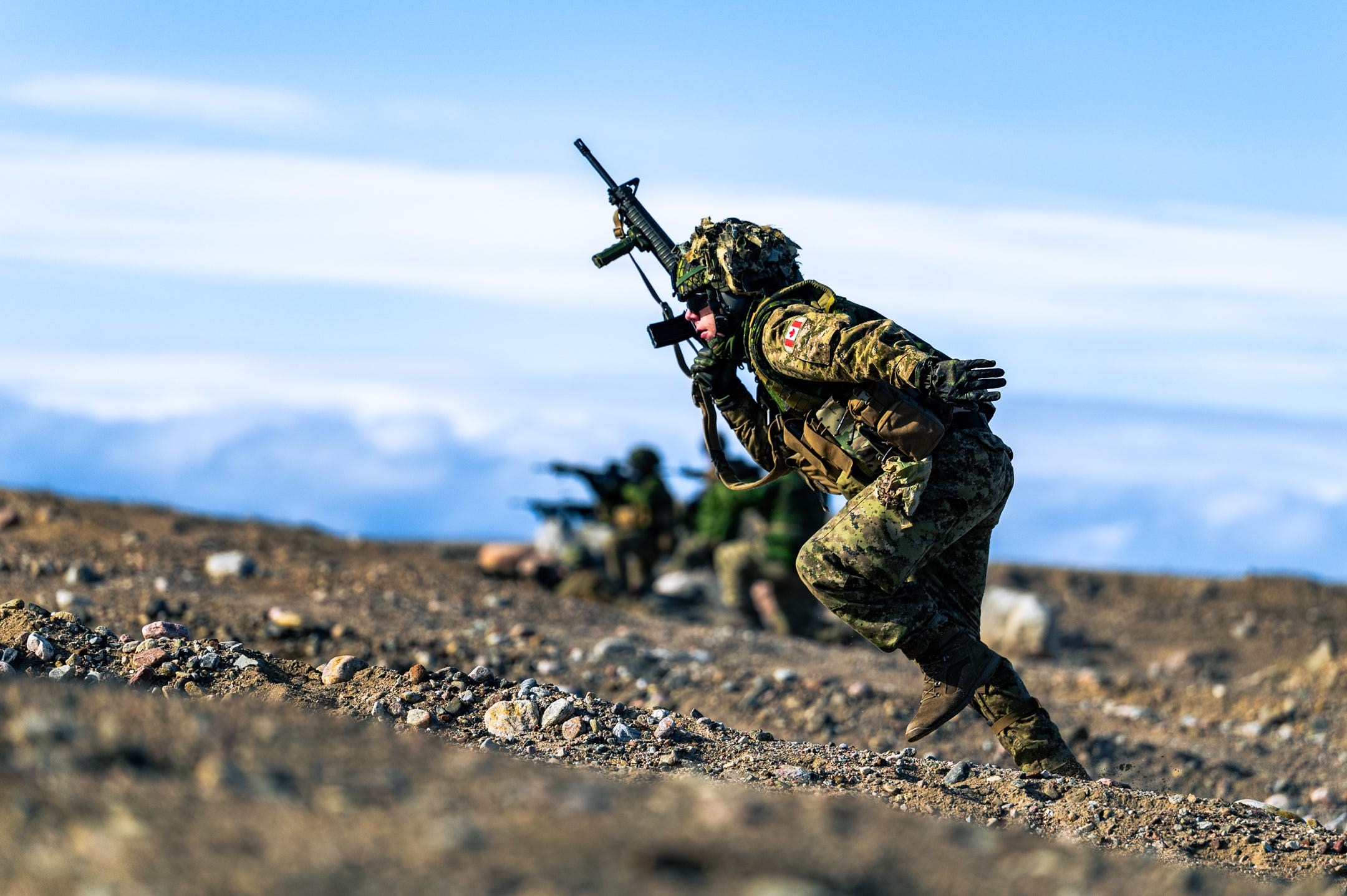
That’s where the other tens of billions of dollars come in. There’s simply no way around the fact that this amount of money, combined with geopolitical reality and political rhetoric, is pointing to an inescapable conclusion: the Canadian Armed Forces are going to get a lot bigger. A lot bigger. We are looking at a substantial increase in the size of the regular forces, and probably an even larger increase in the size of the reserves.
Indeed, you may have seen this article recently in the Ottawa Citizen, by defence reporter David Pugliese. In it, he discusses proposals being prepared at National Defence Headquarters to establish a new reserve force of approximately 400,000 troops. The Line can confirm the general thrust of Pugliese’s reporting. We have no idea what the politicians will eventually sign off on, and we won’t be surprised if they get weak-kneed when some of the details are laid out before them, but discussion of a massive expansion of the Canadian Armed Forces, on a scale we haven’t seen since the Second World War, is indeed happening in certain rather important rooms in Ottawa.
We would sign off on this. It’s overdue. We think we should’ve started the process yesterday. But this is going to require a level of investment of both money and both political and societal capital that we have not invested in defence in 80 years. It’s going to require a much larger share of federal spending on defence on and on into the foreseeable future, and it’s going to require a dramatic expansion of the Armed Forces’ footprint in Canadian society. It would mean more bases, more training facilities, much more aggressive recruitment of young Canadians, and a dramatically expanded officer corps, probably requiring the kind of direct commissioning of civilian professionals into military roles that we haven’t seen since the creation of the Canadian Expeditionary Force in the early phase of the First World War, more than 100 years ago. Depending on how we choose to do this, it could even involve some form of conscription or national service. In any scenario, the military would become a more visible part of life. You’d see more people in uniform. People you know would be in uniform. Some of you, our readers, might find yourselves in a uniform!
Again, we don’t know what form this is going to take. But we want to flag this for our readers as something that Canada, as a society, is going to have to start thinking about. We’ve had an incredible break from history for the last 80 years, but the party is over, and if this country is going to remain safe, secure and sovereign, it’s going to require a level of active investment and work that is completely outside our current understanding of how the Armed Forces exist within Canadian society.
We support this. It’s necessary and overdue. But that doesn’t mean we have any illusions about how hard it will be, and how different. And we hope our fellow Canadians are starting to figure it out. Big changes are being planned by serious people, and we hope to see them follow through — with any luck, sooner than is the norm for Canadian public-policy development. Fingers crossed, and keep your eyes open.