

Hey folks, hope you’re having a great weekend. If you need a little boost, check out this week’s The Line Podcast, with Scott Stinson filling in for Jen Gerson.
Also, check out this week’s On The Line, where Matt Gurney spoke to Mark Cancian of the Center for Strategic and International Studies, a retired U.S. Marine Corps colonel and one of the authors of a new report examining the alarming state of Western ammunition stockpiles. And also David Shipley, of Beauceron Security, on a recent, serious cyberattack that we should be paying attention to.
And now, on with the dispatch.

We don’t normally do themed dispatches. One of the advantages of the dispatch format is that we get to cover a bunch of different topics that aren’t necessarily worth full columns, but we still want to have a word on. This week, we are shaking things up a little bit.
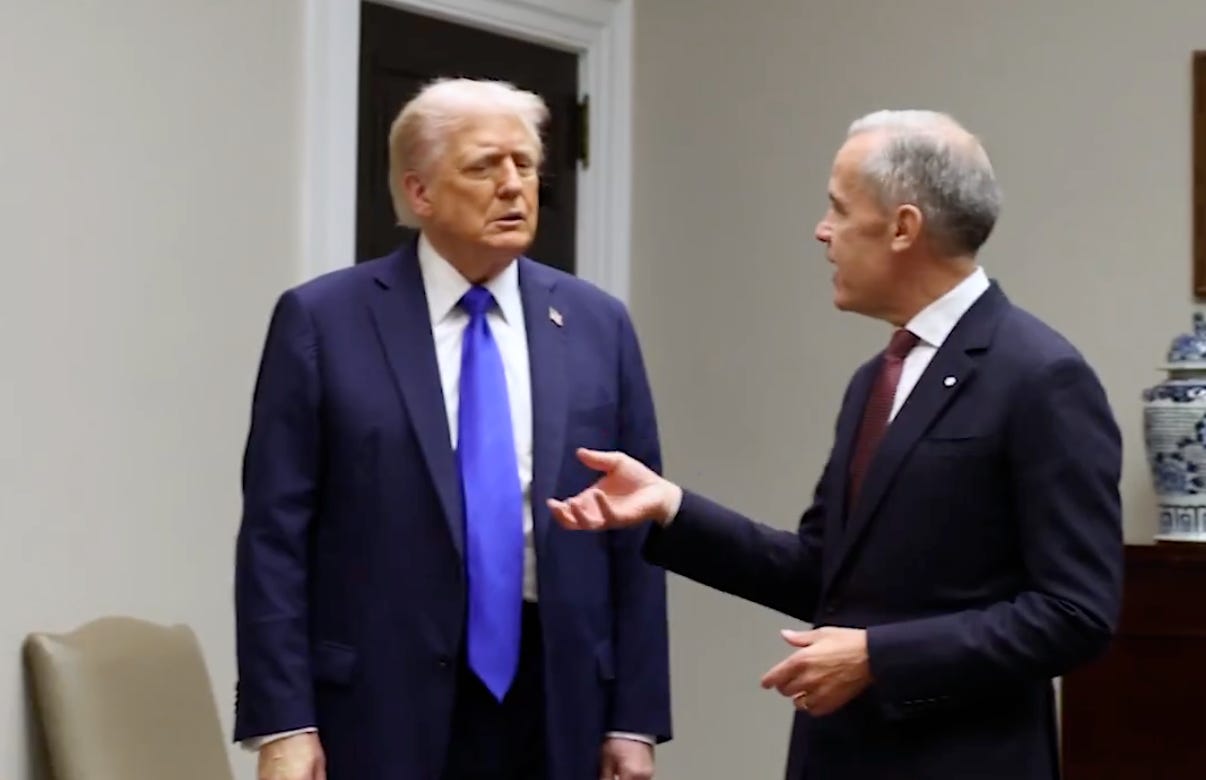
A few days ago, it was reported that Prime Minister Mark Carney wants a broader trade deal with the United States, not just a stopgap measure ahead of the 50-per-cent tariffs scheduled to hit some Canadian exports in 10 days. We have to assume the prime minister hopes that a broader deal would be more resilient in the face of American incoherence or even hostility. It would be a chance for Canada to get a lot of items off the table all at once, while hopefully using our economy as the carrot it wants to offer the Americans in hopes of avoiding their stick.
Okay.
We have concerns about this. But, for the sake of argument, as a thought exercise, let’s take this prospect seriously. What should Canada be prepared to give up? What should it expect back in return?
First, it is worth starting this conversation by noting that the annexation of Canada and turning it into the 51st state has been, and remains, the official and explicit policy of the United States of America. Ever since Donald Trump first whispered it into Justin Trudeau’s ear at that awful, fateful meeting at Mar a Lago on November 29th 2024, Trump and his team have not wavered from that position.
Sure, there have been half-hearted efforts by Trump apologists at dismissing it as a tease, a jest, a friendly offer, a vague warning about the consequences of Canada’s failures on continental defence, or what have you. But despite having been given numerous opportunities to renounce it, to take it off the table now and forever, and to apologise for having given offence to Canadians, neither Trump, nor Vance, nor Rubio, nor Lutnick, nor Hoekstra, nor any of the multitude of other Slurpee-suckers the American president has surrounded himself with, have chosen to do so.
Indeed, just the opposite: Trump called Trudeau “governor” from that meeting right until he left office, and he has consistently used the same obnoxious slur when referring to Carney. Trump continues to routinely post images to his Truth Social account that show the American flag covering all of North America.
During phone calls with Trudeau in early February 2025, Trump questioned the validity of the 1908 treaty defining the U.S.–Canada border. He suggested he could tear it up or revise the boundary. At other times since, Trump or his toadies have threatened to tear up the Oregon Treaty, the Columbia River Treaty, and the Boundary Waters Treaty. Trump or his snivelers have consistently asserted that Canadians are not a people, that Canada is not a real country, and that it survives only by the good graces of America.
Meanwhile the Trump administration continues to work to acquire Greenland in the face of the strong objections of Greenlanders, the government of Denmark, and their NATO allies including Canada. An American oil company with close ties to Trump is actively unloading oil drilling equipment onto the shores of northern Greenland, despite not having received a permit to do so and in the face of the strong opposition of the local government.
It is imperative that we are all in agreement with the simple facts here: Donald Trump has repeatedly expressed a desire to annex Canada and Greenland. He continues to speak and act in ways that make it clear that he continues to have designs on this country. His business cronies are currently doing a little green men routine in Greenland, and there is no real reason to think he would not do the same thing in, say, Alberta. In fact, the current administration has maintained a posture of strategic ambiguity on the issue of separatism — and that’s putting it generously. The Americans are actively working to stoke regional grievances in order to undermine our capacity to retaliate to their economic pressure as a unified polity; they are cultivating and boosting ideological allies that shun Canada for retaliatory economic measures. And they are at least tacitly supporting outlets and personalities that are actively working to break the country.
The absolute best-case read of all of this is that Trump simply does not take Canada seriously and thinks that calling us the 51st state and Carney “governor” is funny. Or that he thinks diplomatic fuckery is going to help the U.S. secure a better trade deal.
But there is absolutely no reason we should be expecting or hoping for a best-case scenario. We are often exhorted to take Trump “seriously but not literally”, so what would that mean in this case? It would mean something like: In an ideal world, Trump would dearly love to annex Canada. Failing that, he would like to annex parts of it, most likely Alberta. And failing that, he would merely like to subjugate, vassalize, and deindustrialize this country. Lol.
Again, let’s make things plain: this is the current, explicit policy of the United States of America toward Canada. No one in the administration has ever said anything that would lead anyone to think otherwise.
So, what does that mean for a trade agreement? By any sane standard, it means we should not enter into one. We understand that the reality before us is difficult for many Canadians to grasp both intellectually and emotionally; but the Americans are not our friends, they are not our allies, and they are not our “closest trading partners”. They are a country with which by force of geography we have strong economic, political and military ties, and a shared history of peaceable coexistence and cooperation. Those days are done, for now and probably for a very long time to come, and they simply cannot be trusted to uphold their end of any bargain.
At the very least, it means that any deal we enter into must be as easy to get out of for us as it is for them. Our commitment level must be as limited as possible. None of our options should be closed off, and we should not agree to anything that cannot be quickly undone. Don’t let them into markets we cannot remove them from; avoid procurement deals that lock us into their defence chain of command and control; don’t commit to common development projects that permanently alter the infrastructure or geological balance between the two countries; don’t sign anything, on any subject, that prevents us from signing whatever we want with whomever we want, and so on.
And most importantly: Do not agree to anything that does not include as a preamble a loud, clear, and uncompromising commitment, from the President and Congress to the unity, integrity, and sovereignty of the Dominion of Canada, now and forever. If they can’t say it, then we know where we stand.
And our message should be: no deal.
As noted above, we at The Line think there is no realistic prospect of a durable or good faith deal in the offing, which is why we find reports of some kind of imminent raft of concessions disheartening. That said, we can understand why the prime minister feels like it’s his best or only option. And we might even have a little sympathy for the overall notion that, well, we have to at least try. So, for the sake of argument, let’s play the thread.
But The Line‘s view, for what it’s worth, is that it is not worth making any major concessions to get a deal with Donald Trump.
It just isn’t. The United States, and Trump specifically, are simply too incoherent to work with in good faith. If there are things we ought to be doing because it’s the right thing to do for Canada, then we should do them. The Americans hate our dairy protections. So do most of our trading partners. Heck, we hate our dairy protections. Canada’s fanatical defence of supply management was a problem when we were negotiating with the Europeans, too. So we have an open mind to making sacrifices that will benefit domestic consumers.
Ditto on national, continental and alliance defence. There are a lot of things the Americans want us to do that we probably should do for our own reasons, and a lot of that stuff would end up buying us credibility with NATO and our other allies. So, let’s consider these notions on their own merits. And if they happen to please the Trump administration, hey, fine.
But make an honest-to-God concession just to keep Trump happy?
No.
The concession will buy us nothing — worse than that, it’ll hurt us. Any actual meaningful concessions — the kind of things that would get a Canadian leader in trouble with some domestic constituency or another — can only be made once.
Everyone else who has signed a deal with Donald Trump knows that no deal we could sign would be durable. We’re not even sure at this point if it’s because he means to be disruptive or is simply forgetting what he’s already agreed to. Trump is simply not someone who can be bargained with, and we shouldn’t sacrifice anything we wouldn’t otherwise sacrifice in order to buy a month, or a week, or a day, or an hour of goodwill from this guy.
At the very least, let’s do this: every single item in our next trade deal with the U.S. should be conditional on the U.S. abiding by their side of the deal. The first time Trump even hints at a new tariff, the booze comes off the shelves. The first levy on a Canadian product triggers an automatic counter-levy on a U.S. product of equal value. Any other measures must, under Canadian law, be matched in mirror-image to whatever insanity the Americans come up with next, with our measures dropping the moment — but not a moment before — the U.S. returns to the text of the agreement.
In short, it’s acceptable to use Trump as an excuse for Canada to get its own act together, and to make the kinds of changes and improvements that benefit our people and for our own sake.
If the U.S. wants to call those “concessions,” so be it. But giving up anything we actually care about ought to be a non-starter, and we believe the country must be willing to accept the economic sacrifices that refusal may entail.
All the above being said, it is worth taking a look at some specifics we could offer. “Concessions,” if you will. Some of these will be trade-related. Some of them won’t.
One of the ones that isn’t strictly trade-related is, as noted above, national and continental defence. This is one where we honestly do think Canada should be ready to pony up. The Americans are not wrong that we have allowed our military capabilities to atrophy to a truly absurd extent. We are a dead weight in the alliance, and we should fix that.
This is going to mean a bigger navy, a bigger and more capable air force, and probably a larger but certainly more deployable and self-sufficient army. And it’s going to require fairly sophisticated weapons across all three branches.
Our proposal, stated plainly, is this: where American weapons are truly the best or only option, buy them without delay. Don’t make political hay over it. Just get it done. But where there are true non-American or even domestic alternatives, we should default to them every single time.
It would be our overall preference not to buy more American weapons than are strictly necessary. We worry that any large defence contract with this administration will be held hostage to American trade negotiation demands. But we live in the real world, and, at least for the time being, there are certain weapon systems and military capabilities that only the Americans can provide.
The F-35 fighter jet is one example. We should go ahead and place a large order for them. We should also order an equal or greater number of Gripen jets, accepting the costs of a larger mixed air fleet simply to get this over with and move on. Other capabilities, like long-range missiles and satellite communication and navigation, are so dominated by the Americans that there is no realistic near-term alternative.
But that’s honestly about it.
The Canadian Army needs more artillery. The South Koreans make really good artillery. The navy is thinking about a whole new class of surface warships. Many of our European allies make excellent ships and naval weapons. Canada itself is awfully good at making armoured vehicles. Small arms and basic military equipment can be bought on the open market basically anywhere, or made at home. Canadian should strive to become not just self-sufficient in ammunition, but a net exporter.
Once we have this gear, we should do our very best to assist America in policing North America by simply taking care of our own backyard. Comprehensively. Calling on the Americans for help should be a matter of last resort. Any vessel approaching or encountering any kind of distress in Canadian waters should be met by a Canadian navy or coast guard ship. Any aircraft potentially threatening Canadian airspace should be intercepted by a flight of Canadian fighter jets supported by Canadian tankers and Canadian command-and-control aircraft. Any and all domestic emergencies in Canada should be met with Canadian forces, and Canadian forces that we deploy abroad in assistance of allies or ad hoc coalitions should be capable of accomplishing their mission objectives without undue reliance on the United States for combat power, logistics or intelligence (that last one is hard — see satellites, above).
This is going to be expensive. There’s no way around that. But we think it’s worth doing on its own merits, will hopefully get the Americans off our back, and will give Canada real credibility and bargaining chips with the rest of our allies.
Besides, what’s not to like? We’d love to see the Americans find ways to pretend to be angry about a much larger, more powerful Canadian Armed Forces doing an excellent job guarding our share of North America and contributing to allied missions abroad.
Seriously. They are welcome to object.
Just to bookend this whole dispatch, we think one of the major strategic mistakes that Canada is making is leaning on the assumption that Trump is a temporary phenomenon. That, God willing, he will pass and, with him, this particularly painful era of U.S.-Canada relations. In short, that we will return to some kind of new normal in a post Trump era.
That is possible. Anything is possible.
But planning around that the best-case scenario could also be a fatal error. We think the nation needs to operate under the assumption that a hostile America is the de facto baseline, regardless of what happens at the coming midterms, and even in the event of a Democratic president in 2028.
In fact, we’d go further. We’re not sure who is doing Canada more damage; the Republicans who are open about their desire to vassalize, if not annex, us. Or the Democrats who are stringing the country along with the false hope that the relationship can return to normal once Donald Trump is out of office.
In the wake of Trump’s latest announcement of 50 per cent tariffs on a raft of goods to come into effect in a few weeks, Canadians have been inundated with messages of support by left-leaning Americans assuring us of their continued goodwill.
“Despite the attacks, distractions, and false narratives, Canada remains one of America’s closest and most faithful friends,” wrote Bruce Heyman on Twitter/X recently. Heyman served as U.S. ambassador to Canada during Barack Obama’s presidency.
“If Americans could choose any country in the world to share our longest border with, we would choose Canada every time. That is the truth—and it is time we stood up for our friends.”
Lovely sentiment. The problem is that it it’s bullshit. Nobody actually has stood up for us, and they won’t. They have their own problems. There is no cavalry of Good Americans coming to save us, and to plan around that assumption would be dangerous and naive.
It’s easy to say pretty things about Canadians and the friendship between our two sovereign nations — one of the most successful in human history. But are Americans actually willing to sacrifice anything in order to retain that friendship?
The Gordie Howe bridge, for example, wasn’t a big win for both nations, though it could have been. It wasn’t a gesture of good will. In its final estimation, it was extortion; a shakedown by the U.S. president for danegeld that Canadian leaders were either too stupid or too weak to meaningfully resist.
Is there a single American politician — Democrat or Republican — who would ever consider re-opening bridge deal as a gesture of good will at some future date? Would they ever offer anything as costless as an apology? Would our friendship be worth even that to them?
We at The Line are no longer quite so naive, and we hope our leaders aren’t, either.
Left or right, doesn’t matter: We were better off when they forgot about us. Now that we are on the radar, any illusion of mutuality has been quickly discarded. Americans operate as if we’re lucky to have their consideration, not the other way around. The psychological assumptions of our inferiority are built in; Trump has simply been more explicit about the sentiment. And in Trump’s honesty lies the gift of clarity.
Canadians are foreigners with no domestic political constituency in the U.S. The same political incentives that are driving the Trump administration to exert economic pressure to force us into compliance will, once institutionalized and normalized, continue to prevail once Democrats resume power. Presuming they ever do. As long as Canadians prove to be too weak to meaningfully resist gangster tactics, Americans will continue to use them. Because they work. And because Democrats serve American interests, not Canadian ones.
Maybe Democrats won’t be quite so rude about our slow-motion vassalization, but putting a polite gloss on the same intentions is neither kindness nor friendship. Trying to hide this behind sentiment and history isn’t actually serving us. It’s just allowing Canadian leadership to delude itself into believing that it doesn’t need to make rapid and radical changes in how we function in the world.
These political incentives remain intact regardless of how Americans themselves may feel about us. Gallup polling consistently shows that an astonishing 80 per cent of Americans think well of Canada.
“We like Canada,” might, in fact, be one of the least controversial and polarizing opinions for an American to hold. But just because someone likes you in theory doesn’t mean they won’t hurt you in practice.
And what has all that goodwill bought us, exactly? Good will that doesn’t translate into restraint on the current administration’s actions is a worthless currency. At this point, it would be better for Canada to be despised and left alone than to be well-liked and a perpetual target.
The United States’ president has chosen to position America as an overtly hostile adversary toward Canada — and even those in the U.S. political class who understand the sheer insanity of that choice are too distracted or marginalized to do anything useful about it.
If Democrats were our friends — heck, if Americans were still our friends — they’d be telling us the truth: that the world has changed, and it is not going back. That the future we have to chart for ourselves is one less dependent on their good will and must instead be founded on our own ability to adapt to their volatility and hostility. In short, we need to start thinking about them in the same way they think about us.
The Line is entirely reader and advertiser funded. No federal subsidies, no bailouts. If you value our work, please consider supporting us by subscribing or making a donation. Donations are not subscriptions and do not unlock paywalled content, but they help keep The Line independent.
To contact The Line with a general inquiry or comment, please email info@readtheline.ca. For other ways to connect with us or to follow us on social media, please see our LinkTree.
Spot on. There is no point in any deal with this administration. Their word is nothing. Take delivery of the 30 F35s we're committed to. Buy Gripens.
The US is an island to itself. What it used to be is gone, and it's not coming back. We should adapt to that and move on.
I'm getting tired of the waffling. Like the author, I want to see Canada's hard nose. Carney, will he show up for this? More than elbows up platitudes, it's time for fists.