


Hey, everyone, quite a weekend already, after quite a week.
Be sure not to miss our latest podcast, where we did our best to cover everything.
For our fans of On The Line, and we’re sure that’s all of you, don’t miss last Tuesday’s episode, where Jen Gerson spoke to Brian Dijkema, president of Cardus Canada, to discuss a new Department of National Defence directive that would move military chaplaincy away from explicit religious language, symbols and prayer in favour of more generic forms of “spiritual reflection.”
And now, on with the dispatch.
Well we at The Line will candidly admit that we are not even sure where to start with this week’s dispatch.
At this point, the state of play ought to be generally understood. In the final hours before another round of arbitrary tariffs were about to come into effect, Canada walked away from a trade deal with America. Although we still do not have the fullest account of what went wrong, Prime Minister Mark Carney said that the Americans demanded too much for too little. Both sides have accused the other of making last minute demands. The Canadians claim that the deal fell apart on a host of issues ranging from French language requirements and digital policies to a demand that we harmonize our tariffs with the U.S., thus undermining our ability to diversify. It also seems clear that the Americans — as we predicted — weren’t interested in offering any certainty in exchange for Canadian concessions.
So, we remain where we have been for much of the last week. Good.
We at The Line believe that walking away from a bad deal was the correct answer, and we’ve spent several days here explaining why.
As we articulated a case for Canadian resistance, Carney announced a highly strategic set of dollar-for-dollar tariffs. Trump announced his own auto-sector killing threats, to take effect in January. He then tried to rename Lake Ontario.
On Sunday, he went on a TruthSocial bender.
“One of the Worst Abusers is Canada. I don’t want Canadian cars, I don’t want Canadian parts, I don’t want Canadian anything. They’ve been ripping us off for decades, and it’s going to stop…
“This should have happened long ago with other Presidents, just as stopping Iran should have happened long ago. They want to be treated like a State, but they aren’t one. I deal with the Leadership of many Countries, but I find Canada to be the worst. They are entitled no longer!”
Okay, gramps.
Look, we at The Line are trying to avoid being flippant because we do understand that individual livelihoods are going to be affected by all this, and we fully support multi-billion dollar measures announced by the government to support those people, and their businesses. But, also, like — at a certain point it requires too much intellectual effort to pretend that a president who probably shit his pants in public and routinely pops off on social media benders is a good faith rational actor whose positions on trade and geopolitics can be taken at face value. It’s perfectly fair and fine to rail about the lost decade under Justin Trudeau; or to pick apart at Carney’s statements, or express skepticism about his trustworthiness or overall economic aims. Canada is not populated by angels. But at this point, you can either see the state of American decline clearly, or you cannot.
We are where this was always going to go, folks. There is no timeline in which some kind of alternative trade negotiation approach was going to wind up in a better place for us — not unless we were willing to accept a quick, open, and explicit capitulation to a president who is openly stating his desire to de-industrialize, if not straight up annex, this country. And we dispute the notion that this would have been “better” for us. Trade war was inevitable the moment Trump won the election and started talking about the 51st state. It was only a matter of when and on whose terms — and if a fight is inevitable, better get on with it.
That said, there isn’t much more to report. Even as the Trade War has begun, we’re also in a kind of holding pattern. Each side is peacocking, testing the resolve of the other, and trying to ascertain how far the other is willing to go.
The general consensus on the American side seems to be that our comparative lack of economic power will push us back to the negotiating table in relatively short order, because that’s what they seem to regard as the rational response.
By comparison, the general consensus on the Canadian side seems to be that it’s time to start compiling the most truly vicious and creative retaliation tactics we can drum up and begin planning where to direct the first trench-digging brigades.
We at The Line think that this has a very high probability of spiralling into a truly vicious fight — the kind from which a bilateral relationship will take a generation or two to recover from, if ever.
We remind our American friends (and their Canadian conservative Americuck allies) that this trade war ends when America chooses to cease its provocations. Trump could have walked back his many threats to our sovereignty at any time. He could have issued a statement clarifying his intentions, noting that he respects our independence, but simply wants greater fairness on military spending or the price of butter — which would lower the temperature, and allow us to return to a more ordinary negotiating environment. If he had, The Line would have agreed with him, and said so.
Not only has he chosen not to back down from his politically counter-productive threats, but he’s doubled down on them, now openly admitting that he wants to de-industrialize and economically isolate us.
Very well.
To quote the Beaverton in its article: Canadians wonder if they can win trade war against famously self-sacrificing and unified Americans:
“The only things Canada has going for us are a stable government, vast natural resources, healthy international alliances, and a near-pathological resistance to the notion of becoming the 51st American state.”
Pitter patter. Let’s get at ‘er.

Well, well, well. Parti Québécois leader Paul St-Pierre Plamondon spent five years promising Quebecers a referendum “before the decade is out.” Last week he said there would not be a referendum as long as Trump is U.S. president, a term that ends on January 20, 2029. That gives him a pretty narrow window, but still Plamondon wants credit for “clarifying” his promise. What he’s actually done is hand the sovereignty movement’s timeline over to a foreign election calendar, and in doing so, conceded the entire argument for sovereignty.
Here is the syllogism the Parti Québécois has run on since 1968: Quebec is a nation, its interests are throttled by Confederation, and it will be freer, stronger, and better able to defend itself once it leaves. If that’s true, an American president threatening tariffs, annexation “jokes”, and economic chaos on Canada’s border should be the strongest possible argument for getting out now. Instead the PQ leader’s answer to Trump is: not yet, wait until he’s gone. The unsaid premise: we still need Canada’s shelter a while longer.
That shouty sound you hear is the bluff called on the whole separatist shebang. St-Pierre Plamondon has argued that debate over independence can only proceed calmly once Trump is out of office, insisting the question must not be hijacked by American political turbulence or an unpredictable president. But guess what? One of the primary drivers of Confederation in the first place was the desire by Canadians to avoid having their security and economic fate determined by American political turbulence and unpredictable presidents. That’s the federalist position! Plamondon isn’t disputing the logic of Quebec being safer inside Canada during a crisis, he is ratifying the entire premise of Canada.
His opponents caught the contradiction immediately. Conservative leader Éric Duhaime branded him a “referendum weather vane,” asking what he’d do if another protectionist administration takes power in Washington down the road — postpone the project again? Liberal leader Charles Milliard’s read was blunter still: a party saying yes and no in the same breath isn’t offering clarity, it’s stalling.
Yet the polling backs the PQ retreat. A recent Angus Reid survey found only 15 per cent of respondents said they would definitely vote to leave if a referendum were held today. Nearly half of Quebecers polled by Pallas Data called a first-term referendum “very unfavourable,” and sovereignty barely registers when voters are asked what will actually decide their vote this fall, trailing health care, the cost of living, and housing by a wide margin. The instinct that’s supposed to surge under external threat — self-determination, get out from under Ottawa, seize the moment — isn’t surging, it is evaporating. Even the PQ’s own voters would rather talk about almost anything else.
Meanwhile Christine Fréchette’s CAQ has built its entire reboot on being the adult in the room against Washington, and a fresh Synopsis poll has the CAQ and PQ in a near dead heat — a race the CAQ was never supposed to be competitive in this late in its mandate. Whatever’s moving Quebec’s electorate this fall, it isn’t a hunger for independence. It’s the opposite: a flight toward whichever leader looks most credible managing a hostile Trump administration from inside the protective umbrella of Confederation.
So what, exactly, is the PQ’s referendum promise? It amounts to pledge to hold a vote on leaving Canada, redeemable only once the thing that supposedly makes leaving urgent has disappeared — at which point, presumably, so has the urgency. St-Pierre Plamondon has built himself an escape hatch he’ll never need to use, because the conditions that would justify a referendum are, by his own logic, exactly the conditions under which he’s refusing to hold one.

Although we understand that most of the attention of Canadians is focused on the above trade war, we do think it’s important to tear our attention away from it just long enough to note for our readers something else that happened last week.
Just a few days ago, John Ratcliffe, director of the U.S. Central Intelligence Agency, unexpectedly flew to Moscow to meet with Russian officials. The meeting had not previously been announced, did not last long, and was very quickly noted as being unusual. President Trump was asked about the meeting and, in a rare moment of evasion for a man who normally loves babbling, redirected the question onto a generic comment about wanting to end the war in Ukraine.
What the meeting was actually about, according to a fascinating report in The Wall Street Journal, was a stern message from the United States to Russia to avoid provoking NATO. In recent months, there have been a series of incidents inside Europe that are believed to have been Russian intelligence operations. These have been kinetic attacks on European military infrastructure and even individuals. They represent a meaningful escalation in the “hybrid war” (though, as noted by Politico, it seems less “hybrid” all the time) that is already raging between Russia and Europe. The attacks have all been aimed at targets that are supporting, in some way, Europe’s commitment to Ukraine, but make no mistake — they are Russian attacks on Europe. On our NATO allies.
There has been a lot going on in recent weeks, which is why we haven’t written about it before, but The Line certainly did notice these attacks. In some of our internal discussions, we also noticed how the Europeans were very coyly pretending to have no idea who could be responsible. We judged both that Europe wanted to keep tensions at a lower level, something that explicitly identifying Russia as the culprit would make impossible, and also that Europe was likely not convinced that the United States would take their side if they did come out and directly accuse Russia.
The honest truth is that no one knows if NATO still really exists. It does on paper, but would the United States honour its treaty obligations, or would it sell the allies out? The fact that we’re even having to wonder about this is alarming, and we understand why the Europeans might not want to force the issue and find out. A NATO of indeterminate reliability is, for Europe, better than a NATO that is proven to be dead. After all, they still have years to go in their rearmament plans. And the possibility of a functional alliance suits Europe’s strategic interests, for now, better than confirming it has gone the way of disco and the dodo bird. If we don’t know if the alliance exists, at least our enemies don’t either, right?
In that way, we are actually mildly reassured by Ratcliffe’s visit. If the Wall Street Journal reporting is accurate, and we have no reason to believe it isn’t, that is a positive sign that America is prepared to at least give Article 5 lip service. We weren’t even sure they’d go that far.
But that is about where our reassurance ends. First of all, it’s alarming that the Russians are indeed choosing to push on Europe. We aren’t shocked that they are; Putin’s failing war in Ukraine has boxed him into a corner strategically, and he may wish to escalate elsewhere in an attempt to shock the allies into forcing Ukraine to end the fighting. “Escalate to de-escalate” is a known part of Russian military doctrine. We would not be shocked if Putin was willing to ratchet up tensions against NATO in hopes of giving the allies cold feet about their ongoing support of Ukraine.
But there is a bleaker, more worrying possibility. Four years of constant combat in Ukraine have largely rewritten the Russian military rulebook. The Ukrainians have been able to adapt better and faster, which is why they can hold off a numerically superior enemy, but the Russians aren’t far behind. And as a series of war games have recently demonstrated, NATO military forces, which are not nearly as sophisticated in using drones both offensively and defensively, would not fare well against an opponent fighting a Ukraine- or Russian-style drone war. Given known shortfalls in allied munitions inventories and the lacklustre pace of adopting drone and counter-drone tactics, it is plausible, hard as it is to believe, that Russia may actually currently hold some real military advantages over NATO, despite NATO’s vastly larger size and conventional military resources. This is a bleak thought, but it’s one we have to take seriously.
For now, the Russians seem to be sulking. Regime mouthpieces have been fuming about the country’s nuclear arsenal in recent days and raising the prospect that Putin might use tactical nuclear weapons, which is what they usually do when they’ve been publicly embarrassed. We actually found the references to their nuclear weapons perversely reassuring. It’s a pretty uniquely Russian way of sulking, but if they’re sulking, we’re happy.
But we’re also worried. The Russian attacks on Europe are real, NATO’s military weaknesses are real, and the reliability of the United States is questionable, to put it mildly. Canada has a real problem right now to the south of us. But it might not be long until we have equally serious problems elsewhere, and our European friends are already behind that eight ball. They’re working on it. We’re not sure they’re working on it hard or fast enough.
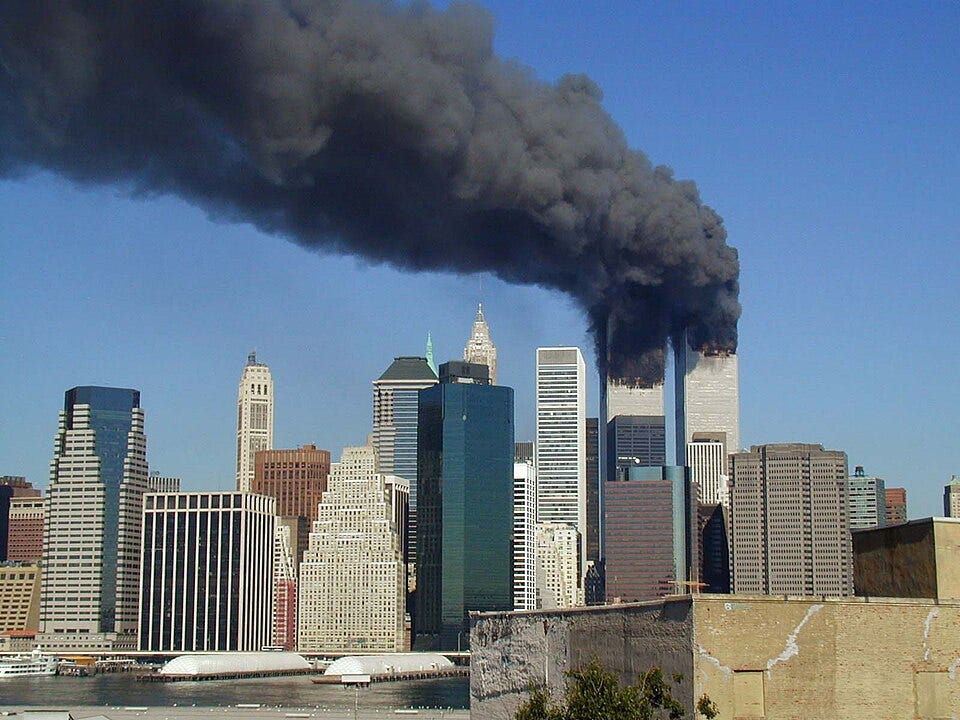
Finally, a bit of media coverage. On Friday’s episode of The Line Podcast, your hosts spent some considerable time explaining the controversy regarding the CBC and the September 11 terror attacks. We’re sure most of you have heard the story by now, but an internal CBC memo was passed on to the Toronto Sun, which published it. The memo reminded CBC reporters and editors not to refer to the September 11 terror attacks as terror attacks without attribution to an expert source. In other words, instead of saying, “the 25th anniversary of the 9/11 terror attacks,” CBC would instead say something like, “the 25th anniversary of the attacks on the United States, which experts have called terrorism.”
This led to quite the online tizzy, because it looked like the CBC was denying the very obvious reality of September 11. The real truth was banal, if dumb. The CBC, like many news organizations, has a set series of rules that cover grammatical conventions and policies that are intended to ensure editorial consistency. The CBC’s policies are collected in what it calls the JSP, for Journalism Standards and Practices. One of their JSP policies, going back many years, is that it is not the position of the CBC itself to declare whether or not any act of violence is terrorism. So, it will instead cite others in its reporting. Again, for example, instead of saying, “Today, in a terror attack, a bomb exploded in the city of Whateverville,” the CBC would write that up as, “A bomb exploded today in the city of Whateverville, in what local officials have described as a terror attack.”
The reason for this actually does make some sense. In the middle of a fast-breaking situation, particularly in parts of the world that are seeing military or sectarian conflict, it might not always be clear what an explosion meant. There are also profoundly passionate disagreements about whether an attack is terrorism or legitimate resistance. The CBC’s position is that it does not want to make that decision. It can report what happened without concluding what it meant.
There’s also a more cynical explanation for this. Many stories are written and published by relatively junior staffers who compile news bulletins arriving via news agencies such as Reuters or the Associated Press. In a breaking news situation where there is a sense of urgency in getting that copy published online or into the hands of TV or radio anchors, it is useful to make sure that younger, less experienced journalists are not, on their own initiative, deciding what an event means and then passing a script to a senior to read on the air.
That’s the purpose and explanation for these kinds of decisions, and most news organizations have some version of them. Postmedia itself, as your editors here can assure you, has its own style guides and editorial practices designed to avoid these kinds of situations as well.
That said, we agreed with the thrust of Postmedia’s critical coverage of the CBC’s edict. The original report, in a column by Warren Kinsella, was fair and accurate. But some of the online commentary that followed was not and treated the CBC’s policy as a proactive denial that the attacks were terrorism. That was inaccurate and unfair, as were some of the personal attacks on Basem Boshra, the CBC editor who sent the memo — The Line knows Boshra, and knows him to be a fair and serious professional. Refusing to refer to the September 11 terror attacks as terror attacks without attribution was asinine, but not denialism nor a deliberate insult.
It was a bad call to apply the policy in this instance. The policy here wasn’t helping avoid problems, it was creating the problem, which is what happens when large bureaucracies slavishly adhere to a rule rather than their God-given common sense. The September 11 attacks were almost 25 years ago and are universally recognized as terror attacks. This is not an edge case. 9/11 is actually basically the template example of what we should call a terror attack. Forcing CBC journalists to refer to the apex example of terrorism with the same rule designed to avoid mislabelling an incident that just happened in a country we’ve never heard of and where there’s very little clarity around the facts doesn’t make the CBC and its journalists sound neutral and credible. It makes them sound like morons. It is corrosive to their credibility and that of their employer.
It is proper to have policies that can be used during when covering nuanced cases. It is also important to be able to tell people what actually happened when there is no real disagreement about the facts. There is no meaningful disagreement about the facts of 9/11 outside of conspiracy movements. And the CBC just sounded ridiculous trying to apply this policy to this incident.
And they did belatedly conclude that. Late on Friday, after we’d released our podcast on audio but before the video went live, the CBC announced that they were reversing their policy in reference to the September 11 attacks and would indeed refer to them, correctly, as terror attacks. We think this is good, because it will make the CBC’s journalism about the event seem more credible. We also think it is good because it will deny the Americans something further to beat us over the head with during our ongoing dispute with them. And as you may have noticed last week, prominent Americans were not hesitating to do exactly that.
But in the main, we’re happy, because the job of the journalist is to speak the truth. And while real life is full of nuanced cases, more often than not, it’s not really that hard for us to factually and plainly tell people what actually happened. We’re glad the CBC has come around to that view. And we hope they’ve learned a little bit of a lesson from this.
Thanks, all. Take good care.
The Line is entirely reader and advertiser funded. No federal subsidies, no bailouts. If you value our work, please consider supporting us by subscribing or making a donation. Donations are not subscriptions and do not unlock paywalled content, but they help keep The Line independent

To contact The Line with a general inquiry or comment, please email info@readtheline.ca. For other ways to connect with us or to follow us on social media, please see our LinkTree.
A reminder that this past week we marked 81 years since the end of the Normandy Campaign, and the liberation of Paris in what experts have described as a war.
I don't agree with your soft-pedalling of the CBC and Boshra in your segment on "terrorist". If it was a one-off it would be one thing. But it is not. This is classic CBC. Boshra believes the huey he said in his memo about 9/11 not being a terrorist attack. Which is crazy. And just because he is your buddy, that doesn't mean you back him up on this issue. Marc Miller - Minister responsible for the CBC said it best - the CBC position was "pedantic and foolish".