

The Line welcomes angry rebuttals and responses to our work. The best will be featured in our ongoing series, Flipping the Line. Today, Peter Sealy on why a design competition to restore 24 Sussex is good, actually
By: Peter Sealy
As an architectural historian, I steeled myself for Jen and Matt’s thoughts on the decision to rebuild the Canadian prime ministerial residence at 24 Sussex Drive (The Line Podcast, June 26). Could I stomach their takes on contemporary architecture? Yet as I listened, I found my ambivalence towards this crumbling Victorian pile fade into general agreement with their positive reaction to Prime Minister Mark Carney’s announcement. This should have been fixed years ago. As a matter of elementary state capacity, the Canadian government should keep its buildings in good repair and provide an appropriate residence for our head of government.
Canadians may not agree on what needs building in our country right now, but getting 24 Sussex fixed would be a good start, a down payment on the rest of what must be done.
But while Matt and Jen supported the rebuilding plan in general, they pooh-poohed the decision to hold a juried design competition. For them, it signified needless delay and risks diluting the artistic vision necessary to create a great work of, ahem, neo-Châteauesque architecture.
I disagree. A juried design competition is exactly the way to avoid bureaucratic inertia, the very sclerosis which seems to afflict our efforts to do just about anything these days. It is an excellent move to take the ultimate decision out of government hands and to vest it with Canadians of exceptional talent and judgment. This provides the best hope for an exceptional result. The Canadian podcasting intelligentsia should get behind the competition and make sure its result is carried out.

What is a design competition? While these can take many forms, they are premised on the idea that architects submit designs and an independent jury will choose the best one. In some competitions, the entries are anonymous; in others, the capabilities of the entrants are also considered. Some may be limited to firms meeting certain qualifications, or those invited by the jury. Certain competitions may deliberately focus upon a project’s conceptual design (the first sketches, if you will), while others will call for fully flashed-out proposals.
It was through an anonymous design competition that a 22-year-old Yale University student, Maya Lin, was chosen to design the United States’ Vietnam Veterans Memorial. The result was the most meaningful work of architecture built in North America in the 20th century. It was also through a competition that a spectacular design for an opera house by an unknown Danish architect, Jørn Utzon, was chosen to grace Sydney’s harbourfront. In both cases, it is almost unimaginable that Utzon or Lin’s designs would have been chosen or built without the independent selection process and validation provided by the competition. The competition brought to light that which could hardly be imagined beforehand.
Closer to home, a competition led to the selection of Ron Thom’s design for Massey College, that great jewel of mid-century Canadian modernism melding traditional and contemporary styles. It is also through competitions that Québec has realized an excellent series of recent public buildings and the city of Edmonton has become a paragon of exceptional civic design. A competition offers an alternative to a race-to-the-bottom of lowest-bid procurement. Canadians are all too familiar with the mediocrity which ensues.
The makeup of the jury for 24 Sussex competition is excellent, and suggests someone somewhere in Ottawa knows what they are doing. Moshe Safdie authored one of Canada’s most famous buildings — Montréal’s Habitat 67 — at another historic moment when our government wanted to balance uniquely exceptional architecture with model housing for all Canadians. Brigitte Shim’s buildings are exquisitely detailed, as anyone who has gone for drinks at Toronto’s Ace Hotel will attest. While built for the site-specific context of a Toronto Ravine, her Integral House (2009) would provide an exceptional residence for any head of government. Nicolas Demers-Stoddard designed an exceptional visitors’ pavilion for Québec’s National Assembly, revealing his aptitude for balancing public representation with practical concern, all in the shadows of a historic monument.
Most importantly, the jury features Edmonton’s city architect, Carol Bélanger. What Bélanger has achieved in Alberta’s capital is truly remarkable. Under his watch, Edmonton has built excellent civic buildings, the equal of anything to be found in global architectural hotbeds such as Japan, Switzerland, or Mexico. The Borden Park Pavilion, the Kathleen Andrews Transit Garage, and the Widdermere Fire Station # 31 — all by Toronto’s gh3* — are buildings of exceptional qualify that dignify the meaning of a “public realm.” It is architecture of this standard that we need for 24 Sussex, and a competition is the way to get it.

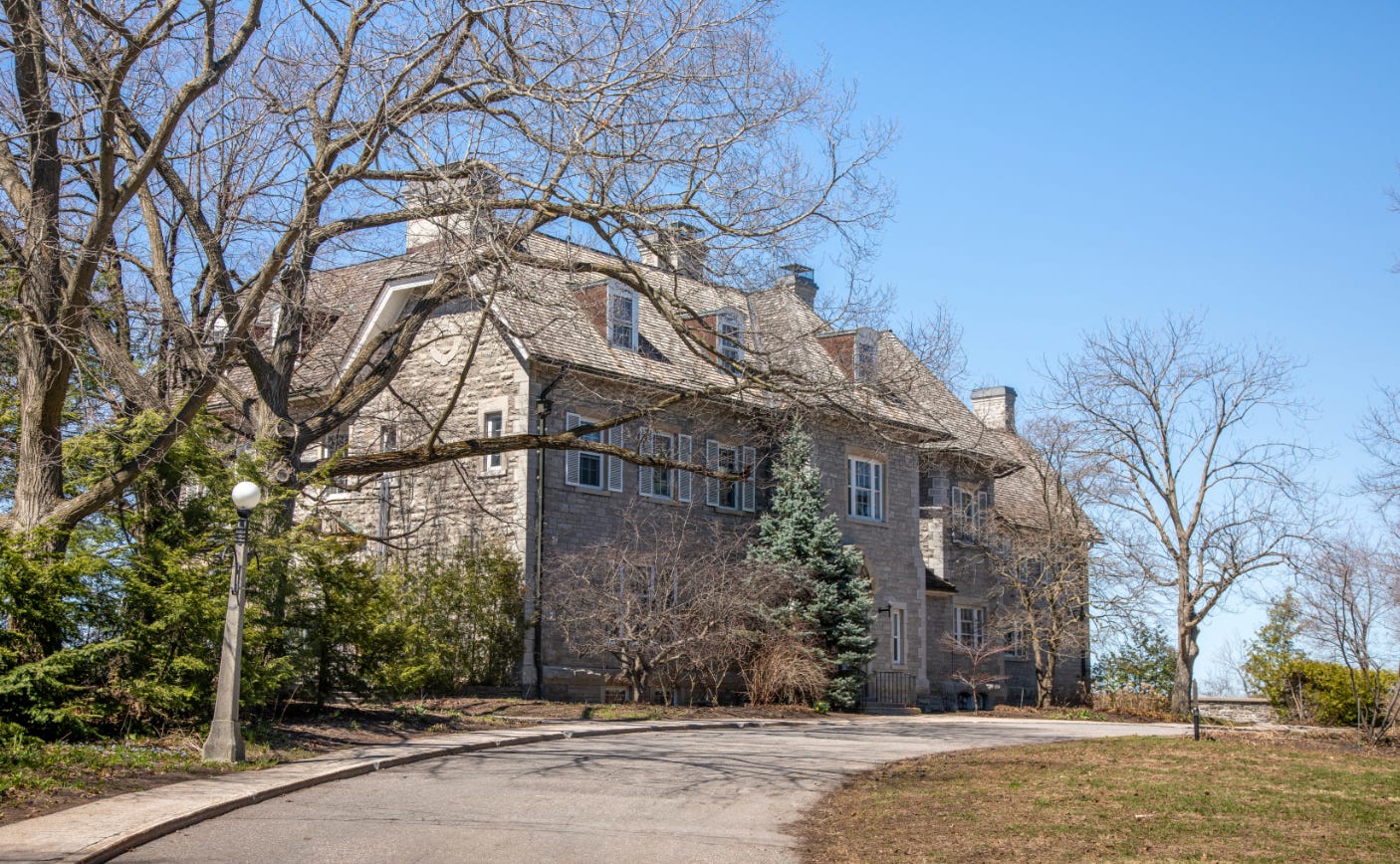
In spite of the many enjoinders to the contrary made by Carney and others, 24 Sussex does not have significant heritage value. It is not a significant work of Canadian architecture, and its historical connotations apply only to its street address. Our Prime Ministers have almost uniformly disliked living in it. Unlike our Houses of Parliament, few if any Canadians know what 24 Sussex looks like. This is not entirely a bad thing, and it is important that any new residence for our head of government does not challenge the Peace Tower’s primacy as the architectural symbol of Canadian democracy.
This does not mean that 24 Sussex should necessarily be demolished, in part or in whole. That is for the design process to determine. The Canadian construction industry is becoming increasingly sensitive to its ecological impact. Whether as a matter of common economy or out of deference to the embodied carbon within 24 Sussex’s stone façades, it is fair to ask whether some parts are worth keeping, or otherwise recycling. But it is important that a slavish reverence to a middling structure plus good environmental intentions do not produce a mediocre compromise. Another reason for competition aiming for conceptual clarity.
Prime Ministers are afraid of the criticism they will receive for spending public funds on what might seem a private luxury, especially given the central place of housing anxieties within the contemporary Canadian id. Such an attitude has led to the false parsimony which has seen 24 Sussex fall into ruin, and also to Carney’s promise that he himself will never reside in our rebuilt prime ministerial residence. His decision to seek private funding for this endeavour is both understandable and misplaced. This is a government building that should be paid for from the public purse. If desired, a new 24 Sussex could be made open to the public at certain times of the year and could include a small gallery documenting the history of Canada’s prime ministers. After all, Buckingham Palace is a significant tourist attraction in London.
In fact, the only real solution to the inevitable criticism that this project will attract is for the Carney government to do an excellent job overseeing both the rebuilding of 24 Sussex and creating the conditions necessary for much-needed new housing across Canada. As with so many initiatives in the early days of the Carney government, we’re about to find out if the announcement was the policy, or if our government can deliver a single house.
Peter Sealy is an assistant professor and director of the Bachelor of Arts in Architectural Studies program at the University of Toronto’s Daniels Faculty of Architecture, Landscape, and Design.
The Line is entirely reader and advertiser funded. No federal subsidies, no bailouts. If you value our work, please consider supporting us by subscribing or making a donation. Donations are not subscriptions and do not unlock paywalled content, but they help keep The Line independent

To contact The Line with a general inquiry or comment, please email info@readtheline.ca. For other ways to connect with us or to follow us on social media, please see our LinkTree.
I like the idea of a design competition, but NONE of the architects that were cited here fill me with any hope; almost every. single. one. of their designs, with the exception of Massey Hall, is garbage, soulless modernist architecture. My biggest fear is that's what we'll get. It's exactly what happened when the Chateau Laurier tried to build an expansion, it was ugly as shit. It looked like a soulless box grafted onto an architectural masterpiece, then we were all gaslighted when we were told "it incorporates historic elements" by including strips of copper. We don't want modernist bullshit, we WANT an appropriate piece of architecture that matches our history.
Yes. I want a house that's a neo-gothic reproduction and matches parliament. Yes. I want I Victorian style building that would be at home sitting next to the Chateau Laurier. Yes. I want a Gothic-Revival style that would match the churches of Quebec. Yes i want a railway hotel inspired house that would match the Hotels of Banff, Jasper, and Waterlakes National Park. Yes I want a replica Scottish-Baronial style home that would be right at home with the Museum of Nature. I was Canada's house to reflect our ACTUAL architectural tradition.
NO, I do NOT want a Modernist glass façade of straight flat lines like the Chateau Laurier did. No, I do NOT want the simplistic modernist bullshit they're building directly across the street from Parliament as part Block 2 renovations. The IMMENSE public backlash against the Chateau Laurier design shows that Canadians agree. Poll, after poll, support that average people love designs that feature artisanry, not glass faces and straight lines.
Architects seem allergic to honouring the past. And this panel, gives me little hope that we'll see something other than a soulless abomination that at best speaks lip-service to our rich architectural past, and doesn't really represent Canadians at all.
Since I am in Alberta and I have never seen a red maple leaf, looking at 24 Sussex, I can at least see a nexus with those grand CP Hotels in Alberta, and their wonderful architecture, and 24 Sussex. Fix the exterior it and do what you want in the inside. I have had enough with the erusure of Canadian culture and history.