

By: Gregory Jack
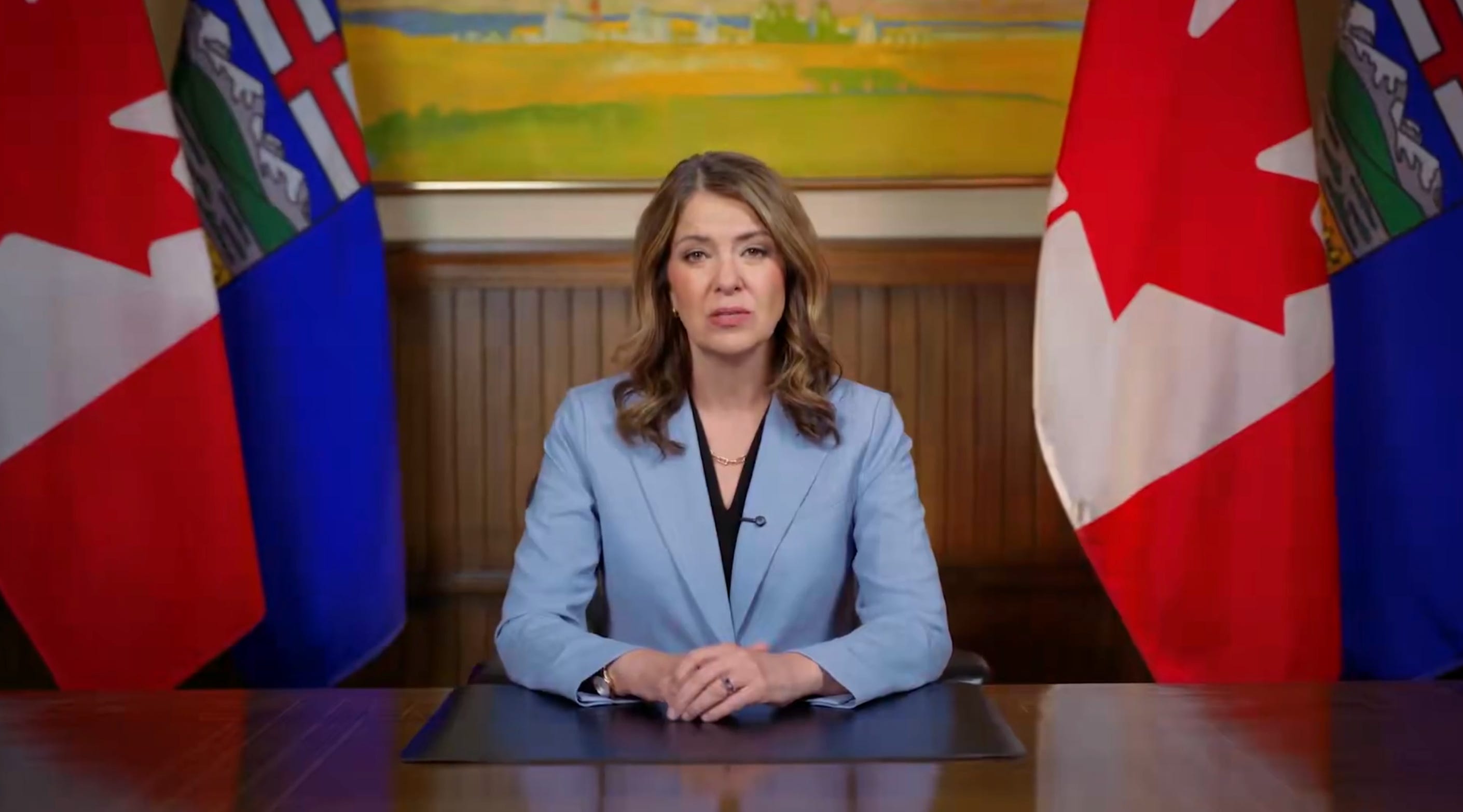
If you’ve ever had the “what’s the state of our relationship” conversation with a partner, you know one option isn’t “let’s stay together” and the other “let’s definitely talk about breaking up, just not right now.” But that’s what Alberta Premier Danielle Smith wants to ask Albertans about their relationship with Canada.
Smith now puts a question in front of Albertans that is not separation, exactly, but the official prelude to a separation question. She is doing so as part of a fall referendum potpourri of policy changes seemingly designed to ensure the premier avoids being taken out by her base.
She likely has good reason to worry; the last conservative Alberta premier to serve a full term was Ralph Klein. Being a conservative premier in Alberta should come with hazard pay.
Thwarted by the courts but still needing a way to ask something about separatism, Smith appears to have pleased absolutely no one, in a most Canadian way. The separatists are mad she didn’t go far enough, and the federalists (a.k.a. most Albertans, according to multiple polls, including our work at Ipsos) are mad we’re going anywhere on this issue at all.
But one person who probably isn’t too mad is U.S. Trade Representative Jamieson Greer. Because Danielle Smith just handed the Americans a powerful weapon in negotiations over the Canada-United States-Mexico Agreement. And for a chunk of the minority of Albertans who will likely vote “yes” to having this conversation later, that may be exactly the point.
In our research, we found that there are lots of reasons why some Albertans identify as separatists. Some, the group we called “symbolic separatists” when Ipsos polled on this issue in January, want to send Ottawa a message. Having seen how effective this approach has been for Quebec over the years, they too would like to hold a knife to Ottawa’s throat. Threatening to leave helped get Quebec concessions and special treatment on a range of issues. These people don’t really want to separate and form their own country, but they definitely want to preserve the option to do so. They may vote the equivalent of “yes” in the fall for that reason.
But the Quebec strategy had costs too, as political uncertainty and constant appeasement of Quebec helped push capital, headquarters and ambition out of Montreal and down the 401 to Toronto. Quebec’s leverage was not free, and the flight of capital and people (including me and my family) after the 1981 referendum is a warning that Alberta should be careful about concluding that political brinkmanship comes without cost.
However, there is another group within the separatist camp, and what they may want most isn’t their own country either. It’s to be part of a different country; to join the U.S. as the “cherished 51st state.”
Back in January, we estimated that Albertans open to joining the U.S. made up about half of the 28 per cent of Albertans who said they would consider voting “yes” to the old question: separate or not? Moreover, they were a large cohort of the “committed separatists,” those for whom the economic cost arguments were not persuasive enough to change their mind about wanting to separate. For these committed separatists, independence may not be the actual end goal. In fact, 70 per cent of committed separatists said they would consider joining the United States. Among Albertans overall, that works out to about 11 per cent, or more than one in ten, who are committed separatists and open to joining the United States. That is nowhere near half of Alberta. But it is not nothing either.
The reasons Washington would care are obvious. Converted into U.S. dollars, Alberta would be roughly a mid-ranking U.S. state by total GDP, but a high-output state per capita. On total GDP, Alberta would not be close to Texas, California, New York, Florida, Illinois or Pennsylvania. But it would be bigger than roughly half the states, roughly in the range between South Carolina and Connecticut on one side and Oregon, Alabama, Louisiana and Kentucky on the other.
So why does this probably make Jamieson Greer and by extension his boss Donald Trump happy when it comes to CUSMA? I can think of several reasons.

First, Trump can (and probably will) revive the 51st-state talk, and now he can say that there are clearly a group of Canadians unhappy enough with being part of Canada that they may just want to leave. (Or at least enter an official process that could lead to that conversation.) Trump can count a sitting premier among those willing to put the question on the official agenda. We were likely going to hear more 51st-state talk anyway, and now Trump has one more reason to raise it.
Second, how can Canada now speak as one united front when the government of one of its most prosperous provinces has forced this conversation? What can Prime Minister Mark Carney and our chief trade negotiator Janice Charette put on the table, or take off it, without thinking whether it will be used by the separatists, or by American backers of the separatists, to advance their agenda? Anything Carney now says or does in these negotiations will have to be evaluated on the basis of “what does this do to national unity in Alberta?”
Canada’s strongest position in CUSMA is that it negotiates as one national economy: energy, autos, agriculture, critical minerals, steel, aluminum, finance, services, procurement, and border management are part of one integrated Canadian offer.
Alberta separatism, and specifically forcing the question onto the agenda, lets Washington now argue, implicitly or explicitly, that Canada is not a coherent counterparty. For Trump, that is useful because his bargaining style rewards visible division. A divided counterparty is easier to pressure: Ottawa has to negotiate with Washington while also managing Alberta, energy politics, national-unity optics, and domestic accusations that it is “selling out” either Alberta or Central Canada. If Carney needs to make a concession that benefits all of Canada but comes at some cost to Alberta, will he hesitate? What about wins that benefit Alberta, but come at the expense of another province? Will this be seen as appeasing Alberta in advance of the fall vote? The U.S. can simply wait for Canada’s internal contradictions to surface.
Third, it may take energy and resource security, Canada’s strongest bargaining chips, off the table. Alberta is not just another province in a trade file. It is central to oil, gas, petrochemicals, agricultural exports, carbon policy, pipelines, electricity, and critical minerals. Energy is also a major reason the U.S. can complain about a trade deficit with Canada in the first place. The President is fond of saying that there is nothing Canada has that the U.S. needs. But that isn’t true. He does need, and want, our energy resources. Whether or not this was Smith’s intent, the effect is that she has made it harder for Carney to use Albera oil as leverage with Washington. Any serious threat to restrict or redirect energy exports now risks being seen as proof for Alberta separatists that Ottawa really is against them, and willing to sacrifice the province in the process. If separatist politics makes Alberta appear politically separable from Canada, Washington can start pricing in Canadians concessions as two things: concessions from Ottawa, but also potential access to Alberta through another channel.

That is damaging for Canadian negotiators because Canada’s energy leverage depends on the premise that Alberta’s resources are Canadian strategic assets. If U.S. negotiators believe Alberta’s political class, or a significant faction of it, may prefer deeper U.S. alignment, or are negotiating partly to appease Alberta separatists, then Ottawa’s ability to use energy interdependence as leverage is as good as gone. The U.S. does not need Alberta to actually separate for this to matter. It only needs Ottawa to believe that U.S. encouragement, recognition, investment signals, or informal contacts could intensify Alberta’s domestic pressure. The U.S. has already openly meddled in this conversation with sympathetic words for the separatist side and there’s no reason to believe Washington will discourage that from continuing leading up to the fall vote. Doing so seriously advances their own strategic interests.
Smith likes to say she supports a strong Alberta within a united Canada, and I take her at her word that she is a federalist. But her actions also point in a different direction. Whatever her reasons, she’s handed the Americans some ammo and put Carney in an awkward spot.
We are going to hear a lot more in the coming months about separatism and national unity. At best, this is a distraction from the many problems we need to solve, including trade with America. At worst, it is the opening Trump needs to bludgeon us in negotiations while advancing his broader territorial ambitions. It is worth remembering that joining the United States appears to be the actual end goal for some of the people currently calling for Alberta to become an independent state.
This is why the referendum is dangerous. It isn’t likely to produce a majority for a second, official referendum, and Alberta is not likely to leave the country regardless.
But it is going to suck the oxygen from the room. It will expose division, raise investor uncertainty, and signal to our predatory neighbour, already eyeing our assets, our territory, or at the very least a better trade deal, that Canada is a soft target. It also makes it politically impossible for Ottawa to use energy as leverage in CUSMA without feeding the very separatist sentiment Smith has now insisted on putting to a vote. Taking oil off the table in negotiations, at the expense of also taking Canada off the table for global foreign investment, is a hell of a trade-off. For about half of those yes voters in our previous poll, and a strong majority of the most committed separatists, that may be part of the plan. For everyone else — all Canadians, not just Albertans — we may be about to pay a steep price.
Gregory Jack is senior vice president with Ipsos Public Affairs (Canada).
The Line is entirely reader and advertiser funded. No federal subsidies, no bailouts. If you value our work, please consider supporting us by subscribing or making a donation. Donations are not subscriptions and do not unlock paywalled content, but they help keep The Line independent

To contact The Line with a general inquiry or comment, please email info@readtheline.ca. For other ways to connect with us or to follow us on social media, please see our LinkTree.
The reality is that our very own Liberal governments have done far more harm to Canada than Donald Trump has. The Liberals have also betrayed the Canadian people with mass immigration. They no longer get to demand silent obedience. If the Liberals can't keep the country united, that is a measure of their incompetence, not of Smith's (or other Canadians') misbehaviour.
I take the author's overall point. But I feel I have to point out the fact that for the most part oil is already "off the table" as a bargaining chip because the Americans already know that they have us over a barrel on that count. We need pipelines ... plural ... and to every coast. This is the only practical way to give us real options in terms of selling our oil to customers other than the US. Canada's failure to do this when we had the chance has done more damage to our bargaining position than any Alberta separatist drama will.
Years ago some of us were pointing out to anyone that would listen that pipelines are not just about making money, but are in our national interest. Canada didn't "need" a transcontinental railroad in 1881 either. There was already one transcontinental railroad (and something like 3 more on the way) that we could have hooked up to by simply building some lines south into the US. Canada built railroads largely because it served our national interest to do so. The fact that so many Canadians failed to see the importance of doing this in regards to pipelines is not on Alberta. And the subsequent weak bargaining position we now hold in terms of energy policy is also mostly on the feds, BC, Quebec, environmental activists, and all others who railed against pipelines and other energy infrastructure to tidewater.
I am not a separatist. But I certainly understand why so many of them find this so absolutely galling. As much as I wish we were not having this referendum, to pin Canada's poor bargaining position in terms of energy on Alberta is simply not fair or accurate.
To the rest of Canada: We. Warned. You. And you sneered, laughed, and said there was no business case. And so here we are. Bent over the very barrel that some of us tried to warn the rest of Canada about. The rest of Canada needs to own their part in this awful position in which we find ourselves.