

By: Jen Gerson
It’s hard to know what to make of Pierre Poilievre’s speech at the Conservative convention this weekend except to note that there is more information to be gleaned from that which was not said than that which was.
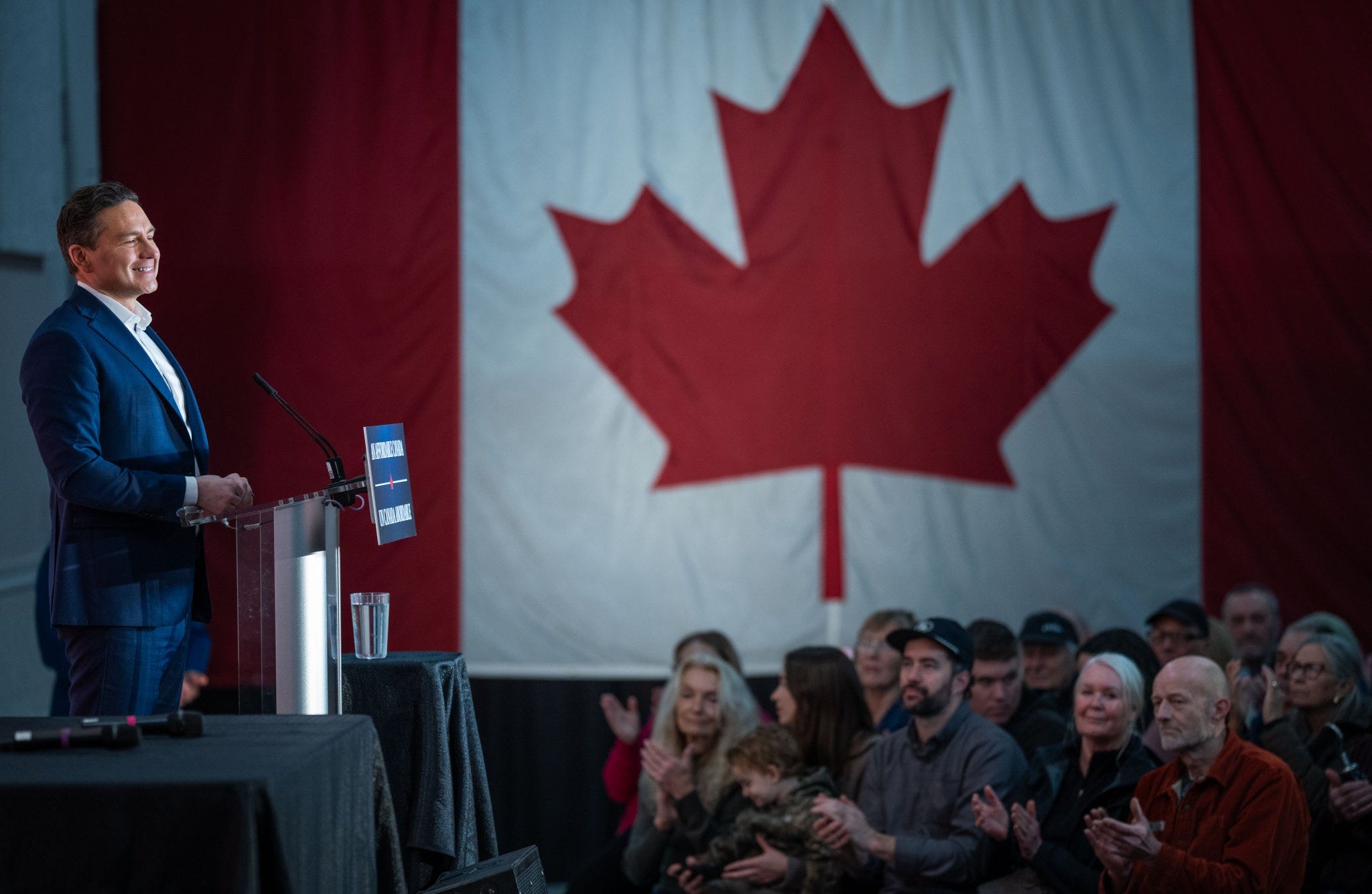
On the one hand, it should be noted, the leader’s address to the faithful was conventionally conservative, tonally appropriate, and entirely safe.
He avoided his trademark acid smarm. The alliterative potshots. Instead, this was a post-election re-introduction that focused on domestic issues like cost of living, taxation and red tape. There were a few planks that warrant a special note; Poilievre would introduce a castle law, and a moderated version of a three-strikes system. He wants to expand Canada’s defensive capabilities, especially in the Arctic.
Poilievre also began to articulate a long overdue post-post national identity.
“We want a nation where all of us are equal, a nation that is colorblind. We want a nation with no more hyphens; no more group labels. We are all Canadians,” he said.
If any of this was proof of Poilievre as “Trump-esque,” as the New York Times put it, in all truth, I fail to see it. If there were populist elements to his speech, they were rationally softened.
What was most interesting was that which was not in Poilievre’s speech.
Firstly, the lengthy address offered no contrition, and no real understanding of how and why the Conservatives blew one of the most astonishing leads in recent Canadian electoral history. To hear Poilievre, the last election was a smashing success — as proven by the fact that the Liberals stole all of the Conservatives’ policy.
“The best part of being Conservatives is that eventually everyone admits that we were right all along,” Poilievre quipped. Though this quote was intended to highlight Conservatives’ prescience, it could just as easily be read as a rebuke to the leaders’ critics.
“I nailed it, naysayers. You just wait.”
Never mind that this boast carries within it the best argument for the Conservatives’ own redundancy. I mean, if the governing party is just going to steal all your best policies, why should Canadians bother to vote for you? Pick the Technocratic Daddy whose faves/unfaves outrank Poilievre by nearly 20 points. Keep the Conservative policy. Best of both worlds, really.
Does Mark Carney make a cartoony “yoink” sound when he grabs the latest policy cuckoo egg? Is he a wily coyote?
“The governing party steals all our ideas” is the kind of humblebrag best made by a think tank, not a political party.
Then there was that touchy matter of separatism. Poilievre pulled a crafty rhetorical sleight by blaming the rise of separatist sentiments in Alberta and Quebec on a decade of Liberal rule. This is valid. It’s also a deflection. The call is very much coming from inside the big Conservative tent on Alberta separatism, and while Poilievre made a credible case for federalism and national unity, that case wasn’t strong enough to extend to outright condemnation of the pointless nihilism of separation as a project.
Poilievre is demonstrably capable of taking enormous amounts of abuse from his enemies, perceived and otherwise. I rather admire him for this. I just think it would be more impressive if he were equally willing to handle the same kind of flak from his friends.
And on that note, we come to the other glaring omission in his speech: Donald Trump.
I’m not even sure what more can be said about this. Failure to address the ailing 8,000-ton elephant on the continent is just laughably untenable, and yet here we are. Still.
If there’s any strategy to it — beyond not wanting to piss off the section of his base that clings to the fantasy that Donald Trump is actually a brilliant comic genius hellbent on reshaping a corrupt global world order to the benefit of all — I suspect it’s a bet placed on the assumption that the U.S. president is an aberration. A bet that sooner or later the Americans will rebound democratically, and everyone will calm down. Then we can all go back to some kind of new normal.
At that point, the Conservatives who have spent years hyperfixating on the literal price of bread and butter will be a welcome relief to the ceaseless geopolitical maneuvering of the Davos set.
Or, you know, the other thing will happen.
American politics could get much, much worse. And after several years of serious economic hardship, Canadians will collapse into a state of fatal resignation and submission. We will cease to concern ourselves with affairs better managed by our hegemonic overlords and focus instead on the limited domestic matters that remain within our control. Like, again, the price of bread and butter.
Whether he acknowledges it or not, these are the moments Poilievre is positioning himself for. He’ll be proven right, eventually. Conservatives are always proven correct in the long run, just ask them. You’ll come back to him. Just wait.
And, you know, I can’t even argue that he’s wrong. Those moments might, indeed, come around. The Americans probably will recover in time. Or we might get tired of keeping our elbows up. I don’t know.
But I do think that the last few months, capped by this speech, offer some insight into Poilievre and the movement he leads.
What I consistently see is a party that puts the locus of control outside of itself. Its leader is the avatar of this tendency.
Poilievre doesn’t meet the moment; he waits for it. He has a good feel for timing and a sharp eye for identifying opportunities — but not creating them. He rides the momentum, but he doesn’t create it.
We’ve heard a lot of this from Conservatives attempting to justify an astonishing loss in the last election — if, indeed, they even acknowledge it as such. It wasn’t their fault, no. The Liberal media is out to get them. They ran a perfect campaign; they were just unlucky. Everything went off without a hitch, they just got blindsided by Donald Trump — a force beyond their control, and something they couldn’t have predicted.
It’s a lot of passive voice.
It’s never: “how could we have made this campaign better?” or, “alienating the mainstream media limited our voter pool, how do we rebuild those relationships?” or, “why did we fail to see this coming, and how can we prevent that blindspot from recurring?”
No, the control is always elsewhere. It’s something other people have. They are the party things happen to. The Conservatives are the slowly attenuating island upon which the waves of history break.
And, hey, maybe history is about to break their way. It could happen any day now. Just wait.
The Line is entirely reader and advertiser funded — no federal subsidy for us! If you value our work, have already subscribed, and still worry about what will happen when the conventional media finishes collapsing, please make a donation today. Please note: a donation is not a subscription, and will not grant access to paywalled content. It’s just a way of thanking us for what we do. If you’re looking to subscribe and get full access, it’s that other blue button!

The Line is Canada’s last, best hope for irreverent commentary. We reject bullshit. We love lively writing. Please consider supporting us by subscribing. Please follow us on social media! Facebook x 2: On The Line Podcast here, and The Line Podcast here. Instagram. Also: TikTok. BlueSky. LinkedIn. Matt’s Twitter. The Line’s Twitter.Jen’s Twitter. Contact us by email: lineeditor@protonmail.com
Funnily enough, this kind of loser talk reminds me of the NDP and the Greens. Think of how Jagmeet Singh now claims that he made a conscious decision to sacrifice the success of his party to stop Poilievre - which comes across as an attempt to retroactively justify his poor leadership performance. I have also seen Green Party members in the past make points along the line of, "We would rather be principled in influencing government from the sidelines, than form governments ourselves."
If your political party's intellectual well is drying so rapidly that the government can "steal" a few of your ideas and you have virtually nothing novel left - or you are reduced to a petty debate on how "they're not implementing our policies with x degree of perfect calibration" - then there really is no one to blame for your party's misfortunes except yourselves!
Can we please do away with this blind, unqualified narrative that the CPC blew a 25 point lead? At their peak, the CPC was polling at about 43% while the LPC was at 18%. There is no realistic chance that the CPC could ever get anything meaningfully more than that 43% anyway. And in the election, they ended with about 41% of the vote - hardly a blown lead. The fact that the NDP collapsed completely and the Libs have a far more efficient voter distribution than the CPC can and should factor into any "blown lead" evaluation. Which is why I question the blind reduction of the entire election to "CPC blew a 25% lead".
In fact, the bigger question is how can the LPC, with ~44% of the votes in a favorable distribution actually fail to achieve a majority? That is, objectively speaking, a bigger failure.