
By: Joel Mckay
Canadians are right to zero in on the impacts U.S. gunboat diplomacy in Venezuela could have for our domestic energy sector.
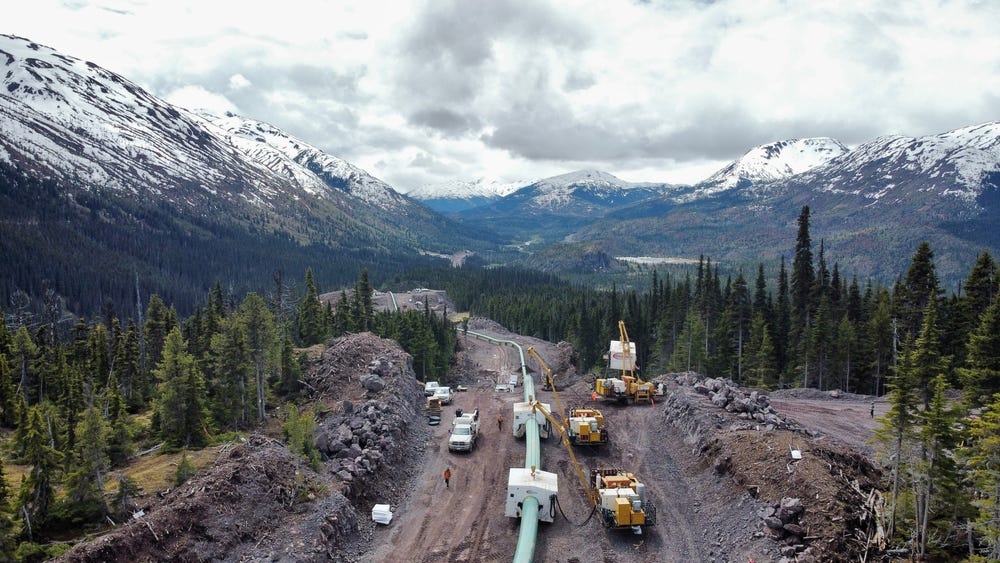
The abduction of Nicholas Maduro will pressure the federal government to get a bitumen pipeline built to tidewater — and it appears the growing consensus is to blunder into the wilds of Northern B.C. wielding the government’s new major projects office as the tip of our collective ‘elbows up’ spearpoint.
Cool.
I support it.
But I’m also a fan of The Simpsons and well-versed in small towns and rural development.
Every time I hear the term “major project” the monorail song rings through my mind (“I’ve sold monorails to Brockway, Ogdenville and North Haverbrook!”)
Allow me to provide a crash course on Northern B.C.’s major projects record as a darkly amusing but genuine attempt to impart some advice as a person who has committed his career, family, and art to this place.
I love Northern B.C.
I support major projects.
But this place is a boneyard of industrial development come-and-gone; a treasure hunter’s wet dream of natural resource wealth that far exceeds any other single location on the continent in the volume, diversity and grade of its resources.
Yet also it is a maddening, balkanized collection of mountains, rivers, lakes, tangled sub-boreal and coastal forest, large toothy predators, and misty coastlines ending with a portion of the North Pacific named for the Greek goddess of witchcraft and ghosts.
I’m certain that was a warning.
It’s also home to civilizations that archaeological evidence would suggest predating the last glacial maximum, and a collection of towns built for resource extraction that take pride in competing with one another.
And did you know we almost had our own monorail once?
In the 1950s, the W.A.C. Bennett government provided support to a Swedish industrialist who dreamed of building a 650-kilometre monorail from the central interior to the Yukon border to unlock the north’s vast resource wealth.
It didn’t happen.
Another dreamer was Charles Hays, who got the financing to build the Grand Trunk Pacific Railway across Northern B.C. leading to a hoped-for world-class port at Prince Rupert.
Unfortunately, after visiting London to secure needed capital when costs overruns became a problem (always a problem in Northern B.C.), he bought a ticket on the Titanic for the return trip, and his dream sank for a century.
In the late 70s, a company built a whole town in the northwest to serve a molybdenum mine—Kitsault operated for two years before prices crashed, and everyone was kicked out of their homes and told to leave the furniture.
North of there is Cassiar, once a community of more than a thousand people built to serve an asbestos mine.
All that remains now are ruined houses and a slag heap so large it could have its own downhill ski run.
We like to build industry towns in Northern B.C.—Kitimat, Granisle, Mackenzie, Tumbler Ridge, all of which bear the scars and resilience of boom-and-bust cycles.
We also seem to attract dreamers, treasure hunters.
During the commodities super-cycle of the 2010s, it seemed every week there was a new proposed LNG terminal.
Thousands of jobs were promised, and a prosperity fund for all.
One got built, and now, finally, more are underway.
Around the same time, Northern Gateway was in the headlines, the proposed bitumen pipeline from Alberta to Kitimat.
It was and remains a solid project but fell victim to an early poor understanding of how to do business in B.C. and deeply splintering protests in communities from the Rockies to the coast.
Even a free-market provincial government couldn’t publicly get behind it.
Its backers didn’t understand the geography or what it meant that this is a province with few treaties, the home of nation-altering case law such as Calder, Sparrow, Haida, Delgamuukw, Tsilhqot’in, and more recently Yahey, Cowichan, and now DRIPA, to say nothing of the protests on Athlii Gwaii or Clayoquot
The same province Greenpeace was founded in, and where the Central Coast Timber Supply Area was rebranded the Great Bear Rainforest and used to argue for a formalized north coast tanker ban.
So then, newspaper baron David Black showed up with a proposal to build a refinery in Kitimat to the tune of $25 billion as the province got sucked into the raw exports versus value-added product argument.
It didn’t move ahead either.
Nor did other big ideas such as the third longest runway in North America in Prince George to attract tech stop traffic from Asia, or the proposed hemp manufacturing plant, or the polyethylene plastics plant, or the promised hydrogen boom.
And we’re all still waiting for the long-promised revolution of mass timber production in our forestry sector.
Meanwhile, there’s not enough fibre available to run a full production line at most sawmills these days.
Did I mention current U.S. cabinet minister Robert F. Kennedy Jr. spent time in the Stikine watershed and wrote the afterword for a beautiful book that contributed to further conservation efforts there that curtailed major projects in B.C.’s touted golden triangle?
Small world.
Look, if you’ve read this far, you’re either howling with laughter, readying to write me an angry letter, or I hope, honestly invested in this topic to the end.
So here it is:
I recently reached out to a friend who tried to get one of these pipelines built in years past and asked what his advice would be.
He said this:
Get on the ground in coastal B.C., base yourself out of Terrace.
Ignore the interior and Alberta until you have the terminal decided,
And don’t worry about the shipping route for now.
In other words, show up.
Be here.
Recognize the hard parts and do them first.
Despite my feeble attempts at humor, there’s an extensive history of major project success here too — the region was built on it.
But make no mistake, if you want to build big here you’ve got literal and figurative mountains to climb and a lot of people to build relationships with.
I’m not the only one with the monorail song echoing in my head.
Joel McKay is the City Manager with the City of Quesnel and Chair of the Board of Governors at the University of Northern British Columbia. He’s the former CEO of Northern Development, British Columbia’s largest economic development trust, and moonlights as a writer of poorly selling but terrifying stories.
The Line is Canada’s last, best hope for irreverent commentary in a boneyard of boring. We reject bullshit. We love lively writing. Please consider supporting us by subscribing. Please follow us on social media! Facebook x 2: On The Line Podcast here, and The Line Podcast here. Instagram. Also: TikTok. BlueSky. LinkedIn. Matt’s Twitter. The Line’s Twitter.Jen’s Twitter. Contact us by email: lineeditor@protonmail.com.
The one advantage that Alberta has is a decade of experience with the oil and gas industry. Provincially, approvals for projects are pretty much predetermined. The province knows the methods the oil and gas industry uses and industry can plan based on expected outcomes. I contrast this with federal approaches which are poorly structured and often based on environmental studies and conditional approvals.
The "drop in and we will talk" approach reeks of risk for corporations.
Regardless of the type of mine, from a regulatory perspective they are very much the same. The corporation controls the surface for a period of time, should be required to remediate it to an industry standard, and limit the environmental effects to that area. Compensation and approvals should be formulaic, not negotiated. This requires the province, the RM, and all surface rights holders including FMAs, and First Nations to have thought out ahead of time what is required of a generic mine, pipeline, well, etc.
The first step in any resource development project is assessment of risk. Uncertain regulatory conditions put a high risk premium on it.
Heck of a good read.
Forget City Government, lad; you are a writer!!
Want to build a pipeline?
Move your pipeline business to the United States.
Only a fool would invest money in this Country, at this time, given the regulatory, cultural, economic, and political climate.