

By: Matt Gurney
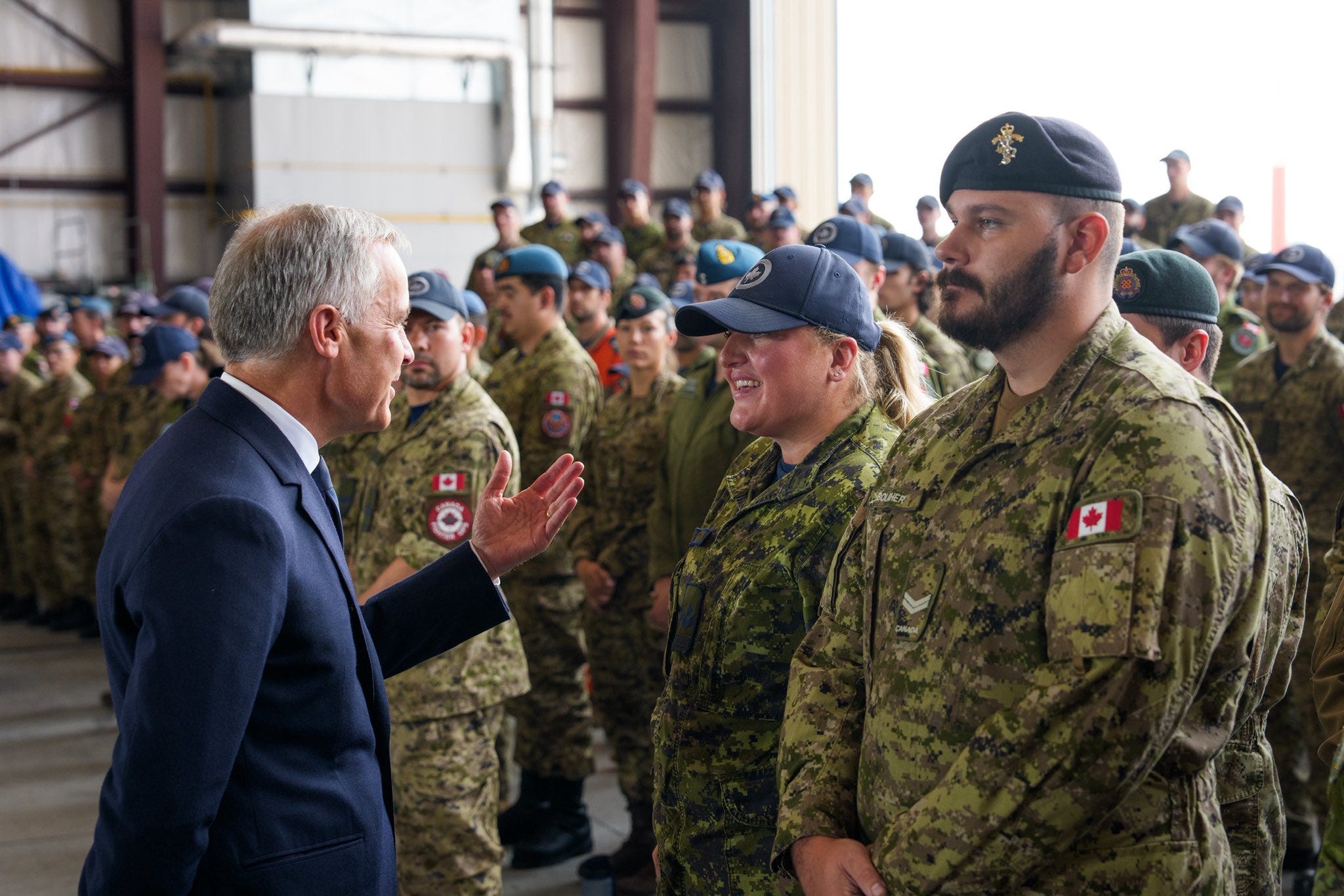
There is a fascinating if glum confession buried inside Prime Minister Mark Carney’s recent announcement, given in the company of Canadian Armed Forces personnel in Yellowknife, of how Canada will spend $35 billion to build and upgrade existing military infrastructure. The major spending announcement was augmented by Carney’s promise to submit four northern road, electricity and port projects to the Major Projects Office for expedited (we hope) approval and completion.
The announcements are interesting, even if the bulk of the military spending was actually just re-announcing stuff Justin Trudeau had announced years ago. Nothing new there, alas. Even so, it was the phrasing of the PM’s remarks that jumped out at me. Striking a familiar tone, Carney said, “We will no longer rely on others to defend our Arctic security or to fuel our economy. We are taking full responsibility for defending our sovereignty.”
I like it! I’m glad we’re doing it.
What the hell were we waiting for? How did we ever get to a place where no longer relying on others to defend our security and fuel our economy became a decisive shift in policy worth highlighting in an announcement?
What was wrong with us?
This is not a column aimed at Carney. I’ve been dismayed and discouraged by a lack of progress on some key files so far, but I will grant that we won’t be able to truly judge this announcement for some time, and that he does at least seem more interested than other recent PMs in getting Canada’s military capability back to where it must be. So, for all the Carney fans out there, you can sheath your swords. I get it. I’ll keep watching and waiting, but my impatience is growing.
But I still think the broader question is still worth asking, even if we agree, for now, to leave Carney himself out of it. Why were we relying on others to defend our own territory? Or fuel our economy? Why were we not taking full responsibility for defending our sovereignty? How did that even happen?
There are some admitted historical factors here, including the fact that Canada was spun up as an independent state out of the British Empire, and obviously counted on the support of that empire for much of our early history. That set a tone, clearly. In more recent generations, there was also the obvious reality that the United States’s desire for continental security was always going to involve a lopsidedly large U.S. commitment, just due to the massive disparity between our populations and economies.
Let’s grant that at the outset. Our history and geography have conditioned us to view domestic defence as a collaborative effort where we are a junior partner even in our own territory — maybe not in a legal sense, but in practical one.
The point here isn’t to lament that Canada never had a fleet as large as the Royal Navy in the 1910s, nor an air force as large as the U.S. Air Force in the 1950s. We can all agree and understand that Canada’s contribution was always going to be more modest and given our massive landmass and air and sea approaches, Canadian defence was always going to be made much simpler with the cooperation of a friendly larger ally or benefactor.
But gosh, we really leaned into the helplessness, didn’t we?
We didn’t have to let the navy’s destroyers and supply ships rust out without replacements. There’s no excuse for allowing a simple process to replace our fighter jets — a process most of our allies pulled off without much difficulty — to turn into a multi-decade fiasco that’s still ongoing. We didn’t need to let our army wither to the point where a huge percentage of our equipment isn’t usable, where key modern capabilities are missing, where many units are understrength, and where senior commanders have been warning in increasingly blunt language that the force is too small to meet existing demands, let alone future contingencies that seem increasingly likely as the world around us goes bonkers.
We didn’t need to accept a broken recruitment system. But we did. We didn’t need to let our procurement apparatus turn into, perhaps, the leading Canadian example of Canadian federal dysfunction. But we did. We didn’t need to let our bases rot. But we did. We didn’t need to let even pretty core and uncontroversial elements of military capability, like search and rescue and training of new recruits, atrophy to the point of crisis.
But we did.
And all those things were choices. Again, I’m not calling for a military fit to conquer the world. I am calling for a military had can competently execute its necessary missions across the whole of our territory without having to rely so thoroughly on the absolute tenacity of our tiny, overworked and underequipped fighting men and women. We are so, so lucky to have them and they deserve so, so much better than this.
And they always have. And it hasn’t mattered. We made a national choice, long ago, that we could afford to shrink our military down to something capable of making minimal contributions at home and token deployments abroad because we simply took it utterly for granted that we’d never really be in any danger. A major war? Our allies would do most of the fighting. An attack on our soil? America wouldn’t stand for that. A disaster at home? Those are rare, and even if they actually happen, our friends will come to our rescue! We’re Canadians, everyone likes us.
And here we are. Our allies, in the main, aren’t much more capable than we are. And there’s no guarantee the Americans are going to ever help us, at least without exacting costs we wouldn’t enjoy paying. As much as it galls Canadians to admit this, Donald Trump has a point when he talks about our inability to defend ourselves and how we’d be better protected as the 51st state. I suspect it pains us largely because we know it’s true and have no real reply.
It didn’t have to be that way. There was no reason Canada couldn’t have chosen a defence policy that recognized that comprehensive continental defence was likely beyond our ability to do alone, but that we could still offer a large, well-trained, well-armed and fully staffed force that used a functional and responsive procurement system to remain competitive with emerging threats.
Whoops.
It’s possible that the unravelling of the entire post-Second World War global order might be enough of a kick in the ass for Canada to get its act together. I actually do believe that Carney sees this issue plainly and understands the problem and wants it fixed. I’m not convinced it will be, but ... it’s possible.
But if we’re going to undo this long-running error, that’s going to require something more than just political will and alarmingly massive piles of cash. It’s going to require some reflection on our part, and a willingness to be honest about our failures. So here’s a dose of that blunt truth: we did this to ourselves. We are prisoners of a big pit we dug on our own and then climbed into. And we didn’t just choose this, we often boasted of it — look at how much health care we can afford because we aren’t imperialists!
Our health care ain’t so hot either, come to think of it, which is one of the more galling parts of it. You could almost understand what we were doing if the rest of the country was running great. “Sure, we skimped on the military, but look at our infrastructure and our hospitals and our national cohesion and our effectively running public services! Look at our diplomatic corps and our foreign aid!”
Friends, we cannot say that, can we? We theoretically prioritized other things. How are those other things panning out? Could be better!
As a country, as a people, we made some terrible decisions, and did it not with ignorance, but with a pretty shocking degree of smug self-satisfaction. This was a massive screw up, an absolutely God-awful multi-generational and totally unforced error, and unscrewing ourselves must start with that admission.
It’s a painful, humbling admission, and those are never fun. It’s the only way to get out of it. And to hopefully ensure we never do it again.
The Line is entirely reader and advertiser funded — no federal subsidy for us! If you value our work, have already subscribed, and still worry about what will happen when the conventional media finishes collapsing, please make a donation today. Please note: a donation is not a subscription, and will not grant access to paywalled content. It’s just a way of thanking us for what we do. If you’re looking to subscribe and get full access, it’s that other blue button!

The Line is Canada’s last, best hope for irreverent commentary. We reject bullshit. We love lively writing. Please consider supporting us by subscribing. Please follow us on social media! Facebook x 2: On The Line Podcast here, and The Line Podcast here. Instagram. Also: TikTok. BlueSky. LinkedIn. Matt’s Twitter. The Line’s Twitter.Jen’s Twitter. Contact us by email: lineeditor@protonmail.com
"Our" "own" territory?
For decades, "we" has been denied, as Canada brings in more and more immigrants loyal to foreign countries. And our state certainly denies there is such a thing as a Canadian people.
In the age of land acknowledgements, Canada explicitly disavows ownership of the territory. Why would we spend money to defend stolen land?
The ideology of the modern Canadian state makes major efforts to defend Arctic sovereignty absurd.
>> Why were we relying on others to defend our own territory? Or fuel our economy? Why were we not taking full responsibility for defending our sovereignty? How did that even happen?<<
Canadians are cheap. Think about it, we are a country that is too cheap to tear down the rat infested prime minister's house. We buy used submarines. We are half-assed and with government's help over the decades, we started to believe our only job was to wear a blue beret and do peacekeeping. That's the image Canada loves to cling to.
It never was real.
This is a country that is too cheap to take care of its veterans. Now with $4.2 billion being slashed from VAC which is perpetually broken and everyone knows it is broken.
Best people I ever worked with.. Veterans deserve better. Why join up in the middle of a recruiting crisis when the government doesn't have your back when you are injured and get out.
I joined the infantry in 1985. I was trained at the height of the cold war when we could get nuked before breakfast
We were cheap then and we are cheap now. I remember going to clothing stores regularly to exchange my worn out combat fatigues for a used set that was only slightly less worn. No blank rounds because of cuts and grown men running around the back forty in their fighting order shouting 'Bang Bang".
Everything Matt pointed out is bang-on 100%.
Self reflection sounds great but we would have to get everyone's eyes off their smart phones for a few minutes.