

By: Matt Gurney
There is a lot happening out there in the world, if I can be forgiven a statement of the obvious. Political upheaval, economic woe, technological revolutions, brutal and devastating wars. Someone like me is amply supplied with writing topics, and then some.
So why can’t I stop thinking about a fictional character, and how sad I am we’ll never see him again?
Sir Patrick Stewart, the British actor, passed away last week at the age of 86, after a short illness. That’s sad. I genuinely felt sorry for his loved ones and friends. But I wasn’t heartbroken about it. The man was 86, had lived a full life, and enjoyed good health almost to the end. We should all be so lucky.
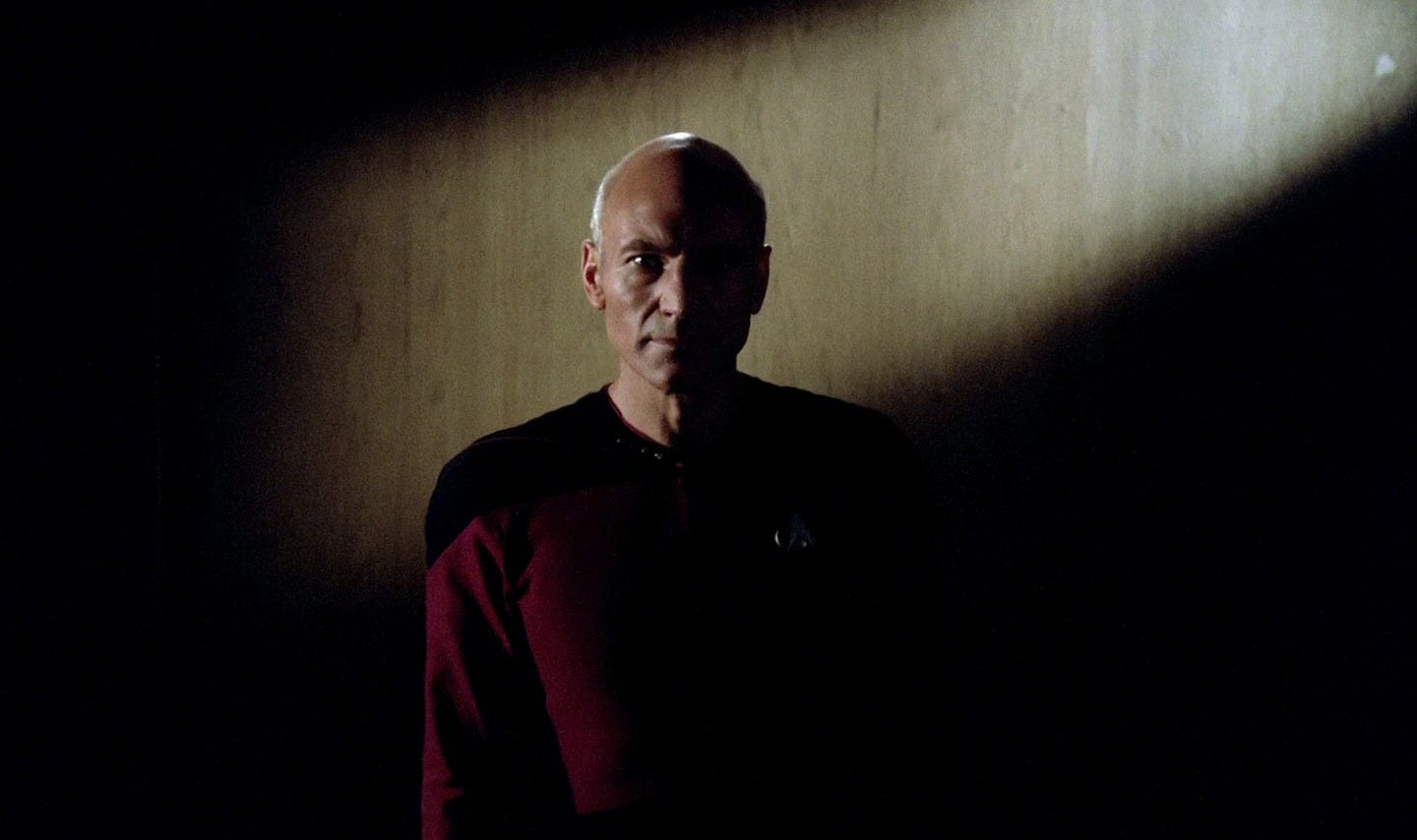
What did get me, though, is that Sir Patrick’s death means the end of his greatest character — Jean-Luc Picard, captain of the Starship Enterprise on Star Trek: The Next Generation and its various spinoffs.
Picard was not Sir Patrick’s first role, far from it. He was well into middle age when he got the part. His career until then had been mostly spent in the United Kingdom, much of it with the Royal Shakespeare Company. Coming over to America to do a sci-fi TV show was just a way to bank some real money before heading home and doing more theatre. No one knew him in America as an actor, and no one really thought that the show would go anywhere. Certainly it wouldn’t match the cultural power of the original series from the 1960s, right?
Wrong. Star Trek: The Next Generation, after an admittedly bumpy first two seasons, became wildly popular, in a way a TV show just couldn’t be today, not with all our attention distributed across various streaming apps. Sir Patrick became recognizable to millions. When the series ended after seven seasons, there were four movies, and then, in 2020, a new show, Star Trek: Picard, brought the character back for three more seasons, showing an elderly Picard, now a retired admiral, getting in a few more adventures in his final years. Along the way, his success as Picard gave him numerous other acting opportunities, and made him a wealthy man.

It also turned Picard himself into one of those special, rare fictional creations — a character that is so beloved by the fans, so inspirational, and depicted so wonderfully over many decades, that the character becomes larger than the actor.
There is a funny little irony here — Jean-Luc Picard and Sir Patrick Stewart were not alike. What follows may sound like speaking ill of the dead, but that’s the furthest thing from my mind; a lot of what I’m about to say is Sir Patrick’s own version of his life (his memoir was quite revealing). He was born poor, raised in an abusive household, never finished much school, and was probably saved by finding acting in his teens. He was passionate about acting but otherwise lighthearted, even a bit silly. In his personal life, he made some poor choices, including wrecking two marriages via infidelity, which he admitted to regretting as he aged. He said he had no real relationship with his children, both from his first marriage; they sided with their mom in the divorce brought about by Sir Patrick’s affair with a younger Star Trek co-star.
But the characters he created rarely reflected any of that frivolity. Sir Patrick himself at times seemed surprised that he kept getting cast as serious, brilliant, thoughtful moral exemplars. He was mature enough to realize that he simply possessed the skill to play those kinds of characters, even while being little like them. He was blessed with other attributes, too: a handsome face, a stern mien, a rich, deep voice ... he was a natural for Shakespeare, and the kinds of characters Shakespeare wrote. He played them well, but he wasn’t those men.
And what a man Jean-Luc Picard was! I was just a kid when Star Trek: The Next Generation premiered, and probably didn’t even start watching it until the third season. That was good timing, as the third season was when the show suddenly got really good. And a huge part of why it was good was because Picard was a wonderful character, and Sir Patrick brought him to life completely.
Picard was not a perfect man. He was standoffish with his peers, and a bit precious and stubborn. He was awkward around children and, often, attractive women. He was largely estranged from his family back on Earth, who had not supported his decision to leave behind the family business (a traditional vineyard) to spend his life in the stars, as an officer in Starfleet, the combined exploration and defensive service of the United Federation of Planets, a democratic union of like-minded worlds of which Earth was a member. Picard could be prideful and even, at times, arrogant. He could be a hard man to like and had a string of failed relationships, wrecked by his single-minded focus on his career at the expense of all else.

But he was an easy man to respect, and in time, love. Jean-Luc Picard was principled, even when those principles cost him. He had integrity, and held himself, his subordinates and even at times his superiors to the standard they all claimed to share. He would use violence when needed, but only when needed, and only as much as required. When he had to fight, he’d fight ferociously, and with true military genius, but even his victories were tinged with regret — he lamented the loss of life, especially if he was the one forced to take it. He protected the weak from the strong, even when the strong were wearing the same uniform as him. He believed in justice, and despite the unavoidable military missions he’d sometimes be assigned, his true passion was exploration and learning, particularly the history of both Earth and other worlds. If he hadn’t been a starship captain, he’d have been an archeologist.
It’s hard to imagine a much better role model than that! And Sir Patrick stepped into that part like he’d been born to play it. He made Picard one of the great characters in science fiction.
Sir Patrick played Picard for more than 30 years, and over that time, the character evolved, as it should have. He mellowed, and allowed himself to overcome the painful losses of his early career and draw closer to his shipmates. He became more open to romance in his later years, not wishing to be alone. As shown in the three seasons of the Star Trek: Picard series, he also became, as men sometimes do, embittered by advancing age, unable to stop thinking about the things he wished he’d done better, or stop grieving the losses he’d suffered along the way. Indeed, those last three seasons were largely about him finding a way to make peace with a life that had been imperfectly lived, finding happiness himself and helping those around him, including Starfleet and the entire Federation, be better versions of themselves, too. One could wonder if some of Sir Patrick’s life was bleeding through onto the page, there.
No matter. Picard was someone you could believe in, which is strange, since it’s hard to believe that such a man could ever thrive today. In an era of bitter social division and cultural conflict, we have come to accept that even moral people will only be able to do little bits of good while having to tolerate a lot of bad. We expect institutions to fail and become corrupt and for the good people inside them to simply tolerate what they must, or give up and move on. We have come to abandon hope that there are still people out there who’d dare to say, no, this is wrong, and I will not support it. And we certainly don’t expect those people to be heeded if and when they do.
Star Trek is science fiction, of course. But in recent years, as the world has fallen apart around us, it’s not the warp drives and deflector shields that seem so impossible. It’s men like Picard. Honourable, principled men, bending the universe to the cause of what’s noble and right by the sheer conviction of their arguments, and, sometimes, maybe with a bit of justified, proportional force. One of the bitter ironies for me in recent years has been watching our space technology rapidly progress, making something like a Star Trek future seem more possible in terms of the gizmos and gadgets, while also seeing us largely revert as a species, moving further away from what Picard embodied.
I think that’s why last week’s news hit me so hard. We didn’t just lose an actor, or a character. We lost a reminder that once, not all that long ago, it seemed possible that that was our future — not the starships and the transporters, but the morals, the values, the courage and the accountability.
Sir Patrick Stewart will be missed by his family and friends. Jean-Luc Picard will be missed by Star Trek fans. But me, just speaking for myself? I miss the belief that one day, the world would belong to men like that Starfleet captain. Because we need them more than ever. And they’ve never seemed more make-believe.
The Line is entirely reader and advertiser funded. No federal subsidies, no bailouts. If you value our work, please consider supporting us by subscribing or making a donation. Donations are not subscriptions and do not unlock paywalled content, but they help keep The Line independent

To contact The Line with a general inquiry or comment, please email info@readtheline.ca. For other ways to connect with us or to follow us on social media, please see our LinkTree.
Very well said.
Not to impugn the rest of TNG’s ensemble, but Stewart carried the dramatic centre of that show entirely on his back. TOS was split between Shatner and Nimoy, and to a lesser degree, Kelley.
To quote “The Inner Light” (which destroys me every time I watch it):
“If you remember what we were, and how we lived, then we'll have found life again. Now we live in you.”
A loving tribute, Matt. 🖖 Recall, though, that even in the Trek timeline, we have to make it through Supervillain Space Fascism to get to Meritocratic Galactic Technocracy. Here’s hoping the midterms put the Bell Riots era behind us!