

By: Matt Gurney
A day or two ago, I found myself thinking about the state of the Royal Canadian Navy. Because, I mean, hey — who doesn’t?
Anyone who has paid much attention to my work will be aware that I’m not exactly bullish on our country’s ability to get much done — especially on the file of military procurement. Yet, a day or two ago, I found myself thinking about the state of the Royal Canadian Navy and feeling something almost like … hope? Is this what hope feels like?
There is a lot going on in Canadian naval news, and that fits a broader pattern. There’s a lot going on on the seas globally, and, somewhat to my surprise, Canada seems to be doing a pretty good job — could be better, but could be worse — adapting to the new reality.
Let’s set the stage globally first. A lot of writing on military affairs these days is focused on newer technologies and emerging weapons systems. Drones are a big one. But it’s important to remember that the Earth is an awfully wet place. Most of the major conflicts or potential conflicts rocking the world today have at least some meaningful oceanic or coastal component — about the only exception I could think of was the recent (ongoing?) Gaza War, where naval activity was largely confined to Israel patrolling the Gazan coast and occasionally redirecting Greta Thunberg.
You don’t need to know a lot of military history to know that true global power has generally required true naval power, however it would be defined in that era. The American fleet kept the seas open and mostly safe since the end of the Second World War — but with a shrinking number of active ships and, notably, an atrophied shipbuilding sector.
The U.S. seems bent on reversing that decline, and the rest of the world is noticing. And, if you buy the theory that we are moving decisively out of an era governed by post-1945 geopolitical norms — I extremely buy this theory — then navies are going to become important again, very quickly.
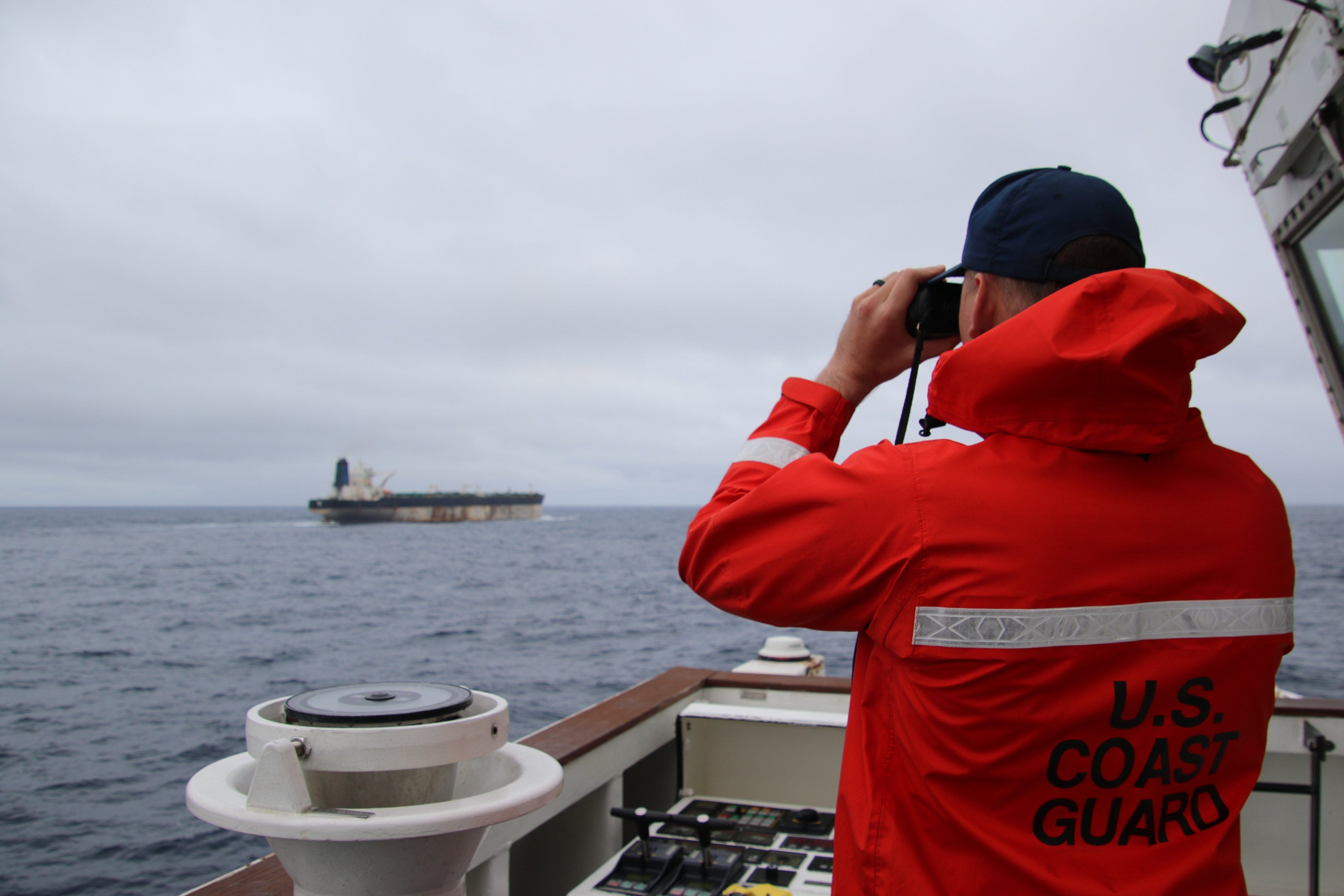
Of course they are. Think about it. The recent U.S. actions in the Caribbean — in which the U.S. struck boats it claimed were smuggling drugs, and deployed a hugely powerful task force off the Venezuelan coast — are obvious examples of where having a fleet came in handy, regardless of what one thinks of the, ahem, wisdom of those actions. And think about the rapid seizure of suddenly Russian-flagged tanker ships bugging out of Venezuelan ports — the U.S. was able to project military power, including naval components, on a global scale. (See photo, above.) Much to the fury of Russian military commentators, the Russians couldn’t do a thing about it. They couldn’t get the ships and submarines in position in time, and had to accept the American seizures as a fait accompli.
The naval dimensions of tension over Taiwan, too, are obvious — China can blow the hell out the island nation with missiles and drones, but actually contesting Taiwan’s control over its own territory is going to require naval or at least anti-naval operations. It would need to land an army, and also, prevent any other country or coalition from stopping them from landing said army. Neither would be easy, both would require a lot of naval firepower or ground- and air-based weapons designed to take out someone else’s navy.
The list goes on. Growing concern over China’s influence in the Panama Canal, more accessible shipping routes through the Arctic, and the continued Russian threats to undersea communication cables in and around Europe are other examples of why control over the oceans and sea lanes matters. Even the Ukraine War has had occasional naval components. The big picture is clear: meaningful global power will rely, now as ever, on meaningful naval power.
So let’s talk about seapower. The U.S. has it — not as much as it wants, but it’s got it. It wants more. Even if that ends up taking some pretty weird forms. And others are racing to catch up.
Including, intriguingly, Canada.
Last week, Canadian shipyard Seaspan announced that it had signed agreements with both Finland and American shipyards to licence its design for Multi-Purpose Icebreakers to the U.S. Coast Guard’s Arctic Security Cutter Program. And while the “Elbow’s Up” crowd may look askance at the prevalence of the word “American” in that sentence, this is damned interesting — not only are we continuing to show interest in the Arctic, but we’re also trying to sustain real shipbuilding in this country. The situation in the White House is so bizarre these days that it’s hard to take any announcement like this to the bank, but it was notable. If nothing else, it would be nice to see more efforts like this — whether the plans work will, alas, largely be out of our hands.
In addition to that, a few more stories came to mind. The first was this announcement from a few months ago: the Irving Shipyards have begun work on the final Arctic Offshore Patrol Ship of the Harry DeWolf class. Irving is also getting started on the next generation of Canada’s main warships, the River-class destroyers. Canada is actively seeking a replacement, in far greater numbers, of its current fleet of problematic submarines. And there’s also growing talk about a new smaller, mid-range class of Canadian warship, dubbed, for now, the Continental Defence Corvette. (Which I guess rolls off the tongue better than the See, Trump, We’re Spending On the Military Now Program.)
It’s easy to be a cynic on Canadian defence procurement — I am cynical about Canadian defence procurement. But then I looked at the ships being seized by U.S. forces. At Russia cutting cables, China ringing Taiwan with missiles and the U.S. throwing fleets around like Theodore Roosevelt has something to prove. And I look at a plan to not only replace Canada’s (too small) fleet of warships, but to considerably grow it ... and it’s hard not to see the bigger picture.
Reverting to a pre-1945 geopolitical reality isn’t going to be an exercise in vibes. It’s going to be an exercise in power — or at least attempts to wield power. Air forces matter, cyber matters, drones matter and Lord knows armies matter. But they matter locally. True global power, or at least the ability to give a global power some pause before they decide to whisk your el jefe off to a Manhattan courtroom in a tracksuit, requires the ability to control your coasts and all the ocean approaches to them.
Canada doesn’t. Canada can’t. But if we actually pull off what we’re talking about doing, we’ll be putting a much stronger foot forward on that metric than we have in a very, very long time. And while a relatively robust Canadian fleet procurement program isn’t as exciting as helicopter raids and special forces attacks, I’m starting to wonder if it’s not actually one of the better indicators that we have very much indeed stepped into a bold new era that’s going to look, sound and feel an awful lot like some of what many of you have read in your history books.
If even Canada is getting serious about having a competent fleet, after all … things really are starting to change, aren’t they?
The Line is entirely reader and advertiser funded — no federal subsidy for us! If you value our work, have already subscribed, and still worry about what will happen when the conventional media finishes collapsing, please make a donation today. Please note: a donation is not a subscription, and will not grant access to paywalled content. It’s just a way of thanking us for what we do. If you’re looking to subscribe and get full access, it’s that other blue button!

The Line is Canada’s last, best hope for irreverent commentary. We reject bullshit. We love lively writing. Please consider supporting us by subscribing. Please follow us on social media! Facebook x 2: On The Line Podcast here, and The Line Podcast here. Instagram. Also: TikTok. BlueSky. LinkedIn. Matt’s Twitter. The Line’s Twitter.Jen’s Twitter. Contact us by email: lineeditor@protonmail.com
Great to read your words again, sir. You were missed, and a few things have occurred in your absence
I would add to the discussion that the navy chief, VAdm Topshee, mused as to the desirability of an assault ship or two - such vessels are designed to carry troops and their gear to a trouble spot and land and support them, along with other warships, aircraft. This is a good idea in our context in terms of defense of the north. Why? Well our Cdn Rangers may need back up one day and we'd be hard pressed to provide it. Such a vessel with its troops would be just the ticket. At the same time, we need our own ice breaker fleet, which with a Finnish design might be doable fairly quickly. Now that the coast guard has been amalgamated with the navy, the co-ordination of civil ice breaker functions and naval can be accommodated.
Bottom line, if Canada is to step up and meaningfully contribute to NATO and NA defence, then defending our Arctic territories would be an ideal function. We need to declare it, create a strategy, identify requirements and build, operate and establish a presence with teeth. All very doable.
We could also offer to help Denmark in the defence of Greenland and branch out with a similar offer to Iceland. We need to step up and demonstrate that we are a rational member of the G7 and not the coat check guy.