


By: Matt Gurney
The trade war between Canada and the United States took another step forward today, with Canada’s retaliatory tariffs kicking in this morning. The U.S. has said it will retaliate, with Bombardier being singled out as a target. This will be the new normal for a while, but not, one presumes and/or hopes, forever. Taking a longer view, the dispute will probably, at some point, have some kind of negotiated solution. Lord only knows how long it’ll take, but my guess is that this doesn’t last forever.
But there is a big spectrum between “now” and “forever.” It might be a long time before we either bend the knee or Trump loses interest and moves on. In the meantime, what we are left with here are a series of choices. Mainly: what the hell do we do now?
A lot of that is going to mean dealing with the United States. There are live debates over how best to respond. So far, I think the government has largely struck the right balance, though I still wish they’d been a lot more transparent than they have been.
But there’s a bigger issue at play here than just managing the relationship with America. What the hell do we do as Canadians?
Don’t think about the States at all. Don’t think about Trump. Just think about Canadians in Canada. What should we be doing for ourselves? Even if the trade war does eventually end, our relationship with the United States is going to require generations to fix. Some very fundamental assumptions about Canadian, well, everything, now need to be reconsidered. I’m the guy who wrote the column about our expectations being a problem, and I’m still having a hard time keeping up with this.
But if there is one thing that I could suggest we should prioritize, it’s simply fixing the problems we have in this country. Really. Just ... do the right things. Fix the problems. Just like virtue is its own reward, making good decisions is always a good decision. It’s bizarrely not something we’ve been good at lately, though, and it’s probably actually going to get harder for a while. In fact, a patriotic rallying-around-the-flag effect is very likely to make it even harder than it already is to get Canadians to actually admit there are major problems in this country, and then insist that the politicians get serious about fixing them.
I’ve been thinking about writing this column for a couple of weeks. Last month I was in the United States for some family business. I was actually there the day Carney called our negotiators home, and I returned to Canada the next day; I joked with some friends that, much like our negotiating team, I was packing up and leaving the United States to show them we meant business.
But one of the things I did notice on my visit to the United States, which included stops in two major cities, was that those American cities were much cleaner than my hometown of Toronto, and in much better repair.
And the especially bizarre thing was, one of these cities was Detroit.
Yes, that Detroit. Astute Line readers — the smartest and best-read people in the whole wide world — will recall that Detroit has not often been held up as an exemplar of civic governance and urban success.
But the downtown looked good. It was safe, clean, well-patrolled; I’m not exactly a regular visitor, but I do pop in often enough to have noted real improvement in the state of things there, even compared to my last visit, which was only about a year ago.
The other major city I visited, Chicago, has always struck me as the best apples-to-apples comparison my hometown of Toronto has with a U.S. city. Chicago has a lot of visible problems. I’m not trying to gloss those over; one thing I quickly noted was a roughly Toronto-esque number of people wandering the streets in evident mental-health crisis, shouting at nothing. But overall, Chicago had much less visible homelessness and was in a considerably better state of repair and cleanliness than my hometown. It wasn’t subtle. Cleaner streets, in better condition, with fewer people obviously living on them. Toronto did not compare well.
And just when the hell did that happen?

I know exactly how Canadians, especially those who will view stating this as some act of sedition, will respond. They’ll note that the crime rates in both Chicago and Detroit are much higher than in Toronto or other comparable Canadian cities.
And that would be correct. I’m not wishing their gang problems on my hometown. I’m simply noting that Chicago and Detroit, both of which I’d visited before, have always had much worse gang problems than Toronto. But Toronto’s downtown used to be pretty clean and safe in comparison to them, especially Detroit.
So what happened? What changed? How did we somehow lose ground?
This is a specific example, but it’s not the only one, just the one that was top of mind for me. Let’s broaden it out. Does the country feel particularly well run to you these days? We don’t have a Major Projects Office for giggles, we have it because we’ve hobbled our own ability to get things built, to just pick one other major example. There are many more. We’ve lost ground on many of the things that were once our advantages: clean and safe cities, sure, but also health care, the success of our immigration system, some of our fiscal discipline. (Our remaining advantage there owes no small amount of thanks to truly mind-boggling levels of federal debt the U.S. seems to have given up on even pretending to take seriously.)
Losing our advantages matters. Canada has always had to work harder. We’re smaller and our weather sucks. That has typically been worth it for millions because things generally worked here pretty well. A lot of things aren’t working here that well.
And we know that. Before the current elbows-up fever swept the land, we spent a few years in Canada asking if the country was broken .... because a whole lot of us were starting to worry that the country was broken. Especially in our big cities and especially for younger Canadians, who are priced out of housing and the normal life milestones that made establishing a family and putting down roots possible.
Almost nothing that people were worried about when we spent years debating if the country was broken have anything to do with Donald Trump. Most of our problems were entirely made-in-Canada. They still are.

And I can prove it! I asked our friends at Ipsos if they could send me a few numbers from their latest survey that asked Canadians specifically to rank their top worries. They sent over their findings from the Ipsos Context Now survey they did in July. And you know what the top issues Canadians are worried about have in common? They don’t involve Trump or America.
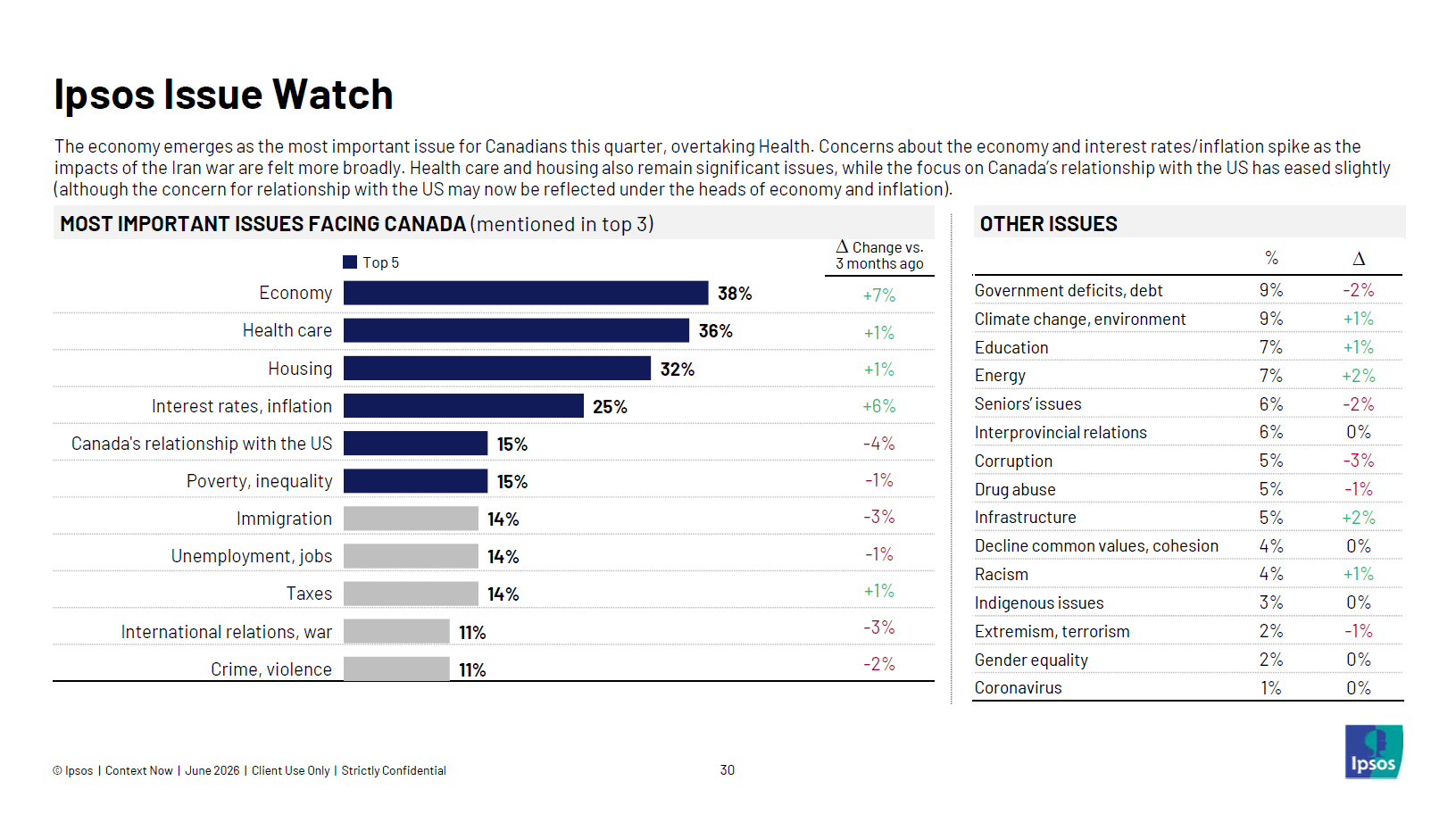
Okay, okay, there’s one glaring exception — Canadians did tell Ipsos that the U.S.-Canada relationship was a major concern. For right now, anyway — it didn’t even make the list between 2019 and 2024. But the rest of the issues? The economy, health care, housing, interest rates and inflation, poverty and inequality, immigration, jobs ... these are Canadian issues. A trade war can (will) definitely make some of them worse, but these are largely domestic problems with domestic solutions.
I asked my friends at Ipsos — thank you, Ipsos friends! — how these numbers compared to the traditional issues Canadians have reported caring about. They told me that a lot of the issues bounce up and down — “ebb and flow,” was their term — but that most of the issues are perennial. Every so often a massive event, like the Sept. 11 terror attacks or the COVID pandemic — will come along and make the list of top concerns. But otherwise, it’s what you’d think. Health care, the economy, jobs. Being able to live safely and well.
Cleaning up our streets has nothing to do with America. It’s something we can do ourselves, and used to be better at. Fixing our health care has nothing to with Trump. It’s something we have to do for ourselves, and used to be better at. Crime and justice, immigration, housing, procurement, infrastructure, a bloated and dysfunctional public service and busted payroll systems ... no MAGA influencer did a single thing to create one of those problems for us.
But they’re sure as hell going to use them against us.
So let’s fix this country. Let’s not let our patriotism blind us to where we’ve fallen short. Let’s not make stating plainly that things here could be better, and often have been better, a taboo, something that we dare not speak because Donald Trump exists. Let’s not hold our elbows so high it disrupts the blood flow to our brains.
Detroit is coming back from the dead. What excuse do we have to not do better than we’re doing? And what better way to survive American pressure than simply live well? If that’s what we choose to do, I do have good news. Most of what’s wrong with this country, most of the things holding us back from living as best as we can, are entirely under our control.
And really, when you think about it, always were.
The Line is entirely reader and advertiser funded. No federal subsidies, no bailouts. If you value our work, please consider supporting us by subscribing or making a donation. Donations are not subscriptions and do not unlock paywalled content, but they help keep The Line independent

To contact The Line with a general inquiry or comment, please email info@readtheline.ca. For other ways to connect with us or to follow us on social media, please see our LinkTree.
Great column, Matt. I would add that Federal government "programs" will not address all these problems. Canadians need to do the work, including holding the appropriate levels of government responsible.
The people who mock the phrase, "Canada's broken" either misinterpret it's meaning or willfully ignore it. Canada isn't "broken", but far too many of our public sector-led institutions are. Hence, Toronto is filthy, in every way imaginable, and the rot is spreading out to small town Canada as well.
The pace at which "stuff", both important stuff and mundane day-today stuff happens in public-sector Canada is not just glacial it's inert. There's NOBODY willing to take responsibility or make a decision. Why? Because the bureaucracy no longer exists to deliver services, it exists to self perpetuate and feed itself.
I read an account of an individual wanting to open a produce/farm store with a relatively fancy cafe attached here in the Port Hope area. The idea was proposed in 2019, "consultations" began in 2022, and the idea died in 2025. Pathetic doesn't scratch the surface as a descriptor.
It's past time that the situation gets fixed. Local government needs to focus on supporting the development and maintenance of a healthy, safe and clean community for the people who are and want to be a positive contributor to society. That means re-balancing the rights to this-or-that arguments to favor those who just want to live a happy and productive life. Make clean and safe streets a priority as opposed to just a talking point. Allow prosperity to flourish, as opposed to snuffing it out through endless consultation with self anointed "stakeholders" and layer upon layer of bureaucratic regulatory muck.