

By: Matt Gurney
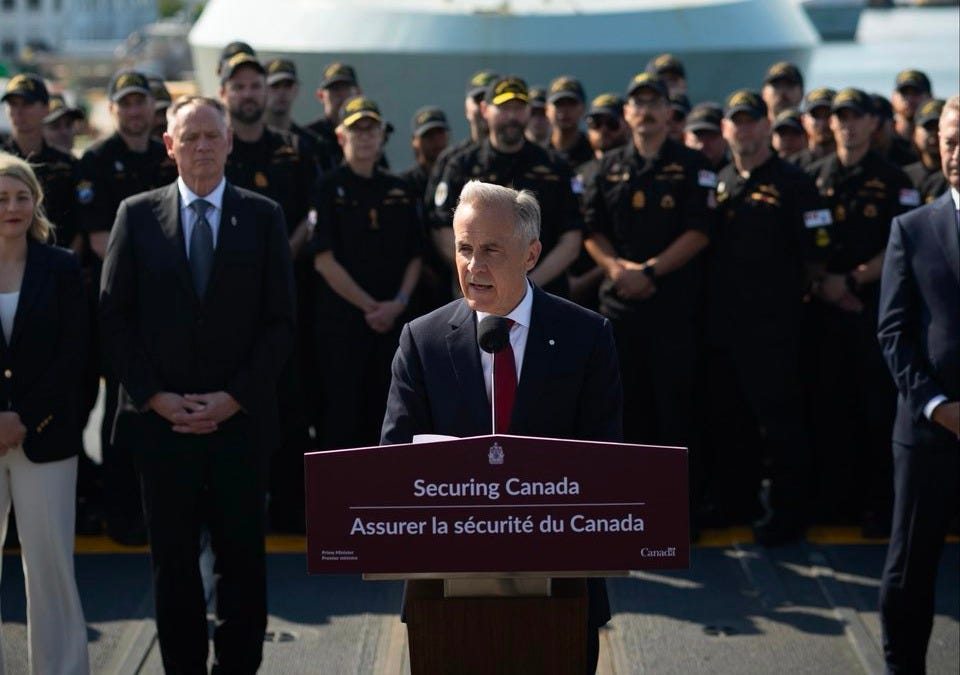
In Halifax on Monday, Prime Minister Mark Carney announced that Canada had chosen a preferred vendor for our new fleet of patrol submarines. Canada will (probably) be going with a German-Norwegian consortium that was offering the Type 212CD submarine, and not the South Korean boats offered by Hanwha. The prime minister said it was a close finish between the two competitors and noted that either design would have met Canada’s needs. The decision announced Monday is not a final purchase order but rather a determination of who our preferred partner would be. The prime minister said that if the negotiations with TKMS, the German company offering the 212CD, did not go well, Hanwha remained an acceptable option.
Personally, I was rooting for the Koreans. I liked their submarine’s ability to launch missiles vertically, which would’ve given the Canadian fleet some powerful strike options. I also tripped a little over the thought of Canadians in U-boats — I suspect many historically minded Canadians will also blink hard at that little twist of fate. But I fundamentally agree with the prime minister — either boat is fine for our purposes. The 212CD will be an excellent asset once it enters Canadian service (presumably with a snappier name).
Sooner would be better. The prime minister noted repeatedly during his remarks on Monday that the government was moving quickly to make this announcement, having settled on a preferred partner five years ahead of the original schedule. This is true, and I give the prime minister full credit for that. I would also note that the schedule was already ridiculously long. We actually should have begun replacing the submarines a decade ago. The PM’s comments reminded me that I had written a column about the urgent need to just get on with replacing the submarines when we had last announced another cycle of refurbishments to keep the current fleet in service because we had yet again delayed a decision on a replacement.
I found my old article. I wrote it seven years ago.

That was bad. Carney accelerating it is good. It’s also good that we are looking at a much larger fleet of submarines, going from four to as many as 12. Submarines are very complicated machines. For every boat you want available for service, you need three or four in your fleet. This gives you a large enough fleet to have an operational submarine available while others undergo maintenance or refits or participate in training exercises with their crews. The four Victoria-class submarines Canada possesses today mean that we typically might have one available for service at any given time, so a fleet of 12 will give us a much more robust presence. Given that we claim three oceans, and that the world is pretty much a dumpster fire these days, having a submarine available on each coast at all times seems like a good idea.
Time is of the essence. Germany and Norway, the prime minister said, have offered to allow Canada to cut ahead of them in line for deliveries of the submarines, which are already under construction but haven’t yet entered service. Given the decrepit state of our elderly existing fleet, that was obviously a meaningful sweetener, and the PM said the first boats could be in Canadian service in seven or eight years, which is pushing the Victorias to their limits, but should work. We hope?
The prime minister also spoke at length about the economic and industrial benefits Canada will receive through the deal, with apparently every dollar we spend on these boats eventually being invested back into Canada. I roll my eyes a little bit at the continued need to treat military procurement as a jobs-creation program — our insistence on doing this probably helps explain why we suck at procurement!
But I have made a reluctant peace with the reality that the destabilization of the Western alliance has made a degree of economic nationalism, particularly on military equipment, unavoidable. I don’t like it, I don’t think it’ll help the military, but I’ve resigned myself to it. I can only shout at clouds so long before turning hoarse, and Monday may have been the day I hit that limit.
So that’s the substance of the announcement: German-Norweigan boats, lots of money spent in Canada, sad Koreans, and genuinely excellent submarines, in large numbers, that will give the Canadian Navy some real capabilities.
Good! Well, mostly good — it’s sad the Koreans are sad. Perhaps we can make it up to them by buying some other Korean weapons. They make some great kit.
In the meantime, though, while we wait to see if we get the boats on anything remotely close to the timeline and budget we were hoping for, it’s worth considering a few things.

The first is that this is yet another Canadian commitment to Europe. I had half wondered if we’d go with the Koreans if only to spread the love around a bit more. We’re already spending big money on European equipment — recall the surveillance plane announcement from just a few weeks ago. I’m not sure I have a problem with the choice to double-down on Europe instead of going with an Asian ally. I’m not sure I have an opinion on that at all. But it is a choice, and it’s one worth considering. Wiser minds than mine might have an inkling about the private thought process behind that — for now, I’ll just file it under interesting.
The second is that, as I noted here a few months ago, the Royal Canadian Navy is set to get much larger. I don’t think the general public fully understands the scale of the military expansion that Canada is considering. During Stephen Harper’s years in government, the Canadian fleet was four destroyers, 12 frigates, four submarines, 12 patrol ships/minesweepers, two refuelling ships and various and sundry small support vessels. Right now, the fleet we’re talking about is much larger than that — 15 destroyers, as many as 20 anti-submarine corvettes, as many as 12 submarines, and two refuellers now under construction, plus the six Arctic patrol ships now in naval service. It’s possible we don’t order that many of each proposed project; I’d go as far as saying it’s likely we don’t. But just for the sake of argument, let’s assume we do. We’re looking at a fleet of 55 large vessels in service, an increase of more than two-thirds since Harper’s tenure.
That’s a gigantic increase. I think this is good and necessary, but with the army and air force looking to expand, as well — also good and necessary — we’re starting to talk about a military that is a vastly larger part of Canadian fiscal planning and even society itself than we’re used to. As much as I support this, and I really support this, it’s going to bring very real challenges. The money is going to be hard enough. But it’s also going to mean a lot more people, a lot more real estate, a much larger defence industry, and a much bigger public role for the military. A pretty small group of politicians, officers and observers like myself have started to figure this out and discuss it, mostly privately, and it’s an open question how the rest of y’all are going to react when the full scope of what’s being discussed here really hits home in a population that hasn’t thought much about the military in over 80 years.
Last and certainly not least, it will be fascinating to see how the Americans respond. They should have no objections, for the simple reason that there was no American-made option on offer — the Americans only make nuclear submarines and Canada chose, probably wisely, to not take on the added cost and technical complexity of trying to add nuclear engineering expertise to a military that is already pretty busy effectively doubling (at least) in size. Indeed, since there’s no direct loss to U.S. industry here, in theory, the U.S. should welcome this. A much larger and more capable Canadian fleet is a real win for continental security and for NATO. This should please the White House.
But, given the White House’s current occupant, who knows? It could just as easily provoke him in some way. The correct response is simply not to care. Canada should decide for itself what kind of military it wants and needs, and go out and get it. Sometimes that’ll mean buying American rockets. Sometimes it’ll mean Swedish AWACS and German submarines.
But it will always mean needing to get things right at home. Adding a dozen submarines will strain the navy — and that’s only one small dimension of the military expansion we are setting out on. I’m excited and relieved, but not in denial about how hard this will be. No one else should be in denial, either. This will be the work of a generation. We will find out if we’re up to it.
The Line is entirely reader and advertiser funded. No federal subsidies, no bailouts. If you value our work, please consider supporting us by subscribing or making a donation. Donations are not subscriptions and do not unlock paywalled content, but they help keep The Line independent

To contact The Line with a general inquiry or comment, please email info@readtheline.ca. For other ways to connect with us or to follow us on social media, please see our LinkTree.
I cannot be the only grumpy approaching-middle-aged dad that is welcoming the return of the military to a visible presence in Canadian life, not because I cheer a more dangerous world, but because it should hopefully help restore a degree of seriousness to public life?
Like for five years our highest-caloric-output public debates were on gender labels, we had more real estate agents than teachers, our young people aspired to jobs as influencers or crypto traders — and I’m just tired of it. I’m tired of us doing and thinking and talking about nonserious stuff.
I want to be able to say to young and/or underemployed people — no, nobody gets to be an “influencer”. And fuck crypto. Learn a trade to build new nuclear power plants, and if you don’t want to do that, our Navy needs 5000 new sailors. There is real opportunity now. For the unserious years of the Long Summer there wasn’t much meaningful to do. There is now. Get to it.
I am relieved the decision was made but this is just an announcement that the decision has been made, until a contract is signed it doesn't mean anything.
Next they need to announce a new F-35 and Gripen air force, which has been ongoing since Chretien.