


By: Peter Menzies
Many years ago, I attended a delightfully dour Presbyterian church in England where the young Scottish clergyman told me a remarkable story about how a village in his homeland had saved itself from possible extinction.
He never mentioned the name or the precise location of the community, but it was one of his first assignments following his ordination. For context, I remember the Man of God in question as very similar in character and personal carriage to Eric Liddell, the devout Scottish sprinter and Olympic champion upon whose life the film Chariots of Fire was based. He was gentle in spirit, firm in his faith and the least likely person in the world to make up a story like the one he told me.
The location was most likely either the western isles — Lewis and Skye — or the Angus Glens. Large percentages of the young men from those regions who enlisted to fight in the First World War never came home. It is estimated that in the latter area and the Perthshire Highlands, as much as 40 per cent of the soldiers from some communities died fighting for King and Country. The deaths of close to half the young men in their communities meant that close to half the young women had no prospect of marriage, which 100 years ago was the norm. That meant that, without some kind of adjustment in societal norms, they had no prospect of becoming pregnant, giving birth and raising the number of children that would be required to keep the community’s economy and culture alive. That’s to say nothing of avoiding a life of loneliness.
So, as my Scottish man of the cloth discovered, rather than inappropriately competing for the affections of the surviving young men and creating social discord, the women of the village had quietly decided to share their husbands and, for a generation, the stigma once assigned to “unwed mothers” was set aside and then, once demographic balance was restored, the traditional Calvinist codes of conduct were restored and no one spoke of the matters again. They had accomplished their goal, which was the preservation of their society.
It’s unlikely this was the first time in human history, given the frequency of wholesale slaughters on battlefields, that communities reacted this way. Societies do what they must to avoid extinction and the first order of business in that quest is reproduction.
Two generations ago, that was done with some enthusiasm in Canada. Among my parents’ cohort, the birth rate per woman was close to four — 3.82 in the year I was born, to be precise.

We “boomers” were then cautioned by our school teachers — incorrectly as it turned out — that the globe’s population was growing at an unsustainable pace and Paul Ehrlich’s 1968 book, The Population Bomb, frightened most of us with the thought that having more than two babies could lead to humanity’s starvation and extinction. So we dialed it back, equipped ourselves with every contraceptive tool available, and, by 1980, the birth rate was 1.75, below the replacement rate of 2.1. The world was saved, or so we thought.
That pattern of behaviour, which is a considerable contributor to the nation’s demographic and cultural evolution, has continued so that, these days, the fertility rate is 1.25. British Columbia is the least interested in reproducing and has the lowest rate — 1.02 — while Saskatchewan has the highest, although its 1.58 is still well below replacement.
Were it not for the contribution of foreign-born mothers (32.3 per cent of the total), who according to Statscan contributed 42.3 per cent of babies (up from 22.7 per cent in 1997), the situation would be even more extreme. As of 2024, the birth rate among native-born mothers was 1.1. In other words, endangered-species levels, should that rate hold for several generations.
All of which explains why, if Canada’s native-born population and culture is to persevere, we need immigration. (Well, we could have more babies but I don’t think a cri de couer from an old white man on that topic would be well-received by young women in their reproductive years. Or any woman, for that matter.)
It’s obvious that modern Canada has been shaped by immigration, initially and overwhelmingly by the French and British. When their numbers proved insufficient to meet the nation’s need to populate the northwest and prevent it from becoming America, others — notably Ukrainians — suited to the nation’s needs and from countries founded in Judeo-Christian intellectual traditions were recruited. As were the Chinese to build the railroad. Their abuse and courageous persistence is one of the country’s great stories.
Nevertheless, there was a necessary new openness expressed — and this is one of my favourite political quotes — by Prime Minister Sir Wilfrid Laurier on Sept. 1, 1905, the day Alberta and Saskatchewan were founded as provinces.
“We do not want nor wish that any individual should forget the land of their origin,” he said. “Let them look to the past but let them still more look to the future. Let them look to the land of their ancestors, but let them also look to the land of their children. Let them become Canadians … and give their heart, their soul, their energy and all their power to Canada.”
And so we did.
Today, we need a similar, sensible conversation about what sort of Canada we will shape through immigration, because, unlike the Scottish villagers, we have taken having babies to maintain our societal status quo off the table.
We may fancy rebuilding the world order through Europe, but it’s definitely not the dependable go-to source it was for new Canadians for most of the 20th century. Birth rates within the European Union are 1.34, while 1.4 is the number in the U.K. Regions with more robust birth rates these days are the Middle East (2.98) and Africa (4.0), so those are more likely, albeit non-traditional, sources offering different cultural influences for us in the years ahead. Indeed, while Prime Minister Mark Carney describes Canada as the most European of all non-European nations, almost half the country’s current population has no European heritage whatsoever and that cohort is only going to grow.
All you need to do to understand the difference between old Canada and new Canada is look at a picture of our national hockey team and compare it with a photo of our national soccer team.

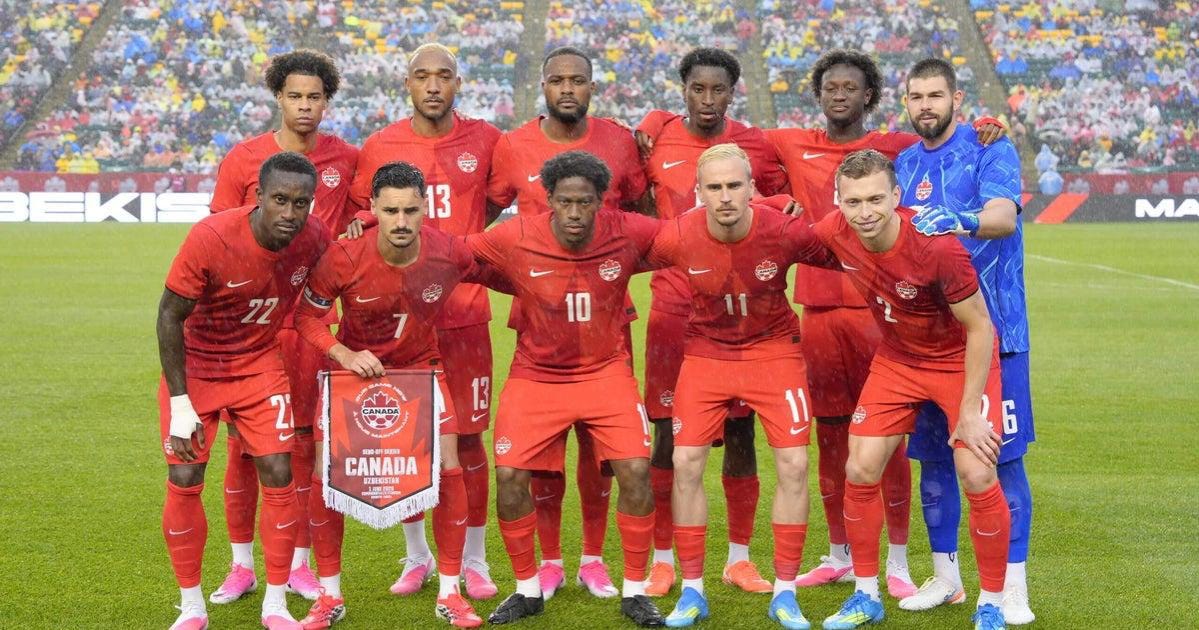
Intellectual foundations are also shifting. Christianity is in a tailspin and Islam is blossoming. Project current trends two or three generations forward (which can be dodgy) and, if our behaviours stay unchanged, what we will have is a nation in which a small majority has no interest in nor knowledge of the nation’s foundational spiritual traditions while the other half are split, primarily, between Roman Catholics and Muslims, each at close to 25 per cent, with sprinkles of Evangelicals, Sikhs, Hindus, Buddhists and others added for flavouring. Presbyterians will be, at best, an endangered species and, in most large cities, the call to prayer will have replaced church bells.
I do not raise this, as others so often do, to sound an alarm or shout a warning. My intention here today is simply to say something that strangely goes unsaid in so much of our discourse: the decisions we make today regarding our growth are going to create the Canada we are building for tomorrow.
We may have to make some adjustments — as did the people in the highlands — and abandon some traditional ways as we make our way forward. But we shouldn’t do it by accident, through fear or political intrigue. It’s long past time Canadians had a grownup conversation about how we want immigration to contribute to the evolution of our culture — and, yes, we have one — while preserving its foundations.
The Line is entirely reader and advertiser funded. No federal subsidies, no bailouts. If you value our work, please consider supporting us by subscribing or making a donation. Donations are not subscriptions and do not unlock paywalled content, but they help keep The Line independent

To contact The Line with a general inquiry or comment, please email info@readtheline.ca. For other ways to connect with us or to follow us on social media, please see our LinkTree.
"It’s long past time Canadians had a grownup conversation about how we want immigration to contribute to the evolution of our culture — and, yes, we have one — while preserving its foundations."
If this is to happen (and I agree that it is necessary), Canada needs very seriously and very quickly to get away from the 'post-national' claims made in recent years -- claims that either failed to appreciate the need for "Canadian values" or sought actively to undermine them. Andrew Potter, a frequent and excellent contributor here, wrote in the Ottawa Citizen in 2011 that "there's no such thing as Canadian values" -- arguing that the pluralism of liberal democracy provided mechanisms for negotiating our differences. Fifteen years later, that pluralism has retreated in the face of active attacks on democracy from both the far left and far right.
The 'Canadian values' we need to far more clearly and loudly defend are those of liberal democracy itself.
By all means we need a frank discussion about the “Canadian values within a Liberal democracy “. Who wants to go first? Who wants to be the one labeled “pure Laine old stock”, or even scarier, “ racist “? This is where we are now, tippy toeing around one of the Liberal Govts biggest acomplishments, the destruction of a Canadian identity.