

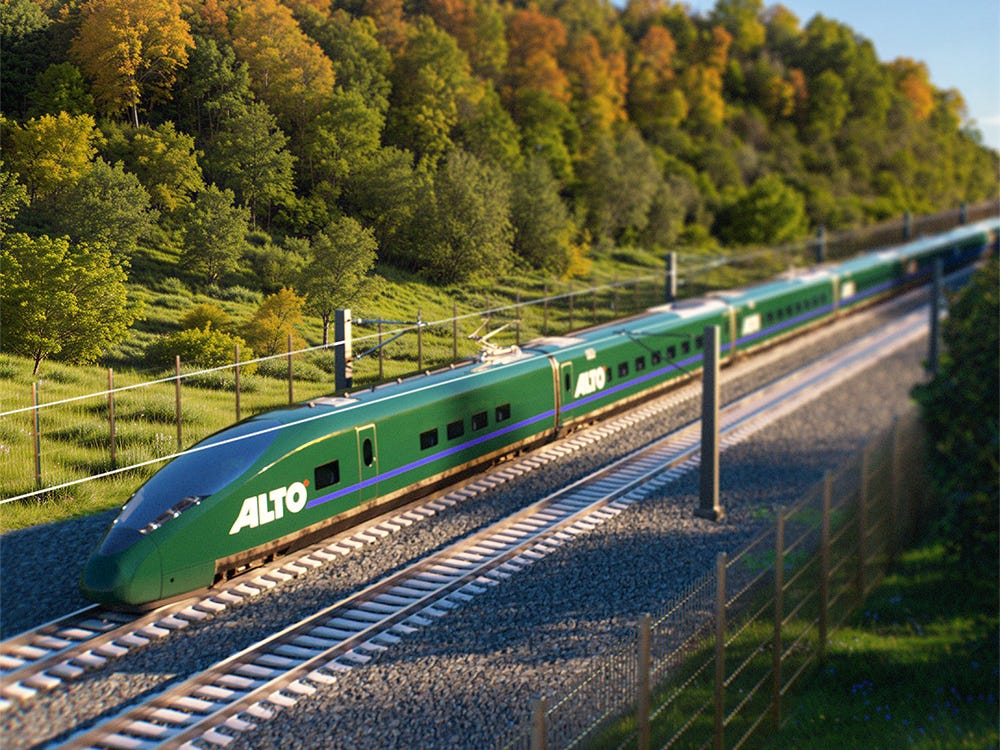
Alto’s high-speed rail project promises to redraw passenger travel between Toronto and Quebec City. The bigger test is whether Canada can rediscover how to build big — without repeating its biggest mistakes.

This is the first in a series of articles that will be produced by The Line with the support of Build Canada, which has generously funded the Build Canada Fellowship. The first Build Canada Fellow is Alan Findlay, who’ll spend the next year doing reporting under The Line’s full editorial control. To learn more about the Fellowship, click here.
By: Alan Findlay
It’s one of the most recognizable photographs in Canadian history, taken on a chilly November morning in Craigellachie, British Columbia, in 1885. A handful of mucky mucks made the storied journey from central Canada to mark the completion of the Canadian Pacific Railway, the new country’s first great nation-building project. Some of the tens of thousands of labourers who risked, and often gave, their lives to build the CPR can be seen looking on at the grey-bearded CPR director Donald Smith. Wearing a silk stovepipe hat and heavy overcoat, Smith is posed, doubled over — “look up for the camera, please” — and holding a sledgehammer over the rail’s last spike, hands apart like he’s holding a hockey stick, posing for the nation’s opening faceoff.
Fast forward almost a century and a half and the federal government is hoping to drop the puck on another rail system under the banner of nation building. Rather than the steel spine that grew the nation east to west, this one resembles more of a long stitch across the seam between Quebec and Ontario. Canada’s first high-speed rail project is proposed to run 1,000 kilometres, connecting Quebec City to Toronto, running through Trois-Rivières, Montreal, Laval, Ottawa, Peterborough and, maybe, Kingston. The corridor is Canada’s most densely populated region, including the country’s two largest cities. The two provinces combined account for more than half of Canada’s GDP. Travel times are projected to be considerably shorter than current trips on VIA, with fewer delays, given that the 300 km/h-plus trains would be primarily running on dedicated rail and not sharing tracks with freight trains.
At a time when the federal government is touting a growing list of “nation-building” initiatives worth half a trillion dollars in private investment as of September, the high-speed rail project is an early test of whether Canada can return to its roots and build big. And yet for reasons distinctly Canadian, its fate remains firmly in the category of “we’ll-believe-it-when-we-see-it” for many industry, political and academic onlookers, not to mention a public weary of projects turning their communities into construction sites for much longer than promised.
The most recent blow was when Quebec voters elected a separatist Parti Québécois government that has explicitly said it won’t support the project. Two days after the election, the top brass for the federal crown corporation tasked with running the project, called Alto, stood in front of the cameras for the corporation’s virtual annual public meeting. When a question about the PQ’s election came up, the Alto board’s vice-chair Marie-José Nadeau vowed to power forward before referring the issue upward.
“We have a mission and mandate to develop a network from Toronto to Quebec,” said Nadeau. “Our first objective is to be ready to shovel in 2029. We are working towards this objective with communities, with governments. For all political questions, it’s the government that will have to answer this question.”
Up closer to Parliament Hill, Transport Canada said it’s still behind the project. For now.
“At this stage, the Government of Canada remains committed to advancing the project,” department spokesperson Flavio Nienow stated in an email.
In a report to Parliament in October, Ottawa’s Parliamentary Budget Officer has already warned Alto is underestimating the project’s costs. The budget officer’s own estimate puts the project’s costs in the range of $75 billion to $113 billion, not including a possible added stop in Kingston.
For many onlookers, these are the signals of a project that could take Canada on the same slow, expensive thrill ride seen many times before.
The dream of joining the major metropolitan regions of Quebec and Ontario, by way of high-speed, or high-frequency, rail is not a new one. A layman’s tally found 30 studies, proposals, task forces and hearings for the idea over the past 56 years. The federal government says the project will create up to 51,000 jobs over a decade, boost the country’s GDP by 1.1 per cent and carry an estimated 24 million passengers a year by 2055. The electrified line will mean lower emissions to the tune of 2.2 million tonnes a year, the federal government’s website states.
Today’s project is by far the most advanced. Four years ago, the previous Liberal government created Alto, a wholly owned subsidiary of VIA Rail, and committed $3.9 billion to design and develop the line. Based on corporate reporting, Alto currently employs more than 200 people and has a 2026-27 budget just shy of $700 million. If all goes to plan, construction of the line’s Montreal-to-Ottawa leg will begin in 2029-2030. Once the work begins, constructing the entire network is estimated to take 12 years. Cadence, an “international team of Canadian-led companies,” was awarded a contract early last year to help Alto plan the new system. Alto estimates the line’s cost at $60 billion to $90 billion, but plans to submit a full business case to the government sometime next year before receiving the green light to start construction.
Alto is certainly doing its part to look like a locomotive at full throttle.
“We have not lost a single moment, and we’ve had this project progress at exactly the timeline that we’ve established,” Alto’s president and CEO Martin Imbleau stated during the annual public meeting in October. Imbleau tied the importance of the high-speed-rail project to Canada’s economic strategy, and said there is a sense of urgency. “Each year of delay before construction could add up to $3.4 billion to the overall project costs,” Alto’s plan states.
It is not an empty threat, and this concern was everywhere at the international investment conference hosted by Prime Minister Mark Carney in September. Toronto’s Yorkville Four Seasons was brimming with genuine optimism and excitement. Leaders of international investment funds spoke of commitments in the trillions, with a “T.” Even standing crowded in the corner of the conference room with a gaggle of other reporters, you could feel the love in the room. Canada was indeed having a moment. But the consistent comment away from the microphones echoed the candid admissions of Carney and his cabinet ministers: Canada has to be better at getting projects through the regulatory hoops before they die on the vine or the next government changes its mind.

Vincent Caron, vice-president of policy at the Ontario Chamber of Commerce, points out that the high-speed-rail project comes with a lot more than what would typically fit in a project’s cost-benefit analysis, however. A planned construction start in 2029-30 means near-term job creation in both provinces and a huge boost to an entire supply chain — think steel for the rails, for example — at a time when Canadian industries are being hit with U.S. tariffs.
“You have here a massive construction project, right? We’re talking about 50,000 jobs during construction and then more than 5,000 long-term operational jobs from Alto,” Caron says. “So you’re looking at a project that’s expected to generate $86 billion in economic activity, $23 billion in tax revenue, and that’s just the construction and supply chain activity.”
Travellers living along the prospective corridor can’t wait.
Brian Hewson and his partner Martine Band frequently travel between Toronto and Montreal for family reasons. Because VIA shares tracks with freight trains, they assume the trains will take longer than scheduled — the fastest trip available for them is roughly five hours.
“It’s always more like six hours. Because there’s usually a delay,” Hewson says. Driving can be cheaper with an electric vehicle, but long and achingly dull, he adds.
Alto’s projected Toronto-to-Montreal travel time is around three hours.
Chris Drew, an urban planner and outspoken local proponent for high-speed rail, says he and his wife frequently travel between Toronto and Peterborough to care for an ailing parent.
“If high-speed rail existed today, getting from Toronto to Peterborough in 40 minutes would be a life-changing development,” Drew says.
Shortening the travel time and making it more reliable has transformational implications for everyone in the region, he says.
“It affects housing choices, supports aging in place, and enhances regional tourism. My own parents prefer traveling locally within Ontario over international trips. High-speed rail opens up these opportunities for students, families, and seniors alike.”
The federal government has also kept the door open to adding a stop in Kingston as it considers the best route from Ottawa to Toronto. Akhil Garg is one of the many people in Kingston who would love to see the train’s route make a swing through John A. Macdonald’s hometown. The physician and his family live “car free.” Garg says they rely heavily on VIA Rail and intercity buses for work and family trips. Planning work trips to Toronto or trips to see his parents in Ottawa would be dramatically different if he didn’t have to budget 30 to 60 minutes for delays on each train ride. Trips to Ottawa inevitably require an overnight stay, he says.
“If my mom has a medical appointment during the day (in Ottawa), I can leave in the morning and then come back in the evening,” he said.
Garg comes off during conversation as upbeat and positive. A glass-half-full kind of guy. Asked when he thinks the project will be done, his response suggests he sees that glass a little farther off on the horizon than projected.
“I imagine this will be for the next generation primarily, but I’m excited for it.”
Public polling research suggests that, so far, Hewson, Drew and Garg aren’t outliers. National surveys suggest Canadians like the idea of major projects, and the idea of high-speed rail (Probe Research surveyed 1,300 Canadians earlier this year and found 61 per cent of respondents supported the project, while 19 per cent opposed it to some degree). It even suggests the high-speed-rail project is more popular than other major national projects, including expansion of the Port of Churchill in Manitoba, modular nuclear reactors in Ontario, a liquefied natural gas terminal in B.C. and a carbon capture storage facility in Alberta. Ipsos polling from earlier this year also suggests a significant overall bump in public support for major projects.
But levels of support for megaprojects have a soft underbelly once the realities of cost and community impacts start to set in. A Nanos Research survey from June asked 1,051 Canadians how much of a priority the federal government should make Alto knowing that its estimated cost was $60 billion to $90 billion. Knowing the early cost estimate, 38 per cent of respondents said they think the project should be a high priority. The same percentage said it should be a low priority.
Alto also already faces local opposition, particularly from farmers, other landowners and environmentalists concerned about potential impacts through areas such as eastern Ontario’s Prescott-Russell Trail.
A vocal opponent on the Quebec side of the border is a commercial membership of more than 7,000 agricultural businesses called the Fédération de l’UPA de la Montérégie.
The Fédération’s regional president Jérémie Letellier says the impacts on landowners whose land may be split in half could add significant time and cost to their daily operations as they navigate around the new rail line.
“A producer who now travels one or two kilometres might suddenly face a detour of up to 15 kilometres,” he said.

Alto has stressed that it will minimize impacts wherever possible and provide fair compensation for any land that is ultimately acquired. The agency has also stated that landowners and the public will get a more precise view of the line’s path between Montreal and Ottawa this fall when they narrow the proposed corridor down to about a one-kilometre strip from the current 10 kilometres. Ultimately, the final right-of-way is expected to span, on average, roughly 60 metres. Once that is done (expected sometime next year), Alto will initiate the environmental assessment process, all of which means more promised public consultations with municipalities, Indigenous communities, landowners and the general public. According to Alto’s reporting, the ongoing consultation process has already included more than 60 events (open houses, virtual sessions, roundtables) and involved more than 10,000 participants.
The project faces several other headwinds, some common to most megaprojects, and others specific to this one.
First off, Canada has a reputation around the world for being bad at committing to, and building, rail projects. Our governments are known for mulish regulatory processes, political reversals and wavering in the face of local resistance around every bend of the track. Not only has Quebec’s PQ government spoken against the project, the Ontario government cooled on the idea after the feds nixed provincial plans for jets flying into Toronto’s Island Airport.
Matti Siemiatycki likes the idea of high-speed rail, but he isn’t holding his breath. Siemiatycki is a professor of geography and planning and director of the Infrastructure Institute at the University of Toronto’s School of Cities. Two years ago he warned a parliamentary transportation committee that Canada’s infrastructure delivery system is not designed for projects of Alto’s scale. In a recent interview, he flagged several concerns he continues to have about how the project is progressing. To him, the early determination to power ahead on a project that still doesn’t have a business case leads to bad outcomes.
“We need to be able to do big things. We are in a major project moment for all sorts of reasons, because of the trade war, sovereignty, national unity, climate change. We have to be able to do big things,” said Siemiatycki. “The key is that you pick the right ones and then you deliver them effectively. And what we’ve seen is that in Canada, the cost of building a unit of infrastructure has skyrocketed. Like it’s gone up. It’s gone up in some cases two and threefold in the last decade and a half.”
Canada’s challenges with rail projects are widespread. Projects in Toronto, Montreal, Calgary, Edmonton and Vancouver have been delayed, over budget and in some cases reduced in scope. Inquiries and commissions like those for the Ottawa LRT and Muskrat Falls Dam repeatedly point to politically driven timelines rather than sound project governance for cost overruns and delays.
A big challenge here in Canada, Siemiatycki points out, is the stop-and-start nature of transit construction in Canada. Canada largely paused on building new transit projects in the 1990s. This meant losing a generation of workers who may have progressed from site experience into senior leadership for today’s projects.
At the end of the day, Siemiatycki says high-speed rail is a nice-to-have, not a need-to-have when local transit systems aren’t being kept up.
“People are experiencing in their day-to-day lives the diminishment of our systems because we don’t maintain them even as we’re talking and in many cases building new.”
Project performance concerns aren’t just being voiced from academic ivory towers. An organization of the biggest construction and development companies in Canada, called the Future of Infrastructure Group, released a report two years ago, entitled “Reducing Risk in Transit Projects.” It offered its own bleak statistics.
“Based on research from Oxford University using 80 years of data from around the world, only two rail projects out of every 1,000 were delivered on time, on budget, and with the expected benefits,” the report states.

Metrolinx is the Ontario government transit agency that plans and runs the system of commuter trains (the double decker ones) and buses (also double deckers), primarily ferrying people between surrounding municipalities and downtown Toronto for work or Blue Jays games. It is currently overseeing six major rail projects in the region. Last year, a Metrolinx advisor co-authored a study written for the U of T’s School of Cities that pointed out Canada ranks near the bottom of 60 countries for the cost-per-kilometre of building transit.
“Out of the 60 countries in our data, Canada ranks ninth highest in average costs per kilometre at $377M/km,” states the study, entitled “Understanding the Drivers of Transit Construction Costs in Canada.”
“For context, the global average for all 1,085 tramway, metro, and mainline rail projects in our database is markedly lower, at $242M/km,” the report states.
One of the answers for why we do so badly might surprise you: We do projects in English. Seriously.
“Other studies have found that Anglophone countries are uniquely insular in their project delivery practices, from procurement to design and stakeholder engagement, which results in higher costs. In fact, every country with a transit project over $1 billion per kilometre speaks English as its primary language,” the U of T study states.
In other words, English-speaking countries tend to trade ideas and expertise with other English-speaking countries. And apparently our ideas are not as good as the ideas used in places like Japan, Spain and South Korea.
There’s hope, however, the report concludes. “(By) ... the nurturing of in-house capabilities, and an embrace of global best practices, high construction costs can be driven down.”
So, is Alto set up to succeed where other Canadian projects have not?
Michael Schabas has worked on projects around the world, including Ontario. In the absence of an official business case from Alto (again, coming in 2027), the railway consultant published his own. Schabas argues that Alto’s biggest risk is going too fast and getting the project design wrong before committing billions to construction. Proceeding without a published business case comparing alternative routes, costs and benefits, could produce a railway that costs more, takes longer and attracts fewer passengers.
“Better to build nothing than the wrong system,” he writes.
Broader governance concerns around Alto’s independence and authority were a frequent flag from experts during recent Senate hearings. Even though the prime minister has announced new rules under the Building Canada Act that promise to fast-track notoriously byzantine federal approvals and give projects more authority to get the job done (central concerns expressed by investors and project management experts), Alto remains absent from the list. Instead, Alto is listed under a specific High Speed Rail Network Act.
When the government’s recently formed Major Projects Office was asked about the designation, a spokesperson for Ottawa’s Privy Council Office responded with a statement by email:
“The Alto High Speed Rail was referred to the MPO as a transformative strategy in September 2025. It is not being considered for listing under the Building Canada Act at this time.”
Alto already has significant project-specific powers under the High-Speed Rail Network Act. And announcements like this fall’s budget confirming its intention to “support accelerating the construction” and “streamline expropriation powers” for Alto may ultimately make the distinction a small one. But even after the high-speed-rail act was tabled last year, Alto continued to identify land acquisition as a risk in this year’s corporate planning summary.
Financing also remains fuzzy absent the business plan. Ottawa has committed $3.9 billion over six years to development and pre-construction, while Alto says eventual funding would combine private capital, fare revenues and targeted public investment. In his own business case, Schabas believes that a well-designed system could generate substantial operating surpluses, but that outcome depends on the alignment, stations, fares and operating strategy.
Siemiatycki warns that Canada would need to avoid the mistakes made on projects like the U.K.’s second high-speed rail project. Originally planned to link London and Manchester, the HS2 rail project has since been shortened to run from London to Birmingham. Even the shorter route is expected to cost roughly double its previous estimate of 35 to 45 billion pounds. Initial services are now estimated to begin in 2036 at the earliest.
The U.K.’s independent spending watchdog, the National Audit Office, Parliament’s Public Accounts Committee and the new government have all piled on, citing poor project governance and “very poor value for money.”
Speaking in the British Parliament this past May, Heidi Alexander, the secretary of state for transport, pointed the finger at the Conservatives across the House of Commons floor.
“I can today confirm the previous government spent most of HS2’s budget without laying a single metre of its track.”
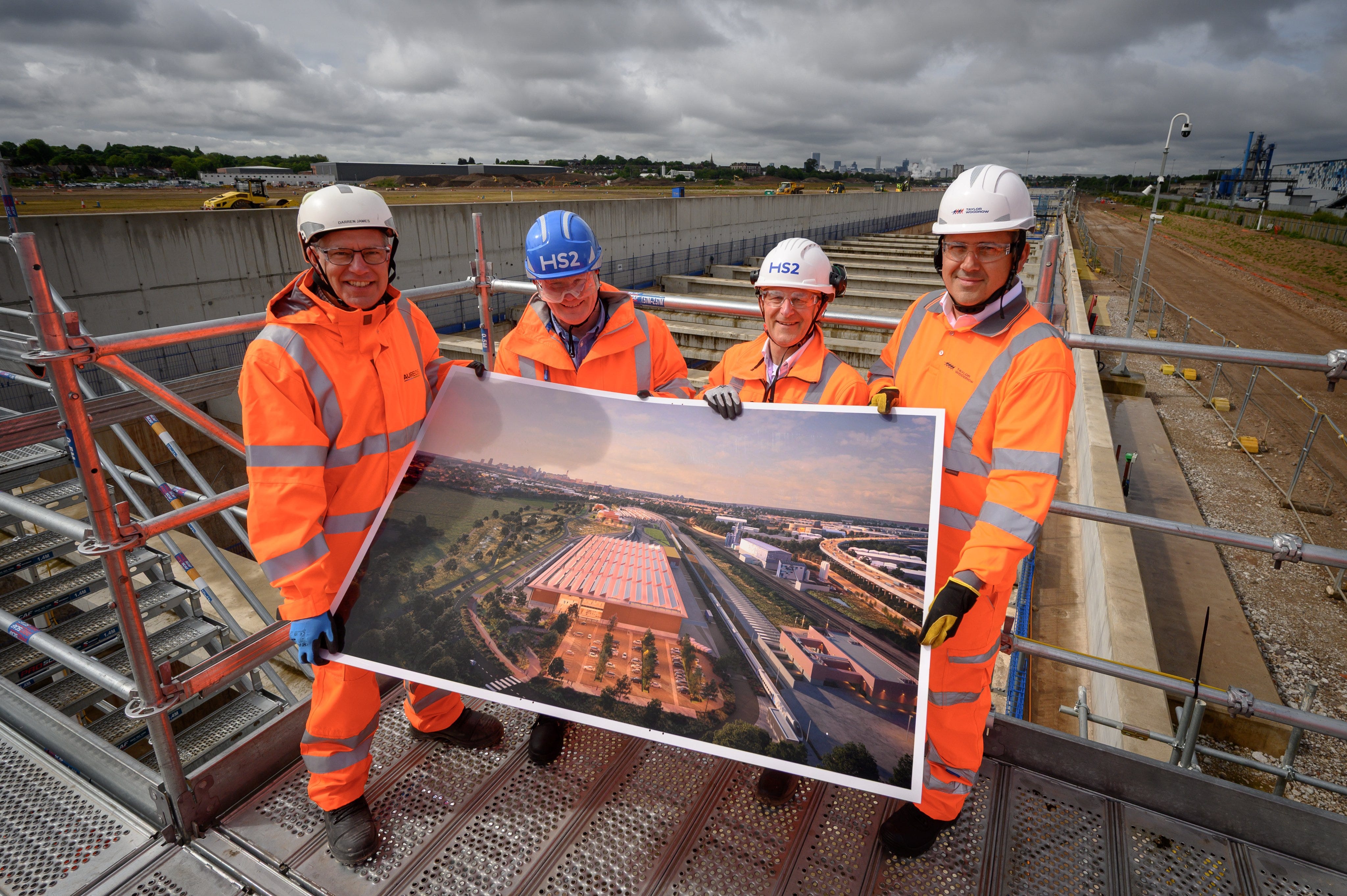
California’s ongoing high-speed rail project is another cautionary tale with no clear end in sight.
California voters approved the project connecting Los Angeles/Anaheim and San Francisco in 2008. At the time, the cost was estimated at $33 billion U.S. and the completion target was 2020. Construction continues. The most advanced segment of the line, which is just over a third of the line’s full 795 kilometres from San Francisco to Los Angeles, is now expected to be up and running in 2033 and consume the entire project’s initial budget.
The former chair of the California High-Speed Rail Peer Review Group, Lou Thompson, wrote a blistering letter to government officials this past spring citing a litany of concerns. He included common complaints about megaprojects that they lack the appropriate upfront planning and are promoted with unrealistic cost and scheduling targets.
“Failure is always an option,” he told CBS News’ 60 Minutes earlier this year.
The fickle winds of politics have been a big X-factor in projects like those in the U.K., California and closer to home. With new PQ Premier Paul St-Pierre Plamondon not supporting the project, those headwinds are now blowing squarely against constructing the first leg of the high-speed rail project, running from Montreal to Ottawa. Similar to Siemiatycki, St-Pierre Plamondon has said the funding should be redirected to local infrastructure instead.
“The real problem with transit is not that Quebecers can’t efficiently commute to Toronto, but that they’re unable to effectively commute within their own city,” he wrote (in French) on the social media platform X earlier this year.
The mayors of both Montreal and Quebec City, both reportedly supporters of the line, have warned against sidetracking a major economic opportunity with partisan politicking. But that might be unavoidable, now: construction of the Montreal-Ottawa leg is projected to start in 2029, which puts it on a collision course with a separation referendum promised by Quebec’s new government.
Over in old Upper Canada, days after the feds rejected Ontario Premier Doug Ford’s expanded, jet-friendly vision of downtown Toronto’s Billy Bishop Toronto City Airport this summer, 11 members of Ford’s Progressive Conservative government caucus released a statement demanding Alto get the support of their affected constituents before moving forward. Queen’s Park media reports also quoted senior government sources stating that Ford was reconsidering his support for the rail project.
Closer to Parliament Hill, Conservative Party of Canada leader Pierre Poilievre has likewise vowed to scrap the entire project if the Conservatives are elected.
Down the street from the Parliament Buildings (another megaproject we hope to get to in this series), over at the University of Ottawa, André Lecours, a professor in the School of Political Studies, says he would welcome high-speed-train service between Ottawa and his hometown of Quebec City.
“(Right now) you have to take a train — Ottawa … Montreal … then you get out of the train and then you wait for your Quebec City train,” he says.
But he is deeply skeptical that a project binding the two provinces together can move forward as long as a separatist Quebec government is looking for points of friction with a federal government.
“It’s not coherent with any kind of independence referendum,” Lecours says. “That’s another link to Canada that’s going to be unwanted.”
Even in a best-case scenario where the PQ is willing to negotiate, Lecours says it would be asking for a lot in return from Ottawa.
“I think it’s dead as long as the PQ governs.”
The CPR died more than a few deaths before rail started being laid across Ontario and the west. It had been debated for years, and was originally set to be completed by 1881 before voters benched John A. Macdonald and his Conservative Party government for a few years in the 1870s. But once Macdonald returned to office and work actually began under a contract with a new private consortium, the CPR was built in a little less than five years from 1881 to 1885. It was fast and messy. Track beds continued to sink into the boggy muskeg of northern Ontario even after it opened. Trestles hanging off the sides of mountains rested on “matchstick” foundations. Memoirs of navigating the track’s original 4.5 per cent grade up and down the western side of Kicking Horse Pass sound like inspirations for the modern roller coaster.
But the last spike marked the completion of a project so big, so audacious, it was frequently dismissed as a pipe dream, right until it wasn’t. It slogged through Ontario’s Canadian Shield and muskeg above Lake Superior, blazed through the prairies laying track as quickly as 10 kilometres a day, and blasted and climbed through three mountain ranges.
Another lesson it offers as we look to replicate that nation-building agenda with new projects is that how they are built is as consequential as what is built. Canada continues to heal from scars inflicted during the endeavour, including the deaths of countless Chinese workers labouring for $1 a day, rebellions and the end of the Indigenous migratory way of life in the prairies.
Add it all up and the Canada we know would not exist without the nation-building ambition exemplified by the CPR. Before it was built, Vancouver was a sawmilling settlement called Granville and Calgary was still a fort. Regina might still be called Pile O’ Bones if the railway’s planners didn’t decide to put a station at that particular spot. There would have been no referendum on a referendum in the yet-to-be province of Alberta without the CPR.
Perhaps the benefits of tomorrow’s high-speed rail will quell the call for future referendums — or at least ensure we’re still debating them inside one Canada 150 years from now.
Alan Findlay is a Toronto-based writer and editor. He covered municipal, provincial and federal politics as a journalist for 13 years before leading communications teams at two government agencies, including Infrastructure Ontario, for another decade-and-a-half.
The Line is entirely reader and advertiser funded. No federal subsidies, no bailouts. If you value our work, please consider supporting us by subscribing or making a donation. Donations are not subscriptions and do not unlock paywalled content, but they help keep The Line independent

To contact The Line with a general inquiry or comment, please email info@readtheline.ca. For other ways to connect with us or to follow us on social media, please see our LinkTree.

This project will probably never get past the approvals stage before fizzling out like all the previous efforts have. As for the "business case", there simply isn't one. There is no conceivable way this thing could ever pay for itself given the huge cost estimates which are almost certainly far below what it would actually cost to build the thing.
Alto is completely dumb. Advantage over flying is tiny at best. Self driving cars on the 401 will predate it by decades. Peterborough in 40 minutes? Ridiculous. Putting stops in everywhere means it's not high speed.
Build rail from North Bay to Churchill instead, and base nuclear icebreakers there. Open up a huge part of the Shield to mining - only 5% of it has been properly prospected. Instead of buying out landowners, give land to the company that builds the railway. That's the CPR spirit.