

By: Rob Shaw
There’s not enough time in the day, or keys on the keyboard, to fully capture the insanity of British Columbia politics over the last few months. So here’s the short version: a desperate NDP premier has called a snap election hoping to take advantage of a U.S. trade war, and a desperate opposition B.C. Conservative party has scrambled to put together a functioning campaign after being driven to the brink of collapse by an abysmal leader.
In short, desperate times have required desperate measures by the main political parties in B.C. recently. And chaos has ensued for voters.
Let’s start with Premier David Eby.
He ended the spring session of the B.C. legislature in May with the lowest approval numbers since taking office in 2022, amid a backlash over how his government’s Indigenous reconciliation laws had put private property rights into question in the courts.
Eby lacked the votes inside his caucus to pass legislative changes. And First Nations leaders eviscerated him publicly for rolling backwards on reconciliation. He pledged to find a solution by the fall. His career hung in the balance. And there were few easy solutions available.
Then, U.S. President Donald Trump jacked up tariffs on Canada, and Prime Minister Mark Carney walked away from an American trade deal.

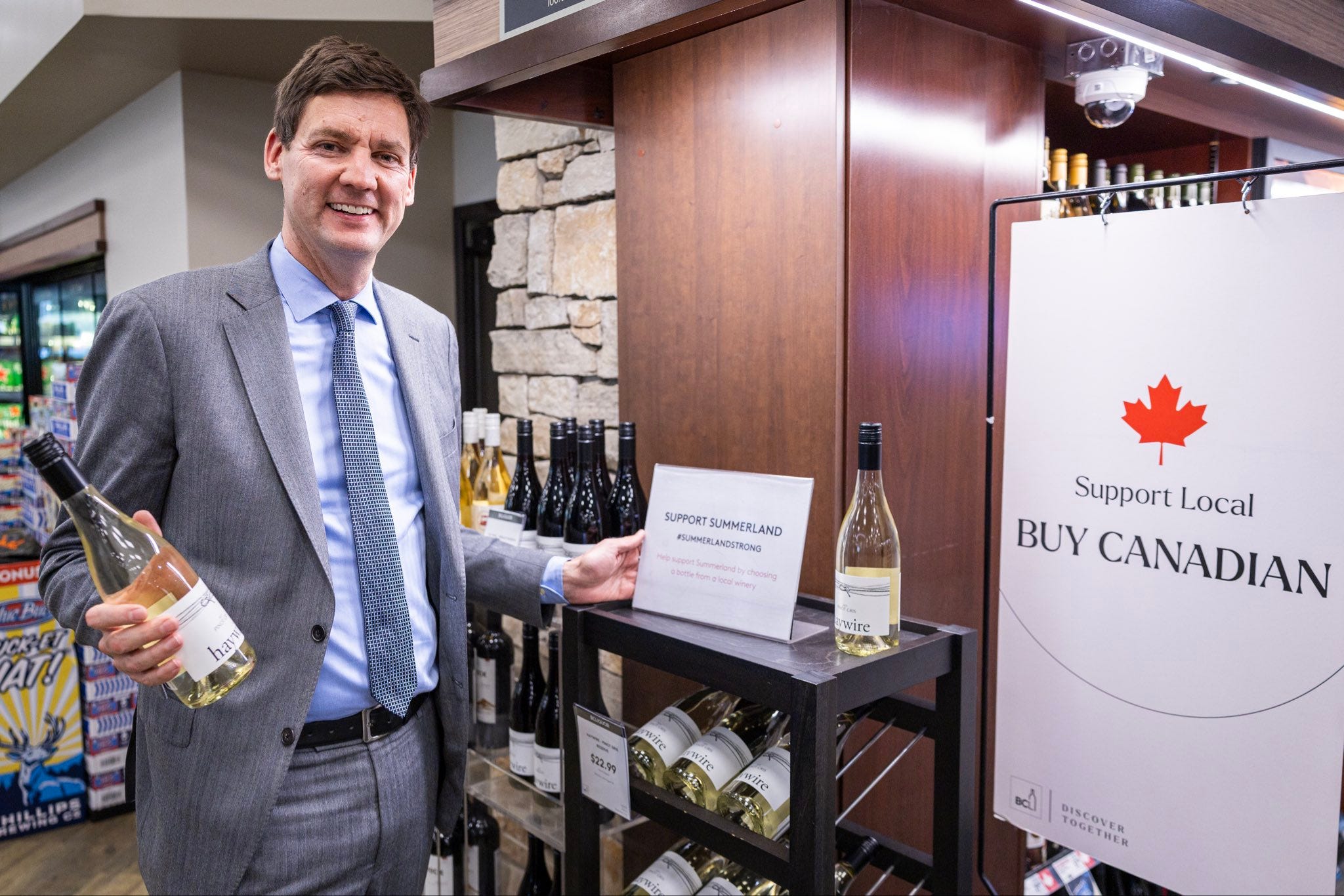
Eby leapt at the opening, appearing earlier this month in flannel dinner jacket, in front of a giant Canada flag, alongside a folksy local rapper who sang about poutine and hockey, to proclaim the province at an “existential moment” of “crisis” that required his leadership.
Tuesday, he rolled the anti-U.S. messaging into a snap election campaign, only two years into his four-year mandate, in an attempt to bolster his chances of staying leader. He currently has a three-seat majority in the legislature, but proclaimed it too “fragile.”
“Join me in saying hell no to Trump and his politics for British Columbia,” Eby said in his campaign launch. “Because the conditions have changed. The moment is here. Let’s meet it together.”
New Democrat strategists are hoping the fear over Trump will blunt any desire for change from voters who’ve had an NDP government now for more than nine years. And by striking early, while the B.C. Conservatives are in disarray, New Democrats also hope to crack open victories in voter-rich Surrey, the Fraser Valley and even the Interior and North.
But in its launch, the B.C. NDP campaign offered zero new policies or proposals. Eby did cite the “chaos” inside the rival B.C. Conservative Party as justification for sending the province to the polls.
To be fair, chaos is perhaps even an understatement for the state of the Conservatives.
Former federal MP Kerry-Lynne Findlay won the party’s May 30 leadership race by only 60 votes on the fourth and final ballot, exposing a base deeply divided over whether to be moderate, or swing hard right.
Findlay stormed into office like she’d won a supermajority, proclaiming an agenda of “faith, family and freedom.” She demanded a salary, clothing allowance, driver and vehicle before even winning a seat. But she rarely showed up for caucus meetings, appearing entirely disinterested in hearing from anyone other than a small group of loyalist MLAs and her husband Brent Chapman (also an MLA).
Findlay quickly purged the Conservative caucus and party of almost all staff, deeming them disloyal to her cause, and installed a new team of — to put it charitably — weirdos, malcontents and grifters.
Her new operations director, Apollo Chung, arrived from the separatist Alberta Republican Party, sowed discord in the ranks, and then was fired after a leaked audio recording in which he allegedly spoke about “stealing” money from the party and donors.
Her chief of staff, Chris Delaney, allegedly offered several MLAs jobs and salaries if they’d give up their seat for the leader to run in a by-election (the RCMP have since interviewed at least three MLAs about whether that was an inducement under the Criminal Code) before he flamed out and resigned.
Her communications director, Cosmin Dzsurdzsa, parachuted in from right-wing website Juno News to proclaim open war with the mainstream media, blacklisting certain journalists and pivoting Findlay towards exclusive interviews with fringe “influencers,” including a gentleman who posted AI-generated videos of Donald Trump beating up Mark Carney.

Meanwhile, Findlay’s party executive director Elaine Allen allegedly hired a private investigator to spy on critics of the leader, including current and former Conservative MLAs, and a journalist (full disclosure: me).
In all cases, Findlay denied any knowledge of anything any of her staff had ever done.
MLAs started leaving; first a trickle, then a flood. Fundraising tanked. The architects of the 2024 election campaign that had vaulted the Conservatives from zero to 44 seats were removed.
By last weekend, 14 MLAs had quit or been fired by Findlay — a third of the remaining caucus.
Former leader John Rustad recalled how after he called for Findlay to step down in a closed-door meeting, he was fired by late-night text from the leader, rehired 15 minutes later, and then fired again by text the next day.
“I’m not going anywhere,” Findlay proclaimed on Friday. But by Sunday, she’d been forced out.
Her reign barely lasted four months, but the damage to the party looked fatal. Eight MLAs had joined a rival party called CentreBC. In a telling sign, the far-right party known as OneBC publicly defended Findlay. The Conservative party was caught in the middle.
B.C.’s business community began to wring its hands about the kind of centre-right vote split that could keep the NDP in power.
Then a funny thing happened. Eby’s early election call Tuesday galvanized the centre-right movement in B.C.
Suddenly, federal Liberal and Conservative organizers started talking. Enemies who’d been fighting online in the wake of the B.C. Conservative leadership race put down their Twitter swords. And within the span of 24 hours, a coalition of some of the province’s brightest strategists were actually working together to cobble together a last-minute election campaign to challenge the NDP.
At the centre of all of this is an interim Conservative leader you almost assuredly have never heard of. His name is Lorne Doerkson and he’s from Williams Lake, in B.C.’s interior. He’s got a low profile, and spent much of his time at the legislature as the assistant deputy speaker.
But Doerkson was named the party’s interim leader for one reason: everyone inside caucus likes him and wants to work with him. So the mild-mannered former newspaper publisher is now the unlikely centre of a provincial election campaign, backed by a coalition of frenemies that are (temporarily) working together to fight a common political enemy.
That’s an extremely truncated version of the last five months in B.C. politics. And it still took more than 1,000 words.
The province is now in the middle of a 32-day campaign that overlaps its municipal elections and is set to conclude Oct. 24. Eby has rolled the dice on his political future, calculating his best chance to survive is to get re-elected with a stronger majority while he’s got cover from Trump and weakened opponents. He may be proven right. Or he may have kicked a hornet’s nest in the B.C. Conservatives, and inadvertently given his opponents a rallying cry to come back together.
Rob Shaw is the host of Political Capital, a daily podcast on B.C. politics and a weekly analysis show. He’s also a political correspondent for CHEK News TV in Victoria, and writes for Business in Vancouver and Northern Beat. He’s covered B.C. politics for the past 18 years.
The Line is entirely reader and advertiser funded. No federal subsidies, no bailouts. If you value our work, please consider supporting us by subscribing or making a donation. Donations are not subscriptions and do not unlock paywalled content, but they help keep The Line independent

To contact The Line with a general inquiry or comment, please email info@readtheline.ca. For other ways to connect with us or to follow us on social media, please see our LinkTree.
I’m going with the hornets nest theory and that Eby with this blatant display of opportunism and cynicism will actually unite and reinvigorate the opposition. He may have underestimated completely the public’s dislike for his politics and that of his party.
This is going to be interesting: I think David Eby called his snap election a few days too late. If he’d called it before Kerry Lynne Findlay’s resignation, he’d have achieved his goal of campaigning against a fractured opposition. Calling it after Findlay’s resignation presents B.C. voters with a choice of NDP and not-NDP: the B.C. Conservatives can fill an undefined Schrodinger’s Cat undetermined space.
I think not-NDP is going to have a strong appeal: the delegation of powers to First Nations and the threat to property rights are extremely unpopular. Provincial finances are in bad shape, the health care system is a mess straining to provide care, and the condo and construction businesses that have been driving the economy are sputtering.
The real hope for the NDP remains a fractured right of center vote. The hard right has almost no chance of winning power in B.C.: they might be able to elect a handful of MLAs in the southern interior, but are toxic in the urban ridings on the coast that determine who forms government. The B.C. Conservatives were a perpetual worry for the right wing BC Liberals, as they could potentially split the vote in some of those interior ridings that the Liberals needed to win a majority. Now the B.C. Liberals have basically moved to the Conservatives, so the quarks will be whether OneBC becomes the new BC Conservatives, or the provincial equivalent of the People’s Party of Canada.
Anyway, this simplifies my choice of vote at the end of October: it’s time for the NDP to go. Eby seems to understand what needs to be done on a number of fronts, even if that’s been belatedly forced on him by reality. His reluctant concessions on ending drug decriminalization and rescoping reconciliation are stymied by an NDP caucus that still won’t acknowledge reality. However, I could not vote for a party led by Kerry Lynne Findlay: right wing populists can call themselves conservative, but they’re actually every bit as radical as the NDP.