

By: Jen Gerson
Elections Alberta had reasonable grounds to know that separatists had access to the province’s voter file at least a month ago, and as far as I can tell, they did sweet fuck all about it.
Let me explain.
On Thursday, Elections Alberta obtained a court injunction to force a separatist group to take down an online database that was populated from the electoral list that is generally only available to select political staff who need access to that data to do legal voter contact and outreach. Access is limited because the voter file contains reams of personal information, including full names, addresses, electoral and local polling districts, phone numbers and emails. Typically, provincial parties will each get a copy of the voter file, and there are strict controls over who can see what, and how personal information can be used.
For very real reasons. The voter file can be used to harass public figures, or track down victims of stalking and domestic violence, which is why the database isn’t supposed to be bandied about carelessly. Holders of the file need to know who can read the data and be able to conduct internal audits of the information they are pulling from it.

At no point should the voter file be freely available to the likes of David Parker, a local political activist in Alberta, well known for his organizational efforts to elect Premier Danielle Smith, and currently running what he calls the Centurion Project.
The Centurion Project is a registered third-party advertiser that seeks “To recruit, equip and mobilize a team of community leaders across the province of Alberta to take on the task of winning Alberta’s sovereignty.”
As court filings now show, the project stands accused of creating a database based on a copy of the voter file allegedly given to Parker by The Republican Party, a fringe and failed effort to elect another well-known political figure, Cam Davies, in Olds-Didsbury during a byelection last year.
Parker’s stated goals were to amass more than 100 volunteers through his project (though he claimed to me personally that he had more than surpassed that goal and hoped to reach 1,000 by mid-April.)
Once the rando volunteers signed on, however, they were given nearly unfettered access to a database that included Alberta’s voters, including their home address, polling, and electoral districts.
The RCMP is now investigating. Separatist meetings have been met with police. Elections Alberta is investigating, and the aforementioned court injunction shut down the Centurion database on Thursday.
Later that same day, Elections Alberta issued its timeline of events:
On April 27, 2026, credible information was obtained suggesting the Centurion Project may be in possession of the List of Electors provided to a registered political party that was a legitimate recipient of the list. Inquiries into the validity of this information began immediately.
On April 28, 2026, the Chief Electoral Officer wrote to individuals associated with the Centurion Project to advise them that if they were accessing a List of Electors, they must immediately cease and desist.
On April 29, 2026, representatives from Elections Alberta, supported by members of the Edmonton Police Service, attended a meeting of the Centurion Project Ltd. being held in Edmonton, to ensure the cease-and-desist letter was received.
Event organizers were once again advised, and a copy of this directive was personally served to a representative of the Centurion Project, to immediately cease and desist accessing any information contained in the List of Electors.
That all sounds like a fast, impressive response. But. Here’s the thing. That summary is, uh, missing a few damn dates.
Like, say, March 31.
That’s when someone reported to Elections Alberta that the Centurion Project appeared to be getting promiscuous with the voter file.
On that date, an email was sent to Elections Alberta titled: “Need to report possible violation - Urgent.” In that email, someone told Elections Alberta this:
David Parker’s new Centurion Initiative appears to be soliciting volunteers. Once accepted - and there appear to be no permissions set up for that acceptance - volunteers are then given access to what appears to be the entire Alberta Voter File.
How do I know this?
I know this because that person was me. I wrote that email.

This all began in late March, after I received a tip from an anonymous source. Using a burner email account and offering no name, nor any traceable personal information, this person signed up for the Centurion Project, immediately saw what was available, and wanted to report the situation as a massive privacy breach. They didn’t want to do it directly, however, so they came to me.
I was able to verify that what the source had sent me was true. My source had access to recent personal information from what appeared to be millions of people — me included. Further, the way the data was structured, which included polling and electoral districts, made it likely to have originated from a voter file I knew the Centurion Project wasn’t supposed to have. (Parker has denied this, and says the database was compiled from a third party.)

This situation, however, put me in a bit of a journalistic pickle. If I just went out and reported on it, I knew anybody would be able to sign up and access the same data — which could potentially put people in danger of exposure.
So, I did what I thought was the right thing. With my source’s consent, I contacted Elections Alberta directly and told them what I was seeing.
On April 1, I got a call from an Elections Alberta investigator and told him what I knew save the identity of my source. The investigator seemed to take my report seriously.
On April 10, I received a Notice of Outcome, which I have attached below.
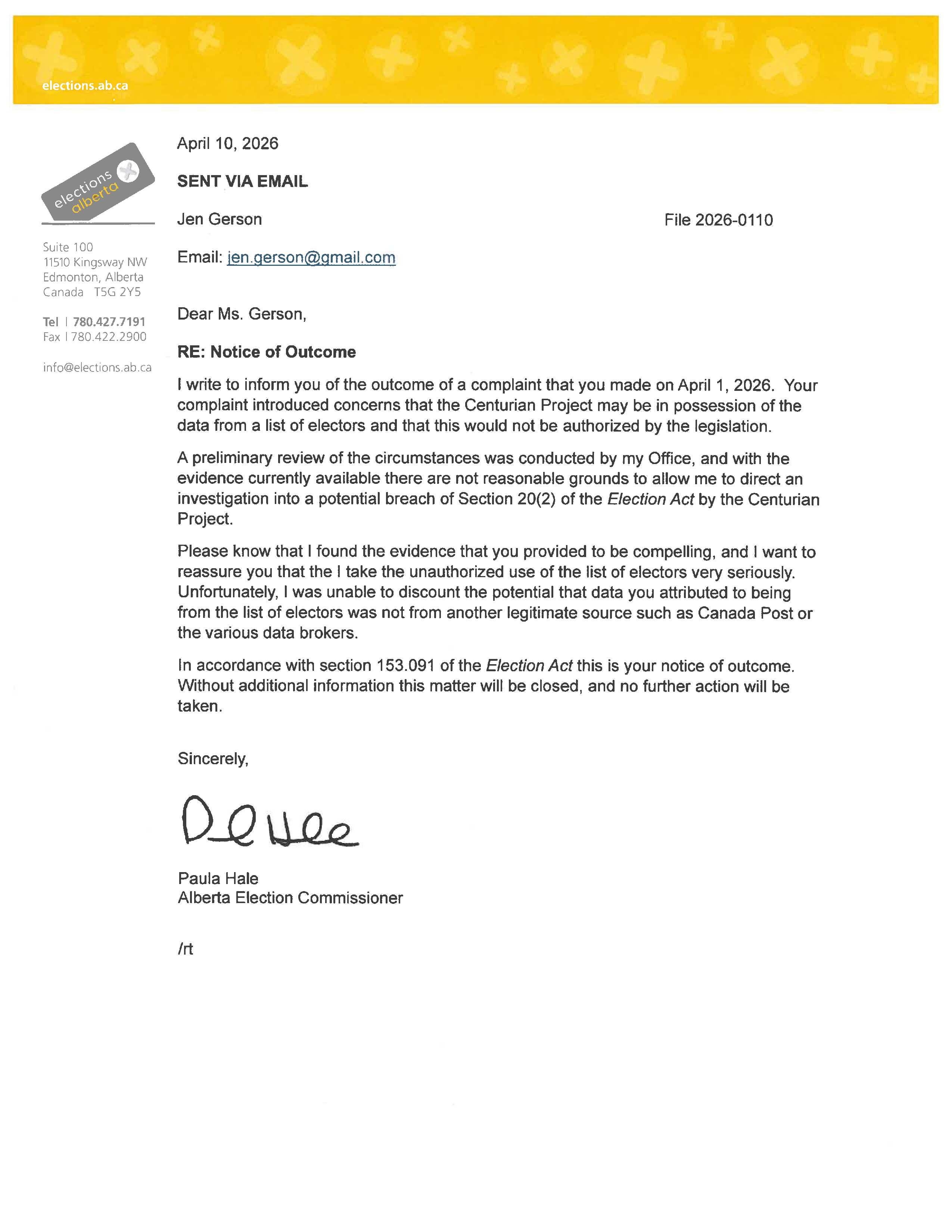
As you can read for yourself, the Alberta Election Commissioner, Paula Hale, said that while the evidence I provided was “compelling,” she couldn’t conduct further investigation because there was no proof that the information Parker compiled wasn’t gathered through legal means.
Gloss over, for a moment, the privacy implications. Instead, stop and just examine the logic of this dismissal. Even though the evidence was compelling, no further investigation into whether or not the data was legally obtained could be done. For … reasons.
Now I don’t claim to be no criminal genius, but that don’t make no damn sense.
If you have compelling evidence of a crime, you don’t not investigate said crime because it’s possible a crime wasn’t committed. You, you know, look into it?
Further, as reporting has subsequently revealed, the voter file distributed to various political parties is seeded — that is, the file has false information placed within it so that in the event of an unauthorized breach, an investigator can trace the origin of the file back to the party of origin.
I can only presume that this is how Elections Alberta came to believe that Parker’s copy of the file originated with the Republicans. That should have made investigating this complaint trivially easy — all anybody had to do was to sign up for the Centurion Project and run a few basic database searches.

Anyway, after receiving this letter, I found myself in a double journalistic pickle. I was hoping that Elections Alberta would look into it, see the blindingly obvious, and then issue an injunction allowing me to report on it. That’s not what happened. Not only was the database still freely available to anybody who signed up; but now I was the complainant, which is not a position any journalist wants to find herself in. I didn’t want to make the story about me.
So, I, uh, passed the ball along to other people whom I knew could pick it up.
And today, here we are.
I’m glad that the injunction was granted. With the list taken down, I feel comfortable reporting on the topic. But boy-o, does Elections Alberta have some explaining to do. I probably wouldn’t have written about my involvement in any of this at all except that the, shall we say, truncated timeline of events they offered today really pissed me right off.
Because it seems to me that if they had simply taken this complaint seriously enough to investigate properly a month ago, they could have received that very same court injunction before the breach came out in the media. And that’s before we begin to ask how many additional people gained access to all that personal data over the last 30 days.
The Centurion Project is an exponential exercise. Once that data is in the wild, it’s not possible to re-home it. The injunction demanded that both the Centurion Project and the Republic Party identify every single person and entity who had access to that information, along with contact information. And all I can say is — good luck, guys. If my source was able to gain access to the partial file with a burner account, I highly doubt these guys even have that information to turn over.
We simply have to operate under the assumption that basically anyone in the province, no matter how unhinged, may now have nearly universal access to the personal information of everybody who lives here, and that there’s not a damn thing any of us can do about it.
The Line is entirely reader and advertiser funded. No federal subsidies, no bailouts. If you value our work, please consider supporting us by subscribing or making a donation. Donations are not subscriptions and do not unlock paywalled content, but they help keep The Line independent

To contact The Line with a general inquiry or comment, please email info@readtheline.ca. For other ways to connect with us or to follow us on social media, please see our LinkTree.
The revelations Jen Gerson made to Alberta elections officials should have resulted in immediate action. That they did not underscores the need for the Canadian government and its provincial counterparts to impose much tougher restrictions on the use and dissemination of voter lists.
This was a huge breach of privacy, one that the Canada Elections Act (S.C. 2000, c. 9) is practically set up to facilitate.
More generally, Canadians ought to ask much tougher questions of ALL political parties and their rights and responsibilities.
I hope there are criminal charges laid against David Parker and other principals of the Centurion Project. In my view a criminal inquiry should be called to determine whether there was collusion between Alberta elections officials and the UCP government of Danielle Smith (designed to frustrate or prevent the investigation of this breach).
Thank you to Jen and The Line for publishing this article.
You know, for a group that is ostensibly for Albertans these separatists sure show a lot of contempt for most Albertans.
My gratitude for your efforts here Jen.