

By: Scott Stinson
Well, that sucked.
To what, you might ask, am I referring? The gut-punch overtime loss of the men’s national hockey team on Sunday? The gut-punch overtime loss of the women’s national hockey team on Thursday? The Milan-Cortina Olympics in general?
Yes.
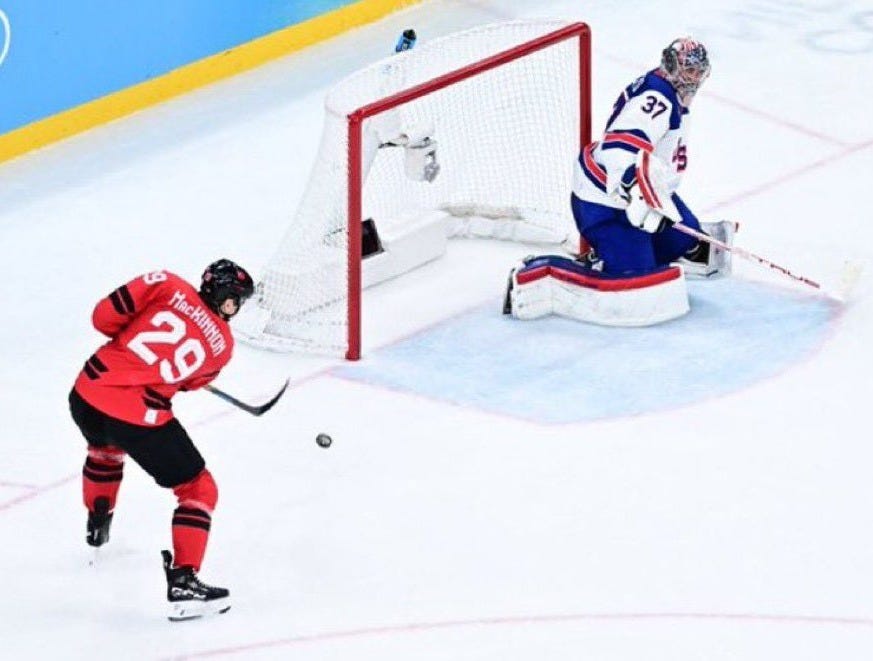
There were moments, as NHL superstars like Connor McDavid, Nathan MacKinnon and Macklin Celebrini were missing chance after chance on Sunday morning, where we all knew where this was going. The Americans were going to pull this thing out, and then we would all have to grit our teeth while they acted like dicks about it.
Sure enough, the on-ice celebrations in Milan had barely finished — celebrations in which the players laudably included the children of teammate Johnny Gaudreau, killed last year by a drunk driver — when the official White House account on social media posted an image of an eagle throttling a goose. This, after a game in which the Americans were largely outplayed and barely managed to eke out a win.
To the victors go the classless spoils, I guess.
But as much as those two hockey games were lost by the narrowest of margins, and even if Canada came oh-so close to a pair of wins that would have done wonder for the national mood, the Milan Olympics were something of a bust for Team Canada long before Jack Hughes rifled home that game-winning shot in overtime.
Twenty-one medals is a decent haul, and one that would have been hailed a few decades ago, but it is also the lowest total for Canada at a Winter Games since Salt Lake City in 2002. From fourth in total medals at Beijing 2022, Canada was down to eighth in Milan. There were many great individual performances, of course, but overall if felt like a Games, much like that hockey game, of opportunities missed.
There had been warning signs that something like this might be coming. The story of Canada’s Olympic success in recent years was well known: an aggressive funding push, beginning with the federal government, was made in advance of the Vancouver-Whistler Olympics in 2010. The pool of money for training and development was expanded, but the way in which it was allocated was also adjusted: more for sports that had medal potential, less for the sports that were likely to just produce Olympic participants.
That eventually led to record-setting Canadian performances in the Winter and Summer Olympics.
But, if I told you that that the federal government had backed what had become a very successful program, and then just kind of ignored it and assumed everything would keep ticking along, would you be surprised?
I’ll answer that for you: No, you would not.
Late last year, I was speaking with David Shoemaker, the head of the Canadian Olympic Committee, for a feature story in a different publication about the rise of Canadian sport, and he said, unbidden, that there were worries about the funding well drying up.
“With declining funding, all this can grind to a halt,” Shoemaker said. “We’re trying to convince the government that this is a virtuous circle that’s well worth our investment to keep moving along.”
The basic sport funding envelope from Ottawa hadn’t really changed since before Vancouver, he said, and meanwhile costs had risen sharply and other nations had poured more of their resources into high-performance sport, eliminating any financial advantage that Canadian athletes might have once had.
Anne Merklinger, the head of Own the Podium, the organization that directs where training and development money goes, told me much the same thing. “We’ve been a victim of our own success,” she said. “Because the funding pot, is staying the same, but we’ve got more and more sports that have an athlete pool that is tracking for a podium result in either the Olympic or Paralympic Games, winter or summer.”
The money was being spread thin. It’s a nice problem to have, Merklinger said, but it’s still a problem.
There were alarm bells being rung more forcefully as Shoemaker and other COC officials gave their closing press conference in Italy.
Eric Myles, the organization’s chief sport officer, gave the quote that was intended to get the Mark Carney government to raise its eyebrows in alarm: “Our system is in decline,” he said.
Is it as simple as throwing more money at sport and waiting for the medal count to start going up again? No, although Shoemaker has said that other G7 nations are vastly outspending Canada on a per-athlete basis.
It is also notable that the United States is not one of them, at least with public money. Philanthropy plays a much bigger role in funding U.S. amateur sport, and certainly there is room for growth with Canadian organizations like b2ten and Great for Gold that funnel private money toward athletes with medal potential.
Governments (and philanthropists) have countless demands on their resources, naturally, and it’s fair to wonder if spending money on snowboarders and skiers is a sensible investment given, you know — gestures wildly at the state of the world — things. I’ll admit that I’ve had some of those thoughts myself, even while actually covering an Olympics on site. The IOC is such an infuriating organization — how dare the Ukrainian athlete memorialize his countrymen killed by Russia, it says with a straight face — that chasing medals with public money can feel a little grubby.
But I also have no doubt that sport can serve a serious nation-building function. Two of the events I covered over the years that drew the most reader interest were the gold-medal wins from the women’s soccer team at Tokyo 2020 and the women’s hockey team at Beijing 2022. Countless Canadians were living and dying with those teams, and the national pride when they won could be felt even while way over there on the other side of the planet.
Good vibes, I think, could come in rather handy, right now.
Scott Stinson is a journalist based in suburban Toronto and contributor to The Line. He has covered four Olympics.
The Line is entirely reader and advertiser funded — no federal subsidy for us! If you value our work, have already subscribed, and still worry about what will happen when the conventional media finishes collapsing, please make a donation today. Please note: a donation is not a subscription, and will not grant access to paywalled content. It’s just a way of thanking us for what we do. If you’re looking to subscribe and get full access, it’s that other blue button!

The Line is Canada’s last, best hope for irreverent commentary. We reject bullshit. We love lively writing. Please consider supporting us by subscribing. Please follow us on social media! Facebook x 2: On The Line Podcast here, and The Line Podcast here. Instagram. Also: TikTok. BlueSky. LinkedIn. Matt’s Twitter. The Line’s Twitter.Jen’s Twitter. Contact us by email: lineeditor@protonmail.com
Meh. Hockey games. Olympics. I like watching them as much as the next Canadian does, but let's be honest - the whole thing is a spectacle. I have nothing against the athletes and coaches, just the whole pretence of the Olympics somehow being critical to our national pride. If it is, that speaks to our national inferiority complex, particularly with regards to the United States.
I (really, really) wanted the Canadians to beat the Americans in hockey, but they didn't. I've been as conditioned as the rest of you that Canadians are somehow better if they did beat them. The reality - both the mens and womens team played as well as could be expected, but both fell short - and it doesn't really matter to the lives of individual Canadians.
Whatever happened to 'it was a good game'; we lost. Oh well. Moving on...
Other Canadian athletes came close to winning medals, but did not.
Oh well, they did their best. Moving on.
Unpopular opinion - we do not need to spend any more public money on elite athletes in an effort to gain more medals in a misguided attempt to boost our national pride. I really couldn't care less what other countries spend on their elite Olympic athletes.
We should refocus the public money spent on elite athletes to build quality facilities and coaching for athleticism at the local level in Canada - let's get more YOUNG Canadians off their damn screens and becoming active and healthy through athleticism, encouraging them to be the best they can be - not to win medals for Canada (though that will eventually come), but rather to teach them they can improve themselves through consistent, steady effort. That ethic goes way beyond athletics and pays dividends in REAL LIFE, which will improve life in Canada for all.
The Olympics are fun spectacle, but in reality they are a worldwide public money draining scam run by the IOC and national organizations around the globe that are beholden to them. We should stop buying into the scam - the sooner, the better.
I have absolutely no issue with the White House tweet depicting the eagle and the Canada Goose. It was funny and in response to Junior's tweet last year after we won in the Four Nations Competition: "You can't take our country - and you can't take our game". No issue with Junior saying that, either, just to be clear, but it opened the door WIDE open to this response from Trump. Trash talk goes BOTH ways.