

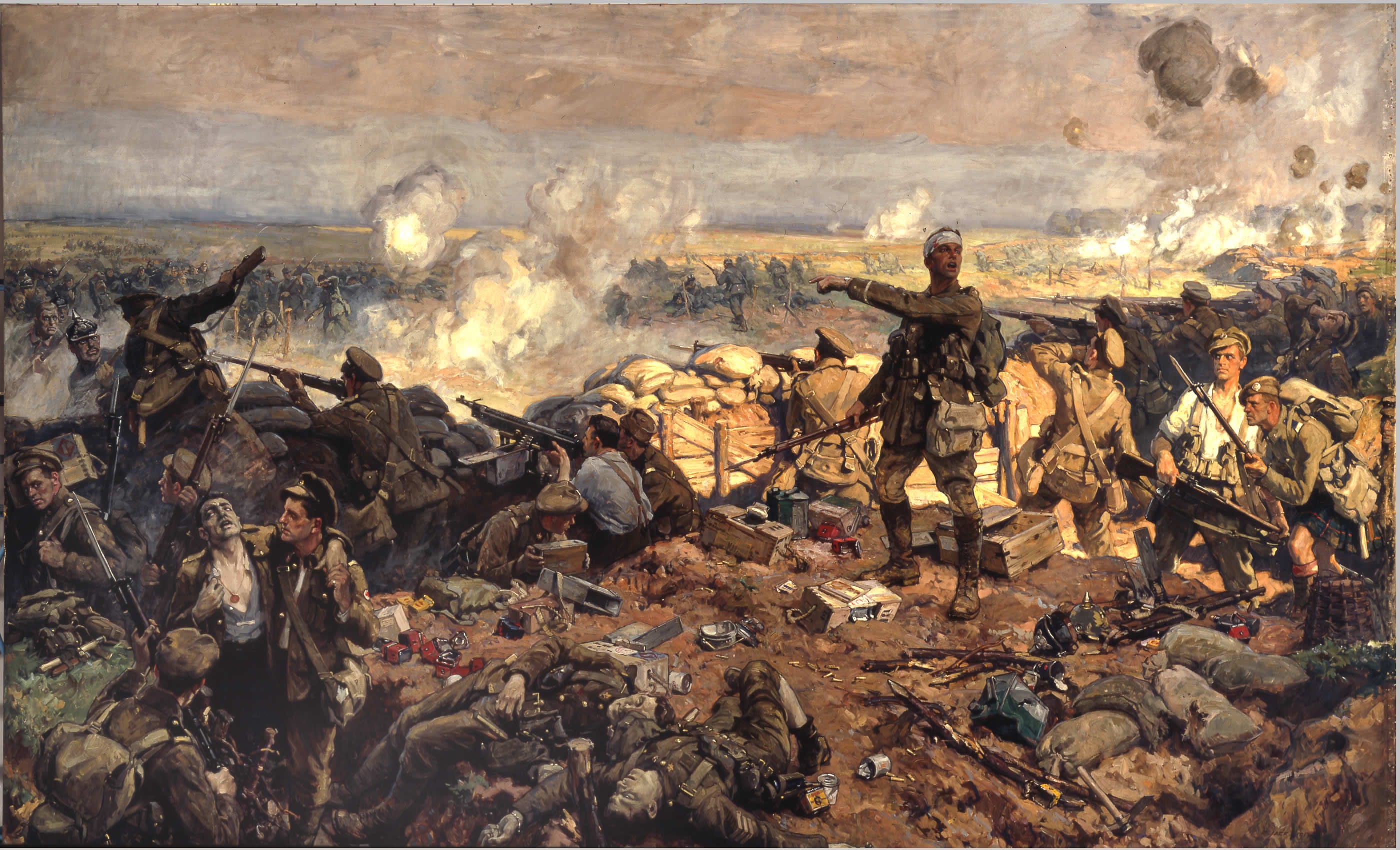
Ypres 1915
The age of trumpets is passed, the banners hang
like dead crows, battered and black,
rotting into nothingness on cathedral wall.
In the crypt of St. Paul’s I had all the wrong thoughts,
wondered if there was anything left of Nelson
or Wellington, and even wished
I could pry open their tombs and look,
then was ashamed
of such morbid childishness, and almost afraid.
I know the picture is as much a forgery
as the Protocols of Zion, yet it outdistances
more plausible fictions: newsreels, regimental histories,
biographies of Earl Haig.
It is always morning
and the sky somehow manages to be red
though the picture is in black and white.
There is a long road over flat country,
shell holes, the debris of houses,
a gun carriage overturned in a field,
the bodies of men and horses,
but only a few of them and those
always neat and distant.
The Moors are running
down the right side of the road.
The Moors are running
in their baggy pants and Santa Claus caps.
The Moors are running.
And their officers,
Frenchmen who remember
Alsace and Lorraine,
are running backwards in front of them,
waving their swords, trying to drive them back,
weeping
at the dishonour of it all.
The Moors are running.
And on the left side of the same road,
the Canadians are marching in the opposite direction.
The Canadians are marching
in English uniforms behind
a piper playing ‘Scotland the Brave.’
The Canadians are marching
in impeccable formation,
every man in step.
The Canadians are marching.
And I know this belongs
with Lord Kitchener’s mustache
and old movies in which the Kaiser and his general staff
seem to run like Keystone Cops.
That old man on television last night,
a farmer or fisherman by the sound of him,
revisiting Vimy Ridge, and they asked him
what it was like, and he said,
There was water up to our middles, yes
and there was rats, and yes
there was water up to our middles
and rats, all right enough,
and to tell you the truth
after the first three or four days
I started to get a little disgusted.
Oh, I know they were mercenaries
in a war that hardly concerned us.
I know all that.
Sometimes I’m not even sure that I have a country.
But I know that they stood there at Ypres
the first time the Germans used gas,
that they were almost the only troops
in that section of the front
who did not break and run,
who held the line.
Perhaps they were too scared to run.
Perhaps they didn’t know any better
— that is possible, they were so innocent,
those farmboys and mechanics, you only have to look
at old pictures and see how they smiled.
Perhaps they were too shy
to walk out on anybody, even Death.
Perhaps their only motivation
was a stubborn disinclination.
Private McNally thinking:
You squareheaded sons of bitches,
you want this God damn trench
you’re going to have to take it away
from Billy MacNally
of the South End of Saint John, New Brunswick.
And that’s ridiculous, too, and nothing on which to found a country.
Still
It makes me feel good, knowing
that in some obscure, conclusive way
they were connected with me
and me with them.
— Alden Nowlan
One hundred and eight years ago today, the guns fell silent. The Line remembers that, and all we’ve done since. Lest we forget.
I remember the dust and the grit of Afghanistan, which gets into literally everything, and the shrieking whine of the Harriers at Kandahar Airfield as they returned from their sorties. I remember the tired, gaunt faces of American infantry soldiers as we hung out and chatted, waiting for our laundry to finish. I remember the blood on the floor of the rear entrance to the hospital at KAF, after another dustoff flight had arrived with wounded. We would pause the work we were doing there so that the wounded and those tending to them wouldn't have us in their way. I remember riding along at night in an armored HLVW, heading to a FOB for a tasking there, wondering which of the many yellow Corolla wagon taxis passing by would turn out to be one of the half-dozen VBIED's assessed to be out looking for targets of opportunity. I remember standing on the apron at KAF with Task Force Afghanistan and "sand in my eyes", paying our respects as Glyn Berry left for the last time the country he had volunteered to help, ultimately costing him his life. I remember all of that and much, much more, like it was yesterday instead of a couple of decades ago. I am fortunate; I came home to my family, physically intact although mentally a bit scarred. Many others either didn't come home at all, or came home shattered, either physcially, mentally or both. I am not looking for thanks or recognition. I am simply sharing some of the memories I live with every single day. More than 40,000 Canadian military personnel, and hundreds if not thousands of Canadian civilians served in Afghanistan; 165 of them never made it home alive. I would like to see more recognition of that.
Oh my. That there are Private McNallys in the world is a blessing to all of us who aren't.