

By: Andrew Potter
I took my son to the Grey Cup in Calgary last weekend, partly to fulfill a long-standing wish to catch a CFL final live, but also to introduce the boy to one of the great and uniquely Canadian sporting traditions. It ended up serving as something of a wake for two important parts of the Canadian identity.
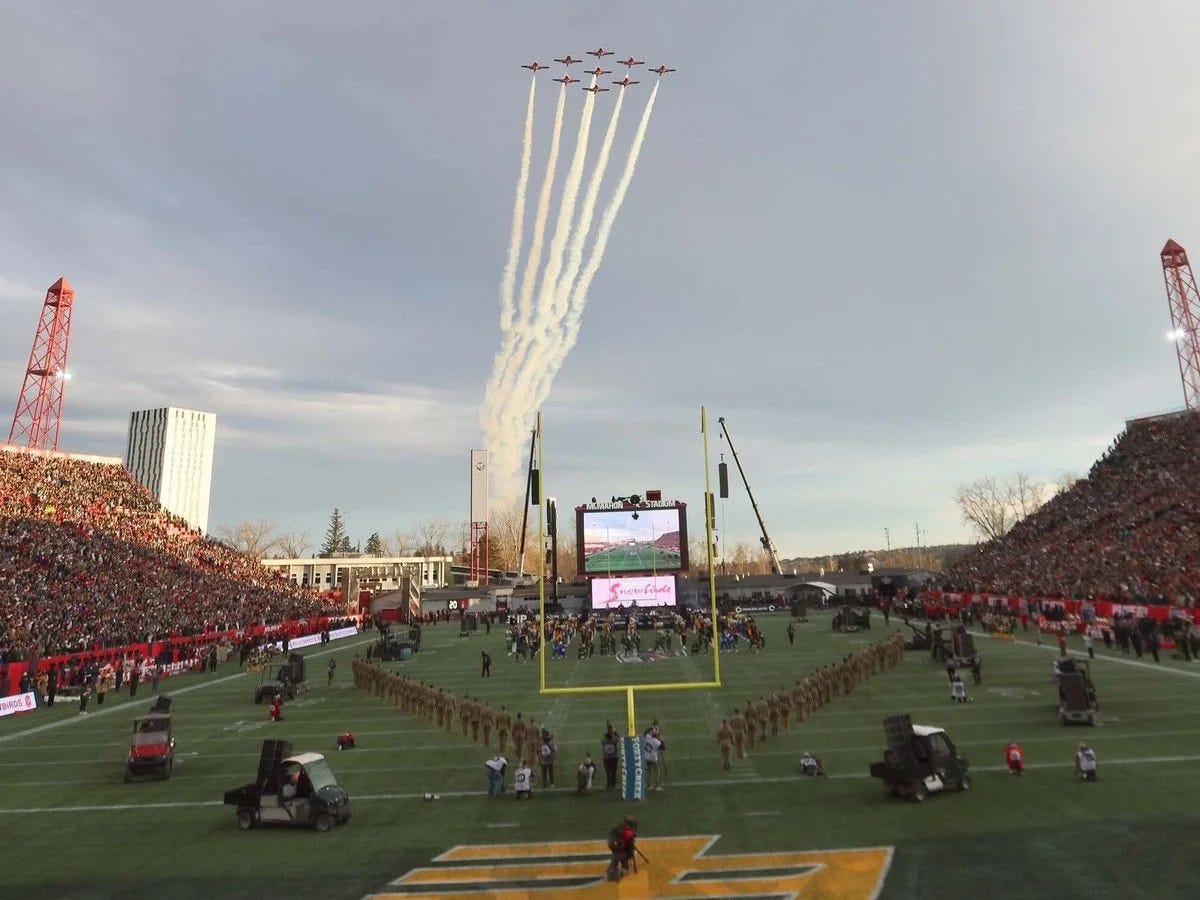
As part of the pre-game ceremonies, the Snowbirds made a pair of spectacular passes over McMahon Stadium, the undersides of the Tutor jets glinting as the setting sun shone through the aerobatic smoke trails of the nine-member formation. It was an electric moment that had the crowd buzzing for minutes afterward, and not just because the Snowbirds are magnificent. As everyone in the crowd knew, it was the very last public appearance for the 431 Air Demonstration Squadron of the RCAF, which is being retired after 55 years in service.
But it was not only the Snowbirds who were getting a sad farewell in Calgary last Sunday. In many ways, the 32,000 fans in the stadium were gathered to say goodbye to Canadian football itself. The major difference is that while the fate of the aerobatic team is the result of Ottawa’s demolition by neglect, the demise of Canadian football is being actively engineered by the CFL brain trust in an astonishing act of self-sabotage.

The CFL is introducing a number of changes to the game that, starting next year, will remove almost everything that makes it distinctly Canadian. The end zones are being shrunk from the current 20 yards down to 15 yards. The goalposts are being moved from the goal line to the back of the end zone. And crucially, the classic 55-yard line is being eliminated as the field shrinks from 110 yards to the American standard of 100 yards.
The league has offered three rationales for these changes, all of them suspect. The aim, supposedly, is to increase scoring, improve fan engagement, and bring uniformity to the league’s stadiums. Let’s take these one at a time.
CFL commissioner Stewart Johnston has said one of the hopes for the shortened field (along with other changes) is to increase scoring by “trading field goals for touchdowns”. But it’s not clear what problem needed solving, since the CFL is already a high-scoring league. By any measure — points per game, touchdowns per game, what have you — the CFL outscores the NFL, as it has since the 1970s. Only 1.2 per cent of all CFL games finish with under 30 points, compared to 11.5 per cent of NFL games. It is the same story for each league’s respective marquee championship: The last ten Grey Cup games have seen an average of 54.2 total points, compared to the Super Bowl’s 51.0.
The need to ensure “league-wide uniformity of end zone dimensions” is even more bogus. Canadian football has had 110-yard fields for over 100 years. The end zones have been 20 yards deep for 40 years. There are only two stadiums in the league that have trouble accommodating the full CFL dimensions: Percival Molson Stadium in Montreal, and BMO Field in Toronto. Molson Stadium has a running track going around the field, so the end zones are trimmed off a bit at the back corner. The problem is slightly more acute at BMO Field, which can only handle 18-yard end zones.
But here’s the thing: Molson Stadium was never intended for a professional CFL team — it’s a multi-purpose university facility that the Alouettes use because they have nowhere else to play. And BMO Field was constructed as a soccer-specific stadium that the Argonauts horned in on because, you guessed it, they have nowhere else to play. These teams are being crammed into unfit-for-purpose fields for one reason, and it is that they don’t have the fanbase or the community or corporate support to build them proper facilities.
Then there is the third argument, about increasing fan engagement. Here is how the league put it: “[These changes] are big and bold because that’s what’s necessary to make our fantastic game even more entertaining, and to win in the attention economy.”

It is probably worth pointing out the obvious here, that this is just code for making the CFL look more like the NFL (and maybe to a lesser extent the NCAA). The idea seems to be that if you make Canadian football look more American on social media, the kids will be more inclined to maybe buy a ticket to a game.
You only have to spend a weekend at the Grey Cup to see just how wrong-headed this is. This is far from a scientific poll, but I spent a good amount of time in Calgary asking fans from around the country what they thought of the upcoming changes. A few were willing to give the shortened end zones a try, and some were open to moving the goalposts. But every single person I spoke to frothing-at-the-mouth loathes the idea of 100-yard fields.
And this is because the whole “make the game exciting and win the attention economy” gambit has the order of things completely backwards. One of the neat traditions of the Grey Cup is that, no matter who is playing in the final, fans from all the CFL cities show up and spend the week walking around in their home team’s colours. The tailgate party before the game Sunday was a sea of people decked out in B.C. Lions orange, Ticats black and yellow, Blue Bombers blue, Stampeders red, and Saskatchewan green. But you know what there wasn’t much of? Alouettes red and blue, or Redblacks red and black. And what were there virtually none of? Argos fans. I might have seen one.
You aren’t going to win fans to the CFL by juicing scoring levels, or chasing the attention economy, or making the whole thing more USA-friendly. That’s not remotely what fan engagement is about. It’s about the communities that are built around these teams, the people who organize their weekends and their vacations around the team and the people they know they will see week after week, year after year. It’s about the distinctly Canadian traditions that they don’t just feel a part of, but which they actively help sustain and replicate.
The problem with the CFL is not scoring, nor is it fan engagement, properly understood. It is hard not to conclude that the most significant and defining feature of Canadian football, namely the size of the field, is being changed solely to accommodate the Argonauts, the team with the lowest attendance in the league, and which plays in a thoroughly Americanized city whose football fanbase treats the Buffalo Bills as their home team.
If the CFL really wants to make a major change to how the game is managed and marketed, probably the best thing they could do is move the head office out of Toronto.
The Line is entirely reader and advertiser funded. No federal subsidies, no bailouts. If you value our work, please consider supporting us by subscribing or making a donation. Donations are not subscriptions and do not unlock paywalled content, but they help keep The Line independent

To contact The Line with a general inquiry or comment, please email info@readtheline.ca. For other ways to connect with us or to follow us on social media, please see our LinkTree.
I couldn’t agree more. Love the CFL’s incredible culture, on display at every Grey Cup. I did see Argo and Als fans, but not a single Ottawa jersey. Moving head office is an inspired idea.
Toronto is a very America-focused city, particularly in terms of sports culture. That, in turn, influences media and that distorts the national aesthetic. So, yes to the conclusion