
By: Joe Varner
The question confronting Washington is no longer whether Iran is unstable, but whether that instability can be shaped in ways that advance regional security without strengthening the very regime it seeks to weaken.
What is unfolding inside Iran is not a symbolic protest movement or a transient wave of unrest. It is a sustained confrontation with a regime that remains coercively intact, anchored not by clerical legitimacy but by a security-economic system that controls borders, ports, energy infrastructure, construction conglomerates, and an estimated 40 to 50 per cent of national GDP. The Supreme Leader and senior ayatollahs provide ideological cover. The enforcement, surveillance, and repression are conducted by the regime’s coercive apparatus. Any discussion of regime change that does not begin from this reality misunderstands how power functions inside the Islamic Republic.
Despite nationwide protests, merchant strikes, women-led defiance, and youth mobilization, the regime retains control over the instruments of coercion. Security forces remain operational. Intelligence services are active. Internet shutdowns, mass arrests in the thousands, and the routine use of lethal force are not indicators of imminent collapse. They are evidence of a regime that has chosen repression over reform. This is not a government falling apart. It is a government fighting to survive.
That survival instinct now extends beyond Iran’s borders. In recent days U.S. President Donald Trump has signalled a willingness to use military force against Iran if the regime continues to kill its own people, and there are some indications that U.S. military forces in the region have begun amassing the forces that would enable such strikes. Tehran has explicitly warned that any military action against it would trigger retaliation not only against Israel and U.S. forces, but against regional states that assist them.
These threats are not rhetorical flourishes. They are central to Iran’s deterrence strategy, designed to widen the conflict envelope, intimidate regional partners, and raise the political cost of cooperation with Washington.
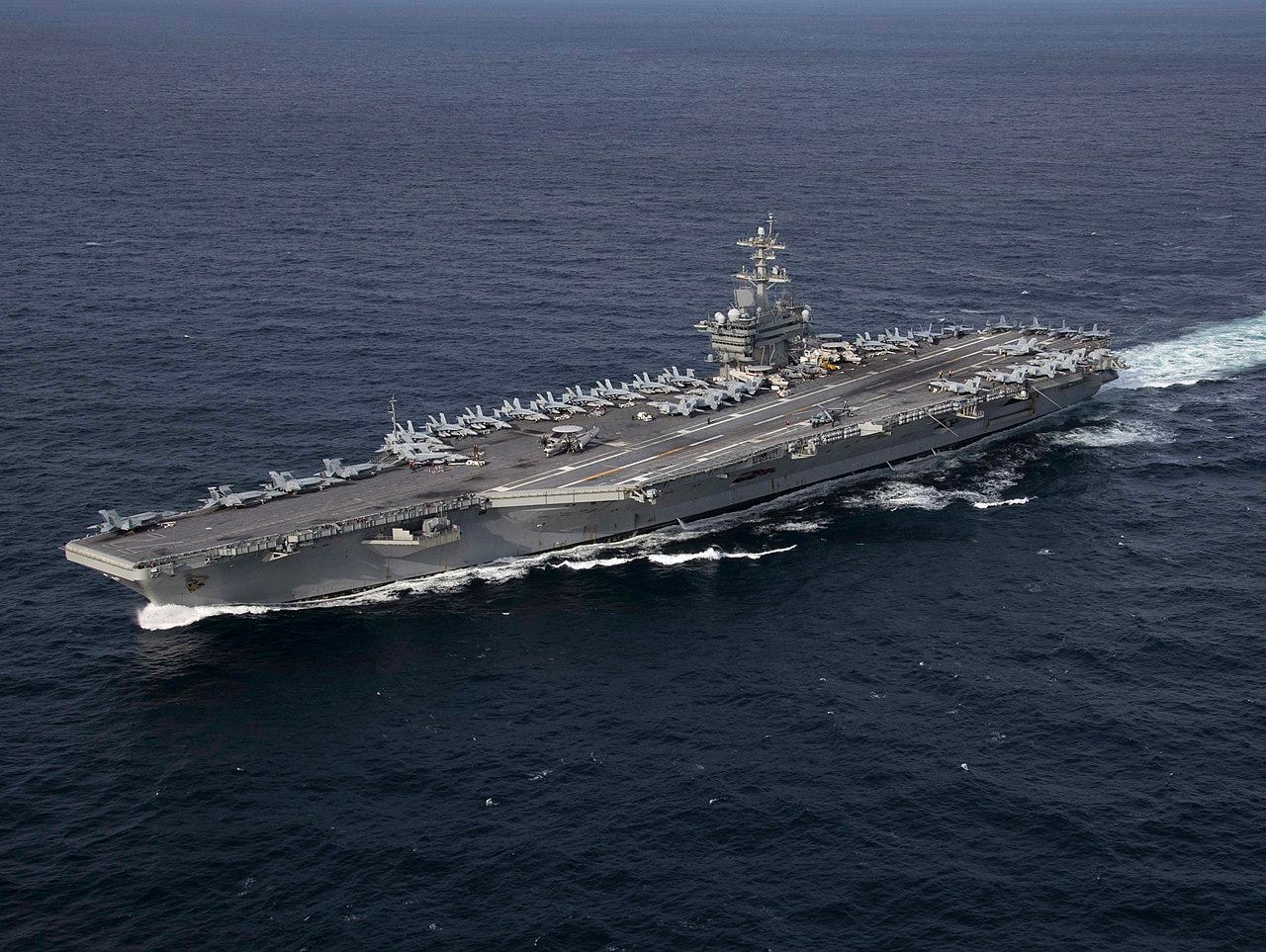
This reality matters. Despite signs of a buildup, at present, the United States has not marshalled the forces required for sustained large-scale military operations against Iran. The nearest carrier strike group, centred around the Abraham Lincoln, is days away, at the earliest. This is arguably useful, as the time needed to prepare for military action forces the U.S. to move cautiously and deliberately, particularly in a region where Iran has demonstrated both the intent and capability to retaliate through missiles, drones, proxies, and asymmetric attacks.
U.S. must also avoid being counterproductive. Overt invasion or a broad regime-toppling war would certainly consolidate elite cohesion in Tehran, validate the regime’s narrative of encirclement, and activate the very regional retaliation it has threatened. Authoritarian systems are strongest when faced with external attack, a dynamic Iran’s leadership has exploited for decades to suppress internal dissent.
Instead, Washington is weighing a narrower, more coercive toolkit. Precision airstrikes against select high-value regime or military targets, expanded cyber operations designed to degrade command, control and internal repression mechanisms, and intensified targeted sanctions against senior leadership and regime-controlled economic networks are all tools that raise cost without triggering immediate regional war. Used selectively, these measures are not designed to collapse the state. They are intended to inject uncertainty, elevate personal risk, and fracture elite confidence while limiting Tehran’s ability to rally domestic or regional support. Pressure should focus on the regime’s internal vulnerabilities rather than the population itself. Targeted sanctions against regime-controlled enterprises, paired with credible humanitarian carve-outs, can intensify friction between enforcement elites, private merchants, and sidelined technocrats. At the same time, contesting the regime’s information monopoly through independent broadcasting and secure connectivity would erode its ability to isolate communities and conceal repression.
Crucially, conditionality must extend to the coercive apparatus itself. Regimes do not fall when protests grow louder. They fall when enforcers begin to doubt that loyalty guarantees survival and begin considering other options. Authoritarian systems erode through sustained pressure that produces exhaustion, fragmentation, and doubt among those who enforce power.
The Iranian people are already bearing the greatest cost, protesting despite bullets, arrests, and blackouts as they withdraw consent from a system that no longer delivers dignity or security. External actors cannot manufacture that resolve. They can, however, decide whether their actions entrench the regime or hasten its fracture. The choice before the United States and its allies, including Canada, is between blunt force that consolidates authoritarian rule and disciplined pressure that allows the regime’s own security-economic core to conclude it is no longer worth saving.
Joe Varner is deputy director of the Conference of Defence Associations, a senior fellow at the Macdonald-Laurier Institute, and at the Center for North American Prosperity and Security in Washington, D.C.
The Line is entirely reader and advertiser funded — no federal subsidy for us! If you value our work, have already subscribed, and still worry about what will happen when the conventional media finishes collapsing, please make a donation today. Please note: a donation is not a subscription, and will not grant access to paywalled content. It’s just a way of thanking us for what we do. If you’re looking to subscribe and get full access, it’s that other blue button!

The Line is Canada’s last, best hope for irreverent commentary. We reject bullshit. We love lively writing. Please consider supporting us by subscribing. Please follow us on social media! Facebook x 2: On The Line Podcast here, and The Line Podcast here. Instagram. Also: TikTok. BlueSky. LinkedIn. Matt’s Twitter. The Line’s Twitter.Jen’s Twitter. Contact us by email: lineeditor@protonmail.com
I think this analysis pretty solid.
I was dismayed at Trump's comment when the protests got underway that 'help is on the way', which obviously acted as an encouragement for continuing same. Unfortunately, the long game is not Trump's long suit. Off the cuff remarks are his trademark and counting on them to actually drive his behaviour is unwise to understate matters. I very much doubt Trump will risk anything in Iran ahead of the midterm elections as he is the 'peace president', the 'president who doesn't embark on endless wars', the 'president who does not attend soldier funerals, because there won't be any on his watch', the 'president denied the Nobel Peace Prize', and, 'what's in it for me' president. Taking out the well embedded, to put it mildly, Iranian regime is a long game, not short, with very uncertain outcomes. It will almost certainly involve troops. Doubt America is willing to use troops. Bombing is their MO. And, bombing won't do the job. As pointed out in the article, the repression apparatus is well entrenched and getting rid of it is not five minutes work.
We see the same 'shock and awe' model in action in Venezuela. Trump has no idea as to what to do now. Keeping the same villains in their jobs is not likely a short road to 'fixing' the country - corrupt extraction of Venezuelan wealth is not a good look for the 'land of the free', which seems to be the idea. Exxon's CEO was quite correct that Venezuela is not investable until civil society returns, with the rule of law, property rights, and internal security. None of that is on the horizon.
These are not happy times.
All said, no tears for the Ayatollahs and no tears for Maduro. But follow through and determination and commitment are required to achieve lasting, positive change and see none of it.
Notice the equivalent outpouring of public support for the Iranian civilians being massacred by their government, the same as we saw condemning Israel for its 'genocide' against Hamas. So principled. Look at all the university encampments championing the human rights of the Iranian victims. Note the classroom disruptions of Islamic Studies about Shia and Sunni sects, the loud call for divestment of those who do business with the Shia regime or those who fail to boycott its allies, the marches held by women demanding if no justice for their Iranian sisters, then no peace. This response isn't Islamophobic, of course; it's virtuously just a criticism of Iran's current government and its willingness to kill and murder its own future in the name of protecting its religious colonizing apartheid past. In fact, thousands are taking to the streets across the west waving Iranian flags and calling for death to the Mullahs because they're on the right side of history, donchaknow. Parliament will vote to recognize only the anti-clerical Iranian people and take this to the UN that is busy with lawyers assembling human rights cases against the leaders of the Revolutionary Guard machine gunning mosque congregants and publicly naming the clerics who support it. World outrage is growing...
Oh... wait...
Crickets.
But the treatment of Israel isn't anti-Semitic, of course. No, no, no. It's just anti-Zionist. Highly principled, in fact. Not a speck of Jew hatred in sight.
Hypocrisy, thy name is 'progressive'.