

By: Ken Boessenkool
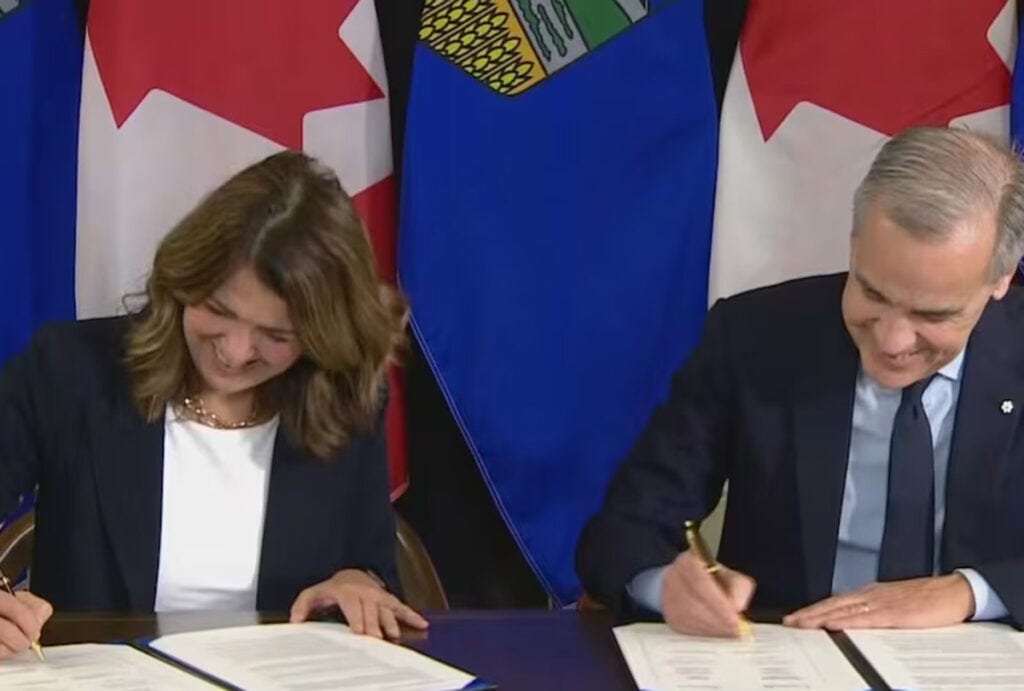
Last week, on the heels of the Memorandum of Understanding (MOU) between Premier Danielle Smith and Prime Minister Mark Carney, I wrote about the first shoe in the MOU, which was climate policy. I wrote that the MOU has the same climate objectives as Trudeau’s, it is just hoping to accomplish those goals through a rising carbon price — which was the centrepiece of former Premier Rachel Notley’s climate plan. The MOU sets out that this must all be negotiated and settled, along with agreements around the Pathways Alliance Carbon Capture, Utilization and Storage (CCUS) project by April 1, 2026.
Failure to agree to these climate objectives by April 1, 2026 will doom the MOU. Let us assume that does not happen. Which brings us to the other shoe in the MOU: pipelines.
Before talking about an actual pipeline, Ottawa and Alberta have agreed to a “cooperation agreement on impact assessments.” This means an agreement on the precise single window regulatory process, presumably for an expanded or new pipeline. The deadline for this is also April 1.
And then the province has agreed to submit a new/expanded pipeline proposal, which the federal government has agreed to refer to the Major Projects Office with its imprimatur, by July 1, 2026.
It is worth quoting the entire commitment in the MOU:
Construction of one or more private sector constructed and financed pipelines, with Indigenous Peoples co-ownership and economic benefits, with at least one million barrels a day of low emission Alberta bitumen with a route that increases export access to Asian markets as a priority. The application for this pipeline project will be ready to submit to the Major Projects Office on or before July 1, 2026. It is agreed this new pipeline would be in addition to the expansion of the Trans Mountain pipeline for an additional 300,000 to 400,000 barrels per day destined for Asian markets.
I have italicized the hard parts.
First, the pipeline must be a private sector project. There is none today. The Alberta government has committed $14 million to help find/shape/determine such a project and has pipeline companies nodding their heads at the bottom of a press release. The other alternative is an expansion of the Trans Mountain pipeline. That pipeline is owned by the federal government and is turning a tidy profit. It is far from clear how a private sector project will emerge by July 1.
Second, the project is to include Indigenous co-ownership. That would seem to rule out a northern pipeline, as most B.C. First Nation communities, to say nothing of the B.C. government itself, are vehemently opposed to lifting the tanker ban required for such a pipeline. On Trans Mountain, the owner – the federal government – has been in discussions with potential indigenous groups to “co-own” the pipeline but has made little progress. Again, it is far from clear how this will come to fruition by July 1.
Any new/expanded pipeline is to transport “low emission bitumen.” This is a reference to the climate conditions of the MOU that I wrote about last week.
The new pipeline is to focus on Asian markets. The reason for this is that we generally get a higher price for our oil sold to Asia than we do when we sell to the U.S. Plus we’re all for diversification away from a country whose President has told Canada, “We don’t need your oil.”
But, and I was surprised to learn this, at least one-third of the oil in the existing Trans Mountain pipe is going to the United States, not Asia (more specifically, China). That oil going to the U.S. is presumably fetching discounted prices and doing nothing for diversification. Surely, we need to fix that? Also, Trans Mountain is running at 90 per cent capacity. Sure, a new pipeline will take years to approve and build, but it’s not encouraging that we can’t fill existing pipes to the west coast.
My own view is that a new pipeline to the Northern Coast of B.C. is a pipe dream for political, indigenous and practical reasons. (I have heard senior pipeline executives call that project a “distraction” in off-the-record conversations.)
The only real viable option is expanding the existing Trans Mountain pipeline. Expanding that will require that Trans Mountain be sold in a deal including Indigenous partners. Or it means governments, once again, become the builder of this pipeline infrastructure, which the MOU doesn’t contemplate. (Shades of Justin Trudeau, anyone?)
It will also mean we need to divert more of our existing, never mind future, oil to more profitable and more reliable markets that the United States.
Again, all of this has to happen before July 1, 2026. It will be fascinating to watch.
Ken Boessenkool is a partner at Meredith Boessenkool & Phillips.
The Line is entirely reader and advertiser funded — no federal subsidy for us! If you value our work, have already subscribed, and still worry about what will happen when the conventional media finishes collapsing, please make a donation today. Please note: a donation is not a subscription, and will not grant access to paywalled content. It’s just a way of thanking us for what we do. If you’re looking to subscribe and get full access, it’s that other blue button!

The Line is Canada’s last, best hope for irreverent commentary. We reject bullshit. We love lively writing. Please consider supporting us by subscribing. Please follow us on social media! Facebook x 2: On The Line Podcast here, and The Line Podcast here. Instagram. Also: TikTok. BlueSky. LinkedIn. Matt’s Twitter. The Line’s Twitter.Jen’s Twitter. Contact us by email: lineeditor@protonmail.com

Thank you. The best summary I've seen of why this is pipedream not a pipeline.
Sure seems that the MOU is another Liberal government PR stunt. “ Everyone look at us. We’re getting it done.”Another distraction. No private investors will ever sign up with those conditions.