

Note to readers: Given unfolding events, we’ve decided to skip our usual weekend dispatch in favour of a column on the situation overseas. The dispatch will return next week.
By: Matt Gurney
It’s far too early in this new war to draw any conclusions or offer deep technical and tactical analysis. So don’t expect much of that here. Sure, there’s the usual caveats we can include in any column about a conflict in the Middle East, and you can probably rattle them off without my needing to list them. It could lead to unintended consequences! Regime change doesn’t always lead to better regimes! We must be prepared for secondary effects and expect the unexpected! Iran may lash out in dangerous ways, and we must be on guard even in the West!
Of course. We all know that. We also all know, or should, that there is tremendous opportunity here for the people of Iran to seize for themselves the future they so richly deserve, and leave the world a better place for it — an Iran run by and for its wonderful people instead of the fanatically evil madmen who’ve controlled it for two generations would be a gift for all humanity. I cannot tell you how much I’d love to visit the ancient sites of Iran in a safe and free country, and see some of what’s left of some of our proudest, earliest civilizations.
But that’s far from guaranteed, and we should acknowledge that upfront.
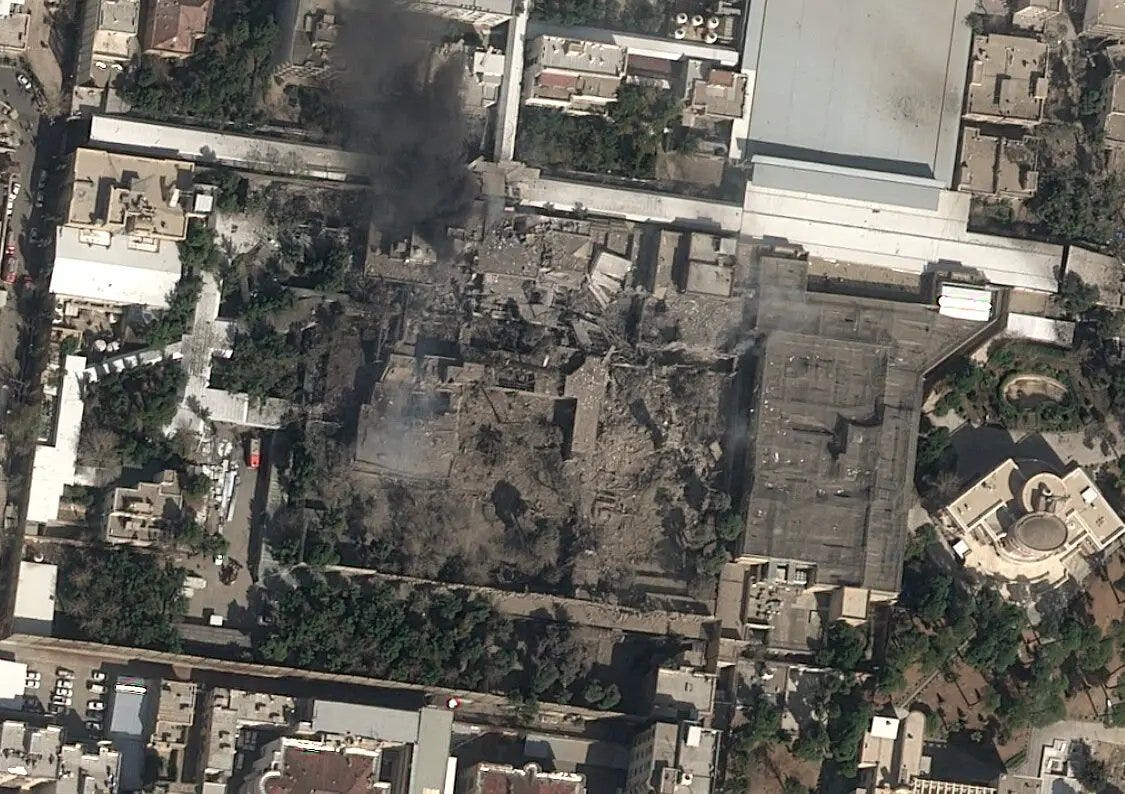
So, as this new war — a war so new we don’t even have a name for it — enters its second day, I find myself less focused on what will happen next and more on what brought us to this point. And, the more I think about that, the more I find myself thinking about the death of the ayatollah. Ali Khamenei died Saturday under a hail of bombs, bombs that precisely struck a location where he was meeting with senior commanders and officials. We don’t know yet the details of the strike — whether it was Israel or America that fired the fatal shots, or both, or what weapons and delivery systems were used. But we can assume one thing: given the stakes, the amount of firepower expended would have been enormous. The images of the site after, showing Khamenei’s compound reduced to rubble, speak to that. Khamenei and his fellow butchers probably never even had time to realize they were dying before it was all over.
But if they did, I can’t help but wonder — if there was just enough warning for them to realize what was happening before the ceiling and walls fell down and a wave of fire found them around their conference table — would they have thought back to Oct. 7, 2023, the day Hamas launched its brutal attack on southern Israel? And would they have had the time to reflect on how that attack will now go down in history alongside Pearl Harbor as examples of massive tactical successes that triggered utter strategic catastrophes?
In October of 2024, just shy of a year after the first anniversary of the Oct. 7 attacks, I wrote a long essay here that set out my analysis of what Israel was doing. You didn’t have to accept their worldview, I wrote then, but it was helpful, even for Israel’s critics, to understand it. My thesis was basically this: Israel had assumed, for decades, that it was strong enough to safely contain its enemies with its intelligence services, special forces and the odd military campaign. It was confident in its security. But October 7 shattered that confidence, and rightly so, and Israel’s actions after October 7 had to be seen in that light. It was seeking to reduce the power of its enemies down to a level that Israel believed, in the aftermath of catastrophe, that it could actually manage.
I stand by that. Israel’s pre-October 7 strategic assessment of its own security was fatally wrong, for more than a thousand of its people. And Israel, a country whose geopolitical vulnerability does not permit it the luxury of ignoring harsh truths, began aggressively rebalancing the entire regional security order, reducing the strength of its enemies until Israel was more confident in its own ability to withstand them.
Iran was always going to be on that list.
It has been fascinating for me to observe these last few years how few people understand this most basic fact of life in the Middle East. Most of the ongoing conflict in the region is a series of proxy wars. The Israeli-Palestinian conflict, in particular, is of course rooted in part in historical disputes over territory and generations of accumulated hate and anger. It would be insane to deny that. But it would be equally insane to ignore the extent to which continued violent resistance by the Palestinians, despite many opportunities to reach imperfect but real peace agreements with Israel, has been driven by powerful interests in other Middle Eastern countries, who saw advantage in Israel remaining constantly tied down in little battles around its own borders and cultivated their own cadre of Palestinian “leaders” to achieve that objective.
And in recent decades, no country has been as enthusiastic about keeping the Palestinians in a constant state of conflict with Israel as the theocrats in Iran.
This is a statement of the obvious for those who follow the region with even passing interest, but often surprises people who don’t. Most of Israel’s conflicts in recent decades have been, in effect, with Iran. Hezbollah in Lebanon? That’s Iran. Hamas in Gaza? Also Iran. The Houthis, and their surprisingly long ranged arsenal of missiles and drones? Iran. The former Assad regime in Syria, and some of the militias that still cling on there? You guessed it! Iran.
Since Iran couldn’t defeat Israel in a direct military conflict, it chose to assemble, fund, arm and otherwise support a network of powerful terror groups on Israel’s borders. That was Iran’s deterrent and, when necessary, its offensive arsenal.
It worked. For decades. Israel continued to pursue a fairly conventional approach to the peace process with its neighbours, especially the Palestinians. Direct talks, negotiations via mediators, preliminary agreements, and so on. Israel’s efforts paid off; it had peace with Egypt and Jordan and working if tense relationships with Palestinian officials in the West Bank. In recent years, it has normalized relations with a series of other Arab or Muslim-majority nations via the Abraham Accords initiative of Donald Trump.
During these decades, Israel generally exercised strategic restraint. There were certainly conflicts, some of them devastating, but in general, Israel tried to keep them small enough to avoid triggering a regional war. And Iran, for its part, also pursued a strategy of strategic restraint — its proxies were mostly useful as deterrents, modern-day versions of the old “fleets in being” that were most effective before they were committed to battle.
And that entire delicate balance of power and terror all came crashing down on October 7, when Hamas smashed through the border fences and Israelis found themselves invaded by a raping and murdering mob that carried out barbaric pogroms and dragged terrified hostages, and the bodies of Israel’s dead, back into Gaza.
It’s still not clear to what extent Hamas kept anyone else, including its Iranian benefactors, aware of its plans. Iran certainly knew Hamas intended to launch an attack in general terms, as Hamas had sought Iran’s direct involvement and support; it’s not clear, however, if Iran was given a specific heads up before Hamas actually began the assault. But certainly we can say that Iran was indirectly responsible for the attack, and that October 7, not to mention decades of strife and bloodshed before it, probably wouldn’t have been possible without Iran.
Israel’s risk tolerance changed, forever, that October two years ago. Taking out Hamas was the first phase. Breaking Hezbollah was the second — and it’s worth noting, at least as of time of writing, that Hezbollah has been awfully quiet even as its benefactors in Iran are getting absolutely demolished. But Israel knows, and knew all along, that going after the proxies was only a partial solution to its real strategic problem. And after October 7, it no longer cared nearly as much about international opinion. It cared about solving its problems.
An astute reader will note that I have barely mentioned the United States so far, and the Americans are themselves, of course, also involved in this war. I confess that I’m honestly somewhat uncertain how to explain the choice by the U.S. to side with Israel and launch this campaign. The Israeli strategic rationale is, as I’ve hopefully coherently laid out above, fairly straightforward. It’s easy to rattle off a number of reasons why America would choose to take on Iran directly, but it’s hard to say with any certainty why they decided to do so now.
Perhaps it’s as simple as President Trump being revolted, as he genuinely seemed to be, by the appalling loss of life during the regime’s brutal crackdown against domestic protesters, which reportedly saw tens of thousands mowed down by gunfire or disappeared into dungeons to be raped, tortured and murdered by security force thugs. Maybe there’s intelligence they have that we do not. Maybe the reasons are entirely crass and cynical — we sure stopped talking about the Epstein Files in a hurry, didn’t we? Or maybe Trump, despite his initial dislike of foreign entanglements, has simply come to enjoy throwing the weight of “his” military around.
Who knows? I don’t. Probably the only thing I can say with confidence is to echo what American writer Noah Smith said in a column he published on Sunday morning — the end of Pax Americana doesn’t seem to signal an end of American involvement in the world, but rather an end to American restraint in how and when it gets involved. And that’s a lesson that we all ought to be paying a lot of very close attention to, I’d dare suggest.
But in the meantime, we should keep our eye on the new Middle Eastern war we actually have before us. Officials in Israel and the U.S. have been telling reporters that they plan for it to go on for days, and perhaps weeks, and the goal certainly seems to be wholesale regime change. For the oppressed people of Iran, this might be the opportunity they’ve been waiting for. If the Israelis and Americans can knock out the major military targets in an opening phase and then switch their strikes to destroying the infrastructure and major armed units of Iran’s domestic security forces, then a successful popular uprising becomes much more plausible. The thousands of Iranian dead, slain in recent months by their own government, may yet have justice. And perhaps soon.
What we can say for certain today is that the October 7 attacks have completely and probably permanently altered the entire geopolitical landscape of the Middle East, in a way that has been entirely to the disadvantage of those who planned, supported and carried out the attack. Israel’s relative power in the Middle East has probably never been greater. A whole coalition of Arab nations, those that are home to U.S. bases, are now de facto fighting alongside Israel against Iran, and that’s something that would have been wild to imagine writing only a few short years ago. Hamas is shattered. Hezbollah is marginalized and broken. Syria has broken totally free from Tehran’s orbit and is seeking normalization of relations with the West and is talking with Israel. The U.S. has committed its full air and sea power to defeating Israel’s primary strategic rival.
And the ayatollah is dead. The only real question is whether the strikes that ended his long and hateful life snuffed it out before he had the time to reflect on how his own actions produced the absolute disaster that led, perhaps inevitably, to the very strike that would end his rule.
The Line is entirely reader and advertiser funded — no federal subsidy for us! If you value our work, have already subscribed, and still worry about what will happen when the conventional media finishes collapsing, please make a donation today. Please note: a donation is not a subscription, and will not grant access to paywalled content. It’s just a way of thanking us for what we do. If you’re looking to subscribe and get full access, it’s that other blue button!

The Line is Canada’s last, best hope for irreverent commentary. We reject bullshit. We love lively writing. Please consider supporting us by subscribing. Please follow us on social media! Facebook x 2: On The Line Podcast here, and The Line Podcast here. Instagram. Also: TikTok. BlueSky. LinkedIn. Matt’s Twitter. The Line’s Twitter.Jen’s Twitter. Contact us by email: lineeditor@protonmail.com
Great column, Matt … Realpolitik indeed! I think the future is ‘unknown and unknowable’ but at least there is a crack of daylight available for the Iranian people that wasn’t there on Friday…
I certainly won't mourn Khamenei's death, nor that of his regime if it does fall. Let's just hope that the aftermath is a wee bit cleaner than Libya or Syria's. You'd also think that there's a bunch of countries with Russian supplied air defenses that are really regretting their purchases, and that Putin is not having a nice weekend.