


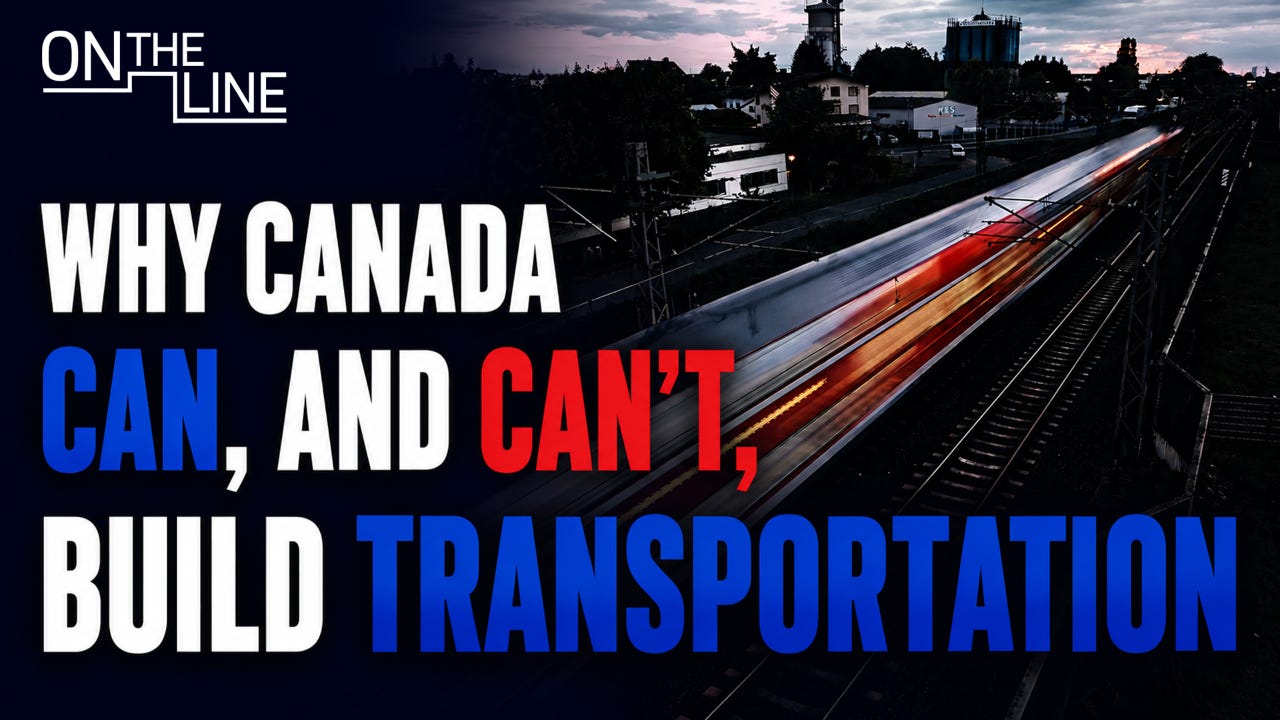
In this episode of On The Line, host Matt Gurney sits down with Reece Martin, transit and transportation expert and new media entrepreneur, for a conversation about infrastructure, public policy, and how an online passion project turned into a career.
This episode is brought to you by BioCanRx, a federally-funded Canadian not-for-profit research network focused on cutting-edge cancer immunotherapy research that they’re helping Canadian researchers bring from labs to patients in clinical trials –– all in Canada.
A new treatment for your cancer has been approved. Can you get it? Maybe, maybe not. Canada isn’t just one health jurisdiction. At the federal level, Health Canada assesses the safety and efficacy of all drugs and therapies in the country, and in a year — sometimes less — they can approve one for sale in Canada. Once approved, — or sometimes while the assessment is happening— the drug’s cost effectiveness is evaluated by Canada’s Drug Agency.
Then the ball goes to the provinces. They work together to negotiate prices with the drug maker, to confirm that it doesn’t duplicate something they’re already stocking, and that its potential value justifies its cost. Only after that can it be provided by each province’s ministry of health. This process can take years. It’s one reason that Canadian innovations leave the country to be developed elsewhere, and why drug companies don’t always choose Canada to initially to launch their products. In the U.S., they get FDA approval, set a price, and wait for the market to decide if the price is right. In Canada, Heath Canada approves and lengthy negotiations start, with no revenue or guarantee of future approval.
Organizations like BioCanRx are willing to wait out the dry years because they’re not-for-profit, but companies with shareholders might skip the Canadian market until they’re making big money elsewhere. This means Canadians have to wait on the system for drugs that could save them, and are saving people in other countries. We’ll talk more about these problems in the weeks to come. Stay tuned for more.

Martin explains how his fascination with transit and transportation grew into a successful YouTube channel, and how that work eventually made him a go-to commentator for conventional media on major infrastructure issues, with his own successful Substack platform. They discuss the opportunities created by the new media landscape, the challenges of building an audience around complex policy topics, and why expertise can now emerge from outside traditional institutions.
From there, the conversation turns to Canada’s infrastructure record. Matt and Jen often joke that “Canada no build good,” and Martin largely agrees — but with important caveats. He explains where Canada consistently goes wrong, why projects take so long and cost so much, and how political incentives often work against good long-term planning.

This episode is also brought to you by the Forest Products Association of Canada. Canada’s forest products sector is not asking Ottawa to start over. The federal government has heard the advice. It has recognized the challenges. And it has put a plan on the table. Now the test is action.
That means clearing made-in-Canada barriers: regulatory duplication, transportation bottlenecks, and uncertainty around predictable access to manage our forests. It means working with provinces to protect communities from wildfire risk and giving companies the confidence to invest here at home. Nearly 200,000 Canadians working in this sector are looking for results.
The playbook is written. Now Ottawa needs to deliver. Learn more at fpac.ca.
At the same time, Martin argues that Canada has real infrastructure success stories that deserve more attention. Rather than assuming failure is inevitable, governments should study the jurisdictions that consistently deliver major projects on time and on budget, both at home and abroad. If Canada can learn those lessons — and avoid the kinds of procurement failures that have plagued everything from pipelines to military equipment — our cities could finally get the transit systems they need.
And yes, that conversation inevitably leads to the question every Canadian transit enthusiast eventually asks: will Canada actually build true high-speed rail?
Be still, our beating hearts. Enjoy the episode, share it widely, like and subscribe! And be sure to check out and follow Reece’s YouTube channel and Substack, as well.
This episode is also brought to you by Cameco. In nuclear energy, timelines and costs matter. Incomplete designs carry real risk of delays and cost overruns. That’s why the AP1000 reactor is the right choice for Canada: it is already operating today and ready now to deliver the power we need, with 100 percent Canadian ownership and strong participation from Canadian suppliers. If we are serious about building Canada and powering it on time and on budget, the choice is clear. The AP1000 reactor is the only option that delivers.
To learn more, visit ap1000.cameco.com.
YouTube:
Video goes live at 7:00 Eastern and 5:00 Mountain.
Spotify:
Apple:
We hope you enjoy the episode — and don’t miss us next week. We’ll be back with more On The Line.
The Line is entirely reader and advertiser funded. No federal subsidies, no bailouts. If you value our work, please consider supporting us by subscribing or making a donation. Donations are not subscriptions and do not unlock paywalled content, but they help keep The Line independent

To contact The Line with a general inquiry or comment, please email info@readtheline.ca. For other ways to connect with us or to follow us on social media, please see our LinkTree.


