


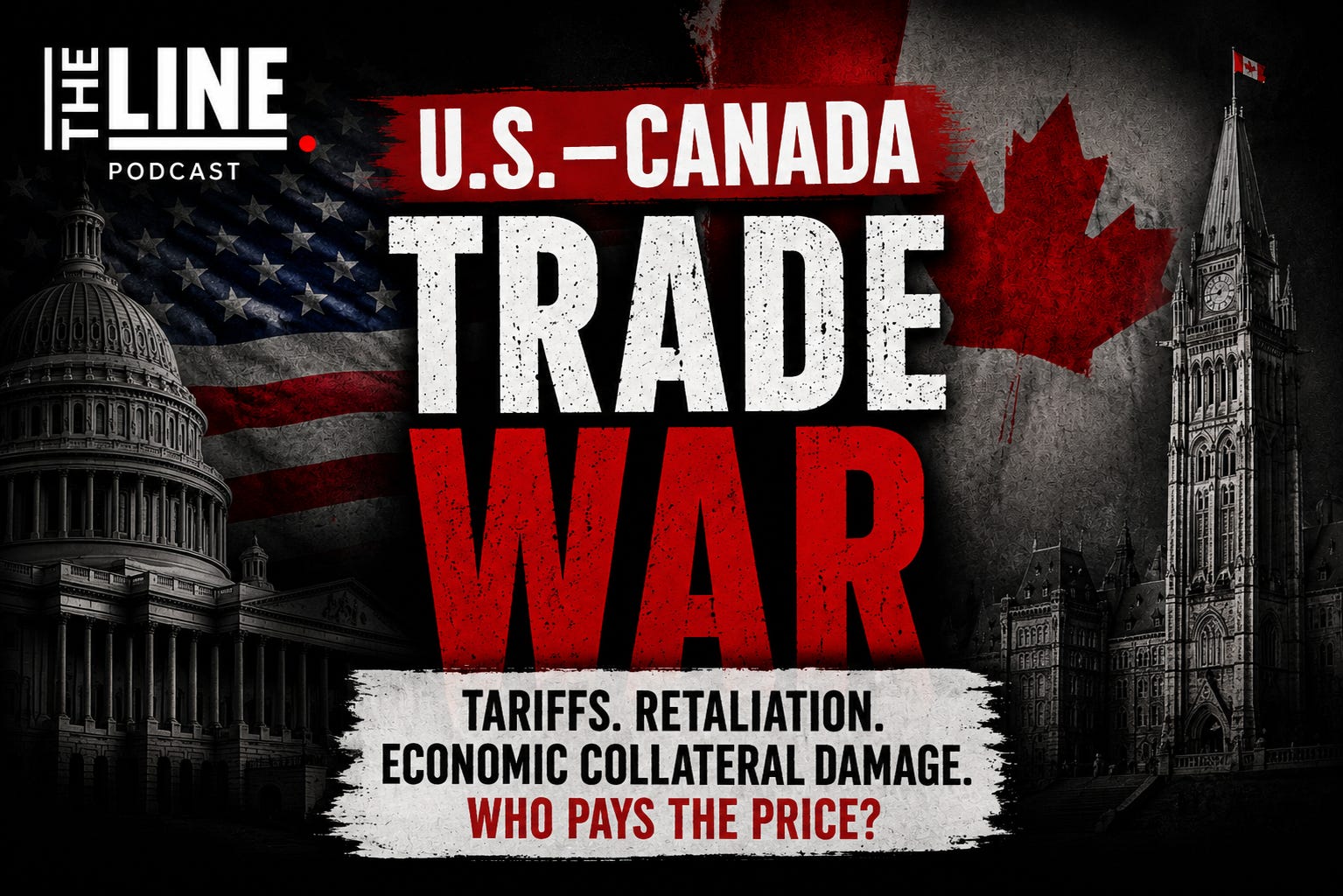
In the latest episode of The Line Podcast, recorded on August 28th, 2026, Matt Gurney and Jen Gerson begin with the rapidly escalating Canada-U.S. trade war, which somehow managed to get very stupid, very quickly. Ontario Premier Doug Ford told Donald Trump to kiss his ass; Trump responded by signing an executive order renaming Lake Ontario “Lake America.” God only knows what else will soon be called America, so your hosts are trying to get ahead of the curve a bit, as you can see. Your hosts discuss just how weird this confrontation could get—and whether what we’re watching now is merely the opening phase of something much longer and more serious.
This episode is brought to you by Cameco. In nuclear energy, timelines and costs matter. Incomplete designs carry real risk of delays and cost overruns. That’s why the AP1000 reactor is the right choice for Canada: it is already operating today and ready now to deliver the power we need, with 100 percent Canadian ownership and strong participation from Canadian suppliers. If we are serious about building Canada and powering it on time and on budget, the choice is clear. The AP1000 reactor is the only option that delivers.
To learn more, visit ap1000.cameco.com

Next, Matt and Jen argue that Canada still needs to get much better at fighting the communications and information war. The United States has recently confronted Chinese influence operations aimed at shaping its domestic politics, which raises an uncomfortable question: how confident should Canadians be that nobody is trying the same thing here? And if information operations are becoming a normal instrument of state power, should Canada be thinking seriously about developing the capacity to play offence as well as defence?
This episode is also brought to you by Fractional Execs Canada. Need help with a serious business problem? As Canadian businesses grow they often require expert help to solve key business challenges. Fractional Execs Canada have assembled a team of experienced strategists, implementors, sales and marketing operators that can help transform your business into a growth engine. They match you with the right person, or team to move your business forward at a pace your business can manage.
Talk to Fractional Execs Canada and discover a better, more collaborative way to take your business and your ‘busyness’ in a better direction. Canadian expertise to support the growth of Canadian businesses. Build your business with those that know how.
Find them Fractional-Execs.ca.

Finally, your hosts turn to a CBC controversy that sounds considerably crazier in the headlines than it actually is. CBC’s longstanding journalistic policy is to avoid independently designating particular acts as “terrorism,” preferring to use the term with attribution—a policy shared in various forms by several major international news organizations. But an internal reminder applying that rule to the 9/11 attacks has predictably exploded into a controversy suggesting that Canada’s public broadcaster somehow doesn’t believe 9/11 was terrorism. Matt and Jen explain why the underlying policy isn’t nearly as stupid as it looks—and also why, in this particular case, it’s still dumb enough that CBC should fix it.
Please note: After this podcast was published in audio format, but before the video went live, the CBC said it would amend its policy.
Hallelujah.
This episode is also brought to you by BioCanRx. Through our partnership with federally-funded Canadian not-for-profit BioCanRx this summer, we’re talking about potential solutions for the problems that are limiting Canada’s ability to domestically develop new drugs, especially immunotherapies for cancer. Today: new methods for biomanufacturing.
Immunotherapies are created using living components –– sometimes even our own cells — so they’re extremely complex and costly to create and deliver to patients. That’s why in the United States, only one in five people who could be treated by a personalized therapy like CAR T can afford to receive it. Fortunately, new manufacturing paradigms have the potential to increase accessibility. Similar to how 3D printers can efficiently produce individual mechanical components, closed-system manufacturing creates immunotherapy drugs in self-contained, benchtop machines that enhance efficiency through automation. This turns many hospitals across Canada into potential manufacturing sites and makes scaling up the delivery of personalized therapies to individual Canadian patients a real possibility.
Some new manufacturing technologies can even scale from producing a single patient’s personalized dose to mass-producing doses for 100,000 patients per day — meaning they could mass-produce vaccines during an emergency.
BioCanRx is working with federal partners to understand where this technology can fit within our biomanufacturing regulatory structure, and how AI might help. More on that next time. Learn more at BioCanRx.com.
All that and more in the latest episode of The Line Podcast.
YouTube:
Video goes live at 6 p.m Eastern/4 Mountain.
Spotify:
Apple:
Please sign up at those options not just for this episode, or future episodes of The Line Podcast, but so that you can also receive our other podcast series, On the Line, which releases new episodes every Tuesday morning. In case you missed it, here is last Tuesday’s episode, where Jen Gerson spoke to Brian Dijkema, president of Cardus Canada, to discuss a new Department of National Defence directive that would move military chaplaincy away from explicit religious language, symbols and prayer in favour of more generic forms of “spiritual reflection.”
That’s all for now! Talk to you guys soon.
The Line is entirely reader and advertiser funded. No federal subsidies, no bailouts. If you value our work, please consider supporting us by subscribing or making a donation. Donations are not subscriptions and do not unlock paywalled content, but they help keep The Line independent

To contact The Line with a general inquiry or comment, please email info@readtheline.ca. For other ways to connect with us or to follow us on social media, please see our LinkTree.


