


By: Gregory Jack
The past two years of public discourse in Canada have tackled big, thorny, nation-defining issues. How can we defend our sovereignty? What will we do to deal with President Donald J. Trump? Can we muster the capacity to build in Canada? How much should we spend on defence?
Two provincial elections are currently being fought in America’s shadow where Trump is the person everyone is running against, and sovereignty is the recurring theme. David Eby’s B.C. NDP launched an election not opposing the views of an opposition without leadership, but against a foreign leader who won’t go anywhere no matter what happens in the B.C. campaign. The Parti Québécois, currently the leading contender to become the governing party in Québec, is promising to defer a referendum until such time as Trump is no longer in office, while the governing CAQ in Québec tried to leverage alleged American interference for electoral gain.
I could go on but you get the picture. In neither of these provincial campaigns, nor in the referenda in Alberta, are questions about Canada’s health-care system taking up any space. As Matt Gurney pointed out in this space, Trump didn’t cause most of our problems, and polling from the last 20-plus-years shows us that health care is the number one thing Canadians worry about most of the time, and it is usually at the top of that list. It remained at or near the top through 9/11, through the 2008 financial meltdown, through COVID-19 (which was a health-specific issue) and through the affordability crisis and the return of Trump.
For literally a generation, Canadians have been telling pollsters like me and the parties running for office that health care is their number one worry. Here’s a snapshot of the last eight years.
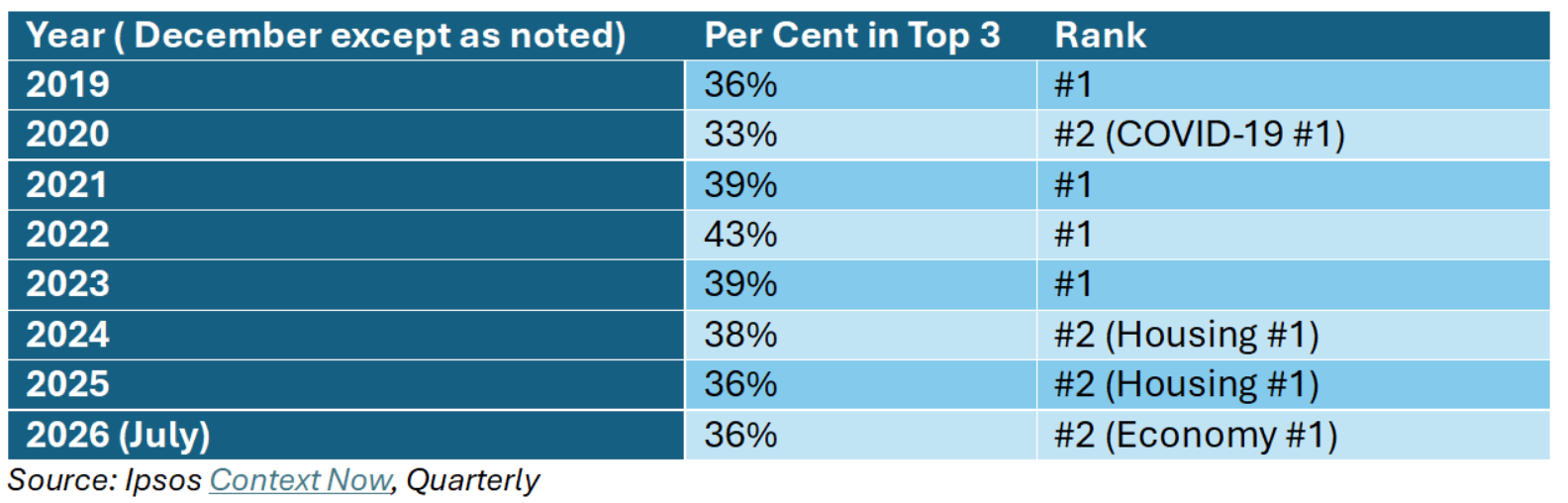
And no one is talking about it right now. Political leaders have stopped discussing health-care in the current provincial campaigns, and we haven’t heard much from Carney on this issue, because it isn’t a federal responsibility and he has wisely avoided being shaken down by the premiers.

Twenty-five years of reforms at all levels of government have objectively failed. Canadian politicians have turned toward external threats while neglecting the very domestic institution, our health-care system, which Canadians encounter most personally.
It isn’t like the federal government hasn’t tried to tackle this problem. As a very green public servant at the Privy Council Office at the time, I worked on the Chrétien government’s response to this plan. The 2001 Romanow Commission reviewed the future of health care in Canada. Today, many of its recommendations remain largely unimplemented, and problems like national accountability, workforce planning and especially timely access remain effectively unchanged, if not worse. In 2002, Senator Michael Kirby released his report on the Health of Canadians — The Federal Role. Same problem: most of the benchmarks have not been achieved.
And in 2004, the government of Paul Martin announced a 10-year action plan on health, with a $41-billion dollar investment. Again, I was in the room when this accord was agreed to and announced. The eventual text included plenty of nods to asymmetrical federalism, different funding for different provinces, and it largely fulfilled the fiscal requirements of the Romanow Commission, but failed to address accountability, timely access and sustainability of the system.
And that’s the last time we had any sort of national conversation about health care.
Stephen Harper held the view that provinces, not the federal government, were responsible for health care and of his five 2006 election promises, only the Wait Time Guarantees for Health Care was not implemented, probably because he had to pay lip service to a priority he believed was a provincial responsibility. Justin Trudeau was more focused on other things like identity, reconciliation and culture, and Carney has made geopolitics and Canada’s economic future the pillar of his premiership. Today, we have a fragmented health-care system that is failing to deliver on core promises made more than 20 years ago. Paul Martin’s fix for a generation didn’t last even one generation, and provinces are increasingly experimenting with privatization and a two-tier system.
I think this is because all the reforms to date have produced, at best, isolated improvements while failing to address the biggest problems of all, and any conversation about reform is stymied behind a values argument and moral lecturing. Discussions about health care that hint at anything but the status quo are off-limits, and so reform is done quietly, or not at all. It is often said that universal, publicly funded health care is a universal Canadian value. But publicly funded health care is not a value, it is a policy choice. The values are timely access, ensuring those without the ability to pay still get care, and fair treatment.

We haven’t been very good at any of them. My own personal experience is that, in the public system, once you get to a specialist, or your life is in imminent danger, you get exceptional care. Canadian health care is generally better at treating the emergency than it is at providing timely access and early diagnosis. But getting to that point, and getting there as quickly as possible, remains a crippling problem.
The Canadian Medical Association finds that 5.9 million Canadians still lack access to a family doctor. I am one of them. I live in Québec, where access to a family doctor is exceptionally difficult to obtain. I’ve been on a wait list for over five years, and at this point I’m not exactly waiting by the phone. Fortunately for me, in Québec, access to private family doctors is rampant, and it isn’t even close. As of 2024, 780 doctors in Quebec had withdrawn their services from the public system, compared to 14 in the rest of Canada. This means I can visit a private doctor and usually get an appointment within a few days, if I am willing and able to pay the $250 fee per visit.
These visits are not your typical doctor visits: they can last up to an hour, and cover multiple maladies. Testing is encouraged, and the private doctor can refer you back into the public system for further treatment. Through using a private family doctor, members of my family have identified several health conditions that, left untreated, would have led to acute problems later on, and massive costs to the system.
Readers outside Québec may find this baffling. Canada is supposed to have a universal public health-care system, where everyone is treated fairly and gets the same level of access; you can’t skip the line. Quietly, Québec has instituted a dual system, while recently, Alberta has done it more explicitly.
Many may object that this all amounts to a violation of the principle of universal access and not requiring people to pay for health care. To those people, I say that I agree, and my family would definitely prefer not to pay twice for our health care — once through taxes and again through a private clinic — but spending money on one’s health is a very reasonable thing to do, especially when the public system is failing.
And it is failing, particularly at the intake level; that is, access to primary care. The Canadian Institute for Health Information notes that access to a primary care provider is atrocious across the country. I highlight the shift to private care in some provinces only to say that Canadians are taking other measures available to them where they can, because we have not yet had the discussion required to reform health care in this country. When faced with a health issue, most people won’t let principles get in the way of treatment, no matter their views of how the system should ideally work.
The very absence of discussion has allowed several two-tier systems to take root in Canada without governments bothering to ask Canadians about how to consciously design, regulate or evaluate a system they will inevitably be forced to navigate at some time in their lives. One reason why there is no public demand for a discussion on health care in the B.C. and Québec campaigns is that Canadians assume it is unfixable, or more correctly, that governments are not capable of fixing it. It has, over time, become an issue that we have learned to live with in sickness and health. We still worry about it all the time.
Health care remains the biggest issue keeping Canadians up at night, more than Trump, tariffs or global security. Our current system represents a policy choice that every single Canadian will be directly affected by at some point. We should probably start talking about it again.
The Line is entirely reader and advertiser funded. No federal subsidies, no bailouts. If you value our work, please consider supporting us by subscribing or making a donation. Donations are not subscriptions and do not unlock paywalled content, but they help keep The Line independent

To contact The Line with a general inquiry or comment, please email info@readtheline.ca. For other ways to connect with us or to follow us on social media, please see our LinkTree.
We aren't talking about health care because the only ways to fix it are remigration, privatization, and rationing, and all of them will burst the boomer bubble of healthy affluence until death.
Our entire political structure rests on a stratum of boomers who believe that things can stay acceptable in Canada (for them) until they die. After which nothing matters.
When that changes, everyone in power now will be swept away.
I think there is general apathy around healthcare which is why people aren’t talking about it. Politicians lack the motivation because it’s not politically good to talk about it. We have a much less effective press overall so they’re not asking about it during election campaigns. And it’s harder than ever for people to reach politicians in a way that meaningfully influences them. So politicians get to talk about what they want to talk about which is the areas they feel like they can improve things or change things.
I think it’s misaligned incentives combined with a bureaucracy that isn’t willing or able to do anything to fix itself because there’s such a huge management class.
Not saying those are acceptable reasons - but maybe addressing the press or finding ways to actually force the topic into the public light is the first step.