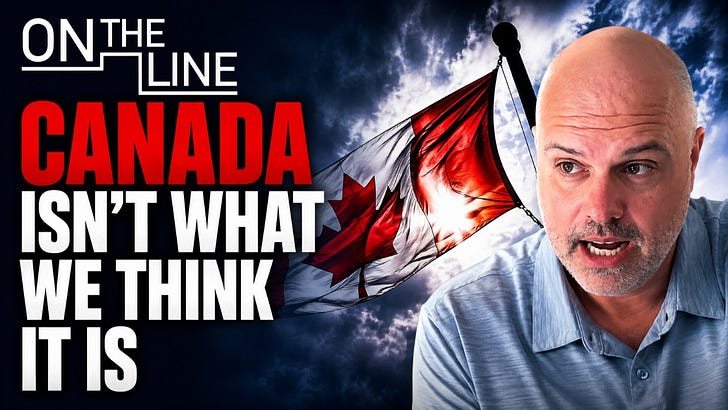


In today’s On The Line, host Jen Gerson speaks with Mark Kawar, an amateur historian and journalist whose book America But Bigger explores a surprisingly persistent feature of American history: attempts to expand the United States beyond its current borders.
This episode of On The Line is brought to you by BioCanRx, a federally-funded Canadian not-for-profit research network helping Canadian researchers bring treatments from labs to patients in clinical trials –– all in Canada.
Cancer can hide from your immune system. So how can we target it? Every day, your immune system finds and destroys different types of threats –– both external invaders like viruses, and internal dangers like pre-cancerous cells in your own body. But no system is perfect — sometimes something evades detection. Researchers are working to identify flags found on cancer cells, called antigens. By training your immune system to recognize these antigens as signals for destruction, some forms of immunotherapy equip your immune system to respond to cancer’s asymmetrical threat.
In addition to funding clinical trials, BioCanRx supports research teams who identify cancer antigens, and find new ways to target them with immunotherapies. There’s still a lot to figure out. Can we train the immune system to hit these antigens before cancer takes root? Why do some cancers still manage to evade therapies designed to find their antigens? Many other questions remain — and we’re working on answering them. You’ll hear more over the summer. For now, go to BioCanRx.com to learn more.
Kawar walks Gerson through the long history of American expansionist ambitions, from schemes that never got off the ground to serious efforts that came much closer to success than many people realize. Along the way, he notes that not every annexation proposal was unwelcome to the people being annexed, and that the historical record is often more complicated than simple stories of American aggression.
This episode is also brought to you by the Forest Products Association of Canada. A stronger forest industry means investing in the mills and facilities that anchor communities across Canada. Companies are ready to modernize with cleaner equipment, better energy efficiency, advanced wood products, biomaterials, and smarter use of every part of the tree. These are productive, lower-emission, export-oriented investments. But good projects need a workable business case. Our economy needs practical tools to unlock private capital and keep investment here. Learn more at fpac.ca.
More importantly, Kawar examines why so many of these projects ultimately failed. The United States has often possessed enormous economic, military, and political power, but translating that power into lasting territorial expansion has proven more difficult than many Americans imagined. Again and again, resistance, geography, politics, and simple practicality imposed limits on what even the world’s most powerful country could accomplish.
The result is a fascinating conversation about ambition, empire, national identity, and the often-overlooked constraints on American power. It’s also a discussion that may hold some lessons for Canadians, should they ever find themselves wondering about the limits of U.S. influence. For whatever reason.
This episode is also brought to you by Cameco. In nuclear energy, timelines and costs matter. Incomplete designs carry real risk of delays and cost overruns. That’s why the AP1000 reactor is the right choice for Canada: it is already operating today and ready now to deliver the power we need, with 100 percent Canadian ownership and strong participation from Canadian suppliers. If we are serious about building Canada and powering it on time and on budget, the choice is clear. The AP1000 reactor is the only option that delivers.
To learn more, visit ap1000.cameco.com.
Visit our main page at ReadTheLine.ca. Be sure to like and subscribe. We’ll be back on Friday with another episode of The Line Podcast.
Be sure to like and subscribe. We’ll be back on Friday with another episode of The Line Podcast.

YouTube:
Video goes live at 7:00 Eastern and 5:00 Mountain.
Spotify:
Apple:
We hope you enjoy the episode — and don’t miss us next week. We’ll be back with more On The Line.
The Line is entirely reader and advertiser funded. No federal subsidies, no bailouts. If you value our work, please consider supporting us by subscribing or making a donation. Donations are not subscriptions and do not unlock paywalled content, but they help keep The Line independent

To contact The Line with a general inquiry or comment, please email info@readtheline.ca. For other ways to connect with us or to follow us on social media, please see our LinkTree.