
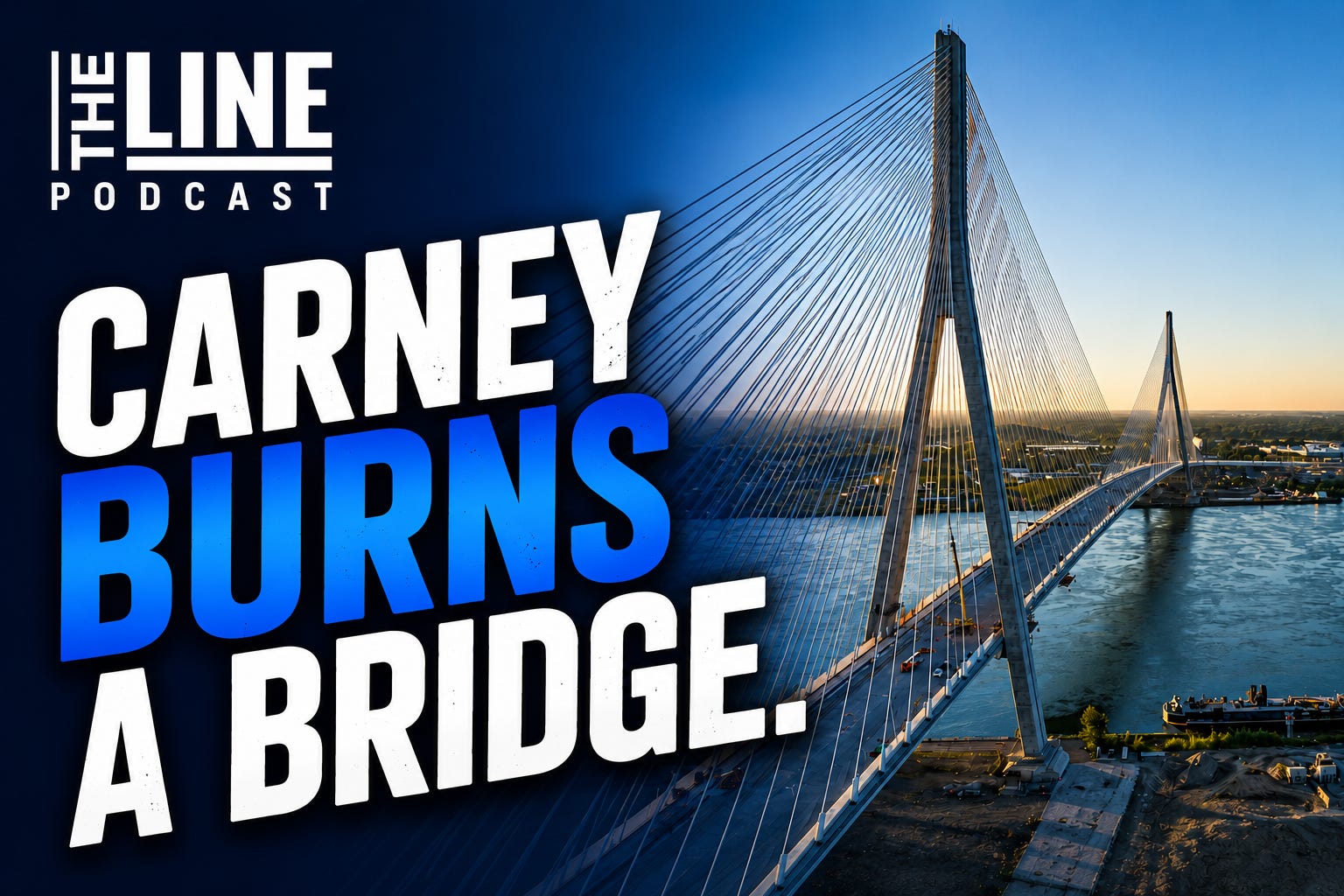
In the latest episode of The Line Podcast, recorded on July 24th, 2026, hosts Matt Gurney and Jen Gerson set out with the ambitious goal of keeping each segment to a specific, fixed time.
They do not succeed.
This episode is brought to you by BioCanRx, a federally-funded Canadian not-for-profit research network dedicated to cutting edge cancer immunotherapy research that they’re helping Canadian researchers bring from labs to patients in clinical trials — all in Canada.
If a drug is discovered in a Canadian lab, and conducts successful clinical trials in Canada, there’s a chance it will be launched in Canada. So how do we get more drugs out of Canadian labs and keep them here? Every year around $500 million is spent on Canadian cancer research, but 70 per cent of that is for early-stage work — discovering whether a therapy can do something in the lab. That leaves limited resources for the complex and often disjointed process of moving Canadian innovations from discovery to a clinical trial and hopefully into the health system.
BioCanRx has stepped into the gap. They specialize in “translational research” — the unsexy work that makes for boring press releases, but gets results: 16 Canadian cancer immunotherapy clinical trials in just a decade, treating more than 400 patients.
Thanks to this, BioCanRx has first-hand experience with the systemic disconnects that are trapping discoveries in Canadian labs, or sending them out of the country to be developed. They have straightforward ideas about how to fix the problems, and spoiler alert: the answer isn’t just “add more money.” Stay tuned to learn more in coming weeks, and visit BioCanRx.com to learn more.

They begin by unpacking a remarkable week in Canada–U.S. relations. New details about the Gordie Howe Bridge agreement have emerged, and neither host likes what they see. Combined with another round of American tariffs, Jen argues that Prime Minister Mark Carney has committed his first major political fumble. Matt agrees that it’s a setback, but also argues that the White House is undermining its own objectives. In an unusual role reversal, Matt even attempts to make the best possible case for Carney’s strategy — despite having been the more hawkish voice in recent month. Jen isn’t convinced.
This episode is also brought to you by the Forest Products Association of Canada. Canada’s forest products sector is not asking Ottawa to start over. The federal government has heard the advice. It has recognized the challenges. And it has put a plan on the table. Now the test is action.
That means clearing made-in-Canada barriers: regulatory duplication, transportation bottlenecks, and uncertainty around predictable access to manage our forests. It means working with provinces to protect communities from wildfire risk and giving companies the confidence to invest here at home. Nearly 200,000 Canadians working in this sector are looking for results.
The playbook is written. Now Ottawa needs to deliver. Learn more at fpac.ca.
The conversation then turns inward to Canadian politics. Jen argues that Carney is trying to do too many jobs himself, and that much of the bridge controversy could have been avoided if he’d simply trusted his communications team. That observation leads both hosts to an amusing realization: Carney relies on his communications staff so infrequently that neither of them even knew who the key players were. They had to look it up. Matt also argues that while the Conservatives remain effective at opposing the government on domestic issues, they’re badly missing the mark on foreign affairs, and that’s probably because they don’t want to admit some things that they’d find awkward and unpleasant. Jen concludes that Canada really needs the Liberals’ strategic instincts combined with the Conservatives’ tactical effectiveness. Matt predicts, with characteristic optimism, that the country will somehow end up with neither.
This episode is also brought to you by Cameco. In nuclear energy, timelines and costs matter. Incomplete designs carry real risk of delays and cost overruns. That’s why the AP1000 reactor is the right choice for Canada: it is already operating today and ready now to deliver the power we need, with 100 percent Canadian ownership and strong participation from Canadian suppliers. If we are serious about building Canada and powering it on time and on budget, the choice is clear. The AP1000 reactor is the only option that delivers.
To learn more, visit ap1000.cameco.com.
Finally, Matt ties together many of the themes from the episode by examining the recent arrest of a man alleged to have been involved in terrorism on behalf of Hamas against Canadian Jews. Rather than editorializing, Matt simply walks through the timeline of the investigation and the eventual arrest. The chronology, he argues, speaks for itself — and paints a deeply troubling picture of how seriously Canada has treated both public safety and the protection of its Jewish community.
All that and more in the latest episode of The Line Podcast.

YouTube:
Spotify:
Apple:
The Line has had a nice little break (mostly a break) but we’ll be back at it next week, including a fresh episode of On The Line on Tuesday. Talk to you soon.
The Line is entirely reader and advertiser funded. No federal subsidies, no bailouts. If you value our work, please consider supporting us by subscribing or making a donation. Donations are not subscriptions and do not unlock paywalled content, but they help keep The Line independent.

To contact The Line with a general inquiry or comment, please email info@readtheline.ca. For other ways to connect with us or to follow us on social media, please see our LinkTree.