

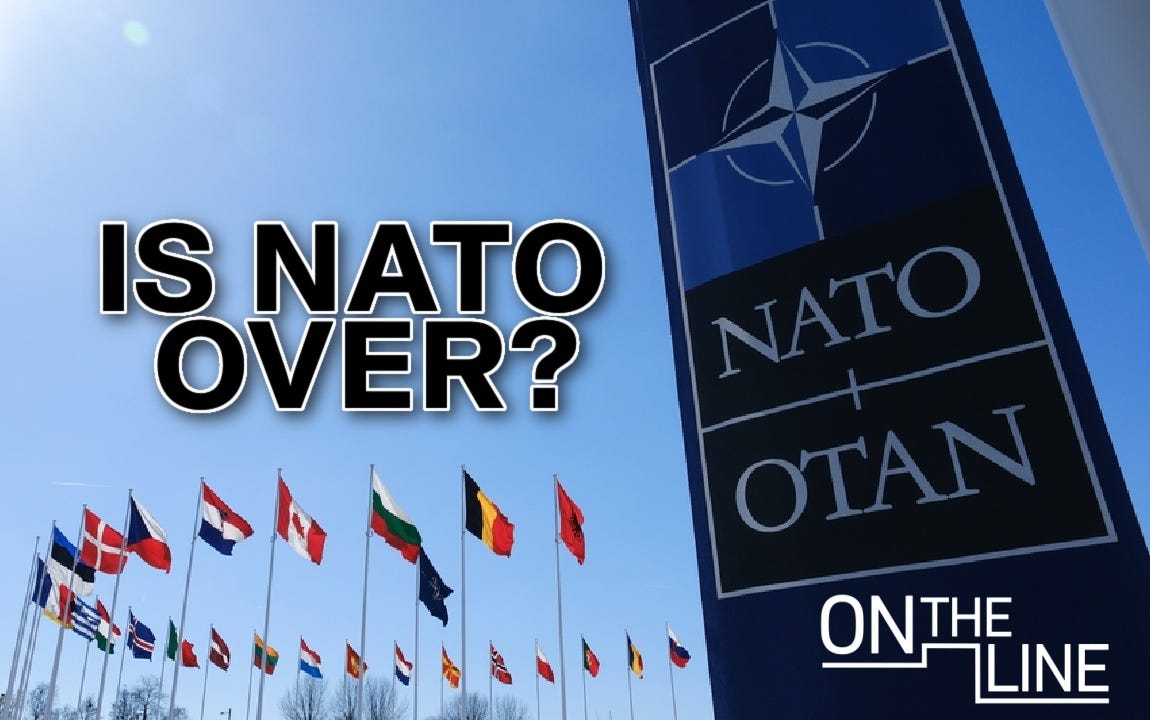
For decades, Canada has enjoyed the benefits of NATO while spending comparatively little on its own military. That era may be coming to an end.
This episode is brought to you by BioCanRx, a federally-funded Canadian not-for-profit research network dedicated to cutting edge cancer immunotherapy research that they’re helping Canadian researchers bring from labs to patients in clinical trials — all in Canada.
If a drug is discovered in a Canadian lab, and conducts successful clinical trials in Canada, there’s a chance it will be launched in Canada. So how do we get more drugs out of Canadian labs and keep them here? Every year around $500 million is spent on Canadian cancer research, but 70 per cent of that is for early-stage work — discovering whether a therapy can do something in the lab. That leaves limited resources for the complex and often disjointed process of moving Canadian innovations from discovery to a clinical trial and hopefully into the health system.
BioCanRx has stepped into the gap. They specialize in “translational research” — the unsexy work that makes for boring press releases, but gets results: 16 Canadian cancer immunotherapy clinical trials in just a decade, treating more than 400 patients.
Thanks to this, BioCanRx has first-hand experience with the systemic disconnects that are trapping discoveries in Canadian labs, or sending them out of the country to be developed. They have straightforward ideas about how to fix the problems, and spoiler alert: the answer isn’t just “add more money.” Stay tuned to learn more in coming weeks, and visit BioCanRx.com to learn more.
This week on On The Line, host Jen Gerson is joined by Jean-François Bélanger, Senior Non-Resident Associate Fellow at the NATO Defense College, for a wide-ranging discussion about Canada’s long-overdue military buildup and what it means for the future of the Alliance. Bélanger’s work focuses on deterrence, nuclear strategy, wargaming, multi-domain operations, and military decision-making, making him well placed to explain the strategic thinking behind today’s defence debates.

As Ottawa commits to dramatically increasing defence spending, Gerson and Bélanger examine what those promises will actually require. Is Canada genuinely preparing for a more dangerous world, or simply catching up after decades of underinvestment? What capabilities do the Canadian Armed Forces need most urgently, and how should those investments be prioritized?
The conversation also explores how NATO has evolved in recent years, how the Alliance has adapted to the return of Donald Trump to the White House, and what Canada’s role should be in an increasingly uncertain international environment. They discuss the growing strategic importance of the Arctic, the impact of emerging technologies on military planning, and how the character of warfare is changing.
This episode is also brought to you by the Forest Products Association of Canada. Canada’s forest products sector is not asking Ottawa to start over. The federal government has heard the advice. It has recognized the challenges. And it has put a plan on the table. Now the test is action.
That means clearing made-in-Canada barriers: regulatory duplication, transportation bottlenecks, and uncertainty around predictable access to manage our forests. It means working with provinces to protect communities from wildfire risk and giving companies the confidence to invest here at home. Nearly 200,000 Canadians working in this sector are looking for results.
The playbook is written. Now Ottawa needs to deliver. Learn more at FPAC.ca.
Along the way, Bélanger explains why modern defence planning increasingly relies on forecasting, simulations, and sophisticated wargaming, and why many Canadians misunderstand both NATO’s purpose and Canada’s obligations within it.

For more, be sure to check out our main page at ReadTheLine.ca. Like and subscribe!
This episode is also brought to you by Cameco. In nuclear energy, timelines and costs matter. Incomplete designs carry real risk of delays and cost overruns. That’s why the AP1000 reactor is the right choice for Canada: it is already operating today and ready now to deliver the power we need, with 100 percent Canadian ownership and strong participation from Canadian suppliers. If we are serious about building Canada and powering it on time and on budget, the choice is clear. The AP1000 reactor is the only option that delivers.
To learn more, visit ap1000.cameco.com.
YouTube:
Video goes live at 7:00 Eastern and 5:00 Mountain.
Spotify:
Apple:
We hope you enjoy the episode — and don’t miss us next week. We’ll be back with more On The Line.
The Line is entirely reader and advertiser funded. No federal subsidies, no bailouts. If you value our work, please consider supporting us by subscribing or making a donation. Donations are not subscriptions and do not unlock paywalled content, but they help keep The Line independent

To contact The Line with a general inquiry or comment, please email info@readtheline.ca. For other ways to connect with us or to follow us on social media, please see our LinkTree.